The Gyeonggi-do administration under Governor Kim Dong-yeon will mark its third anniversary on July 1. Over the past three years, Gyeonggi-do has been racing forward with the goal of creating the “Opportunity Capital” of Korea, under the vision of “more opportunities, fairer opportunities, and better opportunities.” Governor Kim Dong-yeon reviews the “opportunity” policies that have been implemented over the past three years to fulfill promises made to the residents.
◆ The Future of Shared Prosperity: “Opportunity Income”
Now in its third year, the Opportunity Income policy aims to transform social values that lie beyond the limits of the market economy into real-life opportunities for residents. The policy is being implemented across six sectors: artists, people with disabilities, athletes, farmers and fishermen, child care, and residents practicing climate action. Last year, the cumulative number of beneficiaries reached 300,000. The program is credited with institutionally rewarding invisible social values, thereby enhancing residents’ self-esteem and quality of life, while also supporting the sustainability of the social community.
The Opportunity Income for Artists, which began in 2023, provides 1.5 million won per year to Gyeonggi-do resident artists who hold a certificate of artistic activity and whose individual income is at or below 120% of the median income.
The Opportunity Income for People with Disabilities is a policy that simultaneously guarantees health promotion and social participation. It provides 100,000 won per month to severely disabled individuals aged 13 to 64 whose income is at or below 120% of the median, upon verification of health activities using a smartwatch (twice a week).
The Climate Action Opportunity Income is a carbon-neutral practice incentive program open to all residents. By participating in up to 15 activities?such as walking, using reusable containers, or purchasing high-efficiency appliances?residents can receive incentives worth up to 60,000 won. Within just one year of implementation, the program attracted 1.28 million participants, actively supporting residents’ carbon-neutral practices.
The Childcare Opportunity Income provides activity allowances to participants in childcare communities. This program is being recognized as a new welfare model that strengthens the public and communal aspects of childcare. Residents who participate in childcare for more than 30 hours a month, substituting for parents, can receive up to 2.4 million won per year.
The Farmer and Fisher Opportunity Income rewards the public value of agriculture. It provides 150,000 won per month in local currency to young farmers and fishermen (under 50), returnees to farming or fishing (within the past five years), and eco-friendly farmers (those certified in eco-friendly, animal welfare, or premium fisheries). General farmers and fishermen receive 50,000 won per month. The program, which started with 9,478 participants last year, expanded to about 172,000 participants in just the first half of this year.
The Athlete Opportunity Income provides 1.5 million won, paid in two installments, to athletes, coaches, and referees whose individual income is at or below 120% of the median. This year, 24 cities and counties in the province are participating. Beneficiaries are contributing to the circulation of social value in sports by participating in local sports classes and other activities.
◆ The Dreams of Youth: “Youth Opportunity Package”
Gyeonggi-do is accelerating policy expansion, connecting Opportunity Income to the youth, middle-aged, and regional balanced development sectors.
The Youth Opportunity Package consists of new programs established by the 8th popularly elected Gyeonggi-do administration to provide opportunities for young people, including the Gyeonggi Youth Ladder, Gyeonggi Youth Gap Year, and Gyeonggi Youth Opportunity Ladder Finance.
The “Gyeonggi Youth Ladder Program,” which offers overseas university training experiences to local youth aged 19 to 39, saw 200 participants at five universities?including the University of Sydney in Australia?in 2023, and 270 participants at nine universities?including the University of Michigan in the United States?in 2024. This year, 340 young people will travel to 12 universities in eight countries for training.
There is also the Gyeonggi Youth Ladder Program for adolescents. Last year, 95 teenagers visited Detroit in the United States and Toronto in Canada, participating in debate classes with native-speaking instructors and special lectures on career mentoring. This year, 105 participants will be selected to take part in a three-week program in Vancouver, Canada, and Brighton, United Kingdom, between July and August.
The Gyeonggi Youth Gap Year program, which provides competency training, mentoring, and project grants to help young people concretize their dreams while taking on new challenges, selected and trained 629 participants in 2023 and 903 in 2024. This year, 1,091 participants have been selected.
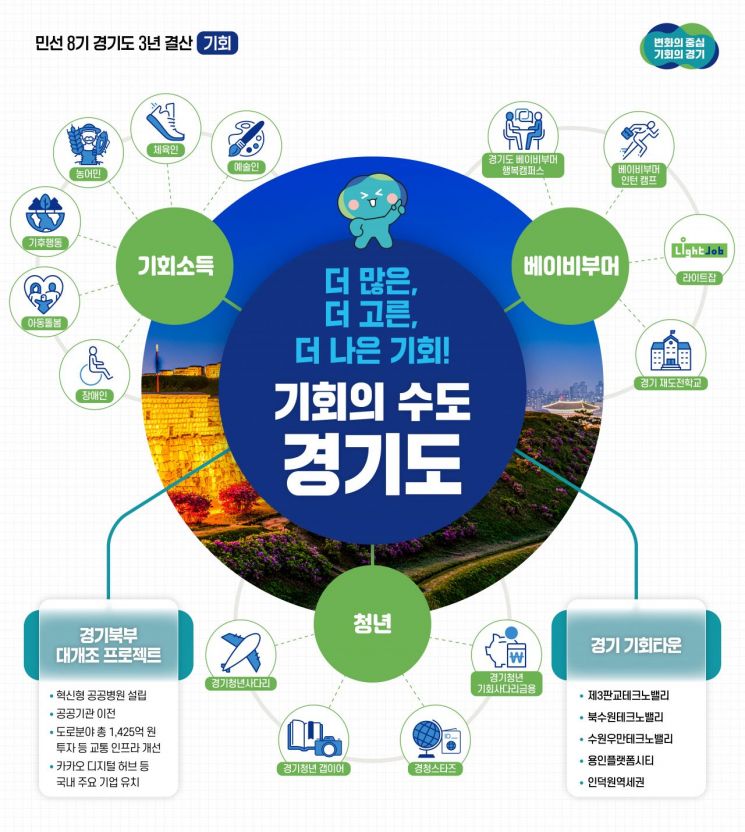 Policies Related to Gyeonggi-do, the Opportunity Capital, Promoted by Gyeonggi-do over the Past Three Years
The Gyeonggi Youth Overseas Employment and Start-up Opportunity Expansion Program (Gyeongcheong Stars) offers local youth aspiring to work or start businesses overseas the chance to experience overseas companies firsthand. From 2023 to 2024, a total of 297 participants completed competency enhancement programs for overseas employment and entrepreneurship through overseas company field experiences and mentoring. This year, 200 participants will visit overseas companies, gain hands-on experience, and network with local youth leaders in 14 cities across 13 countries.
The Gyeonggi Youth Opportunity Ladder Finance is a financial product for residents of Gyeonggi-do aged 25 to 39, allowing them to access low-interest loans and preferential savings rates through a single account. The loan supply is approximately 1 trillion won, supporting up to 5 million won for up to 10 years. From October 2023 to February this year, loans totaling 70.42 billion won were provided to 18,313 people. From April this year, loans totaling 6.96 billion won have been provided to 2,321 people.
◆ New Opportunities for the “Baby Boomer” Generation
Gyeonggi-do is expanding support for baby boomers, who have often been excluded from policy targets.
The “Gyeonggi-do Baby Boomer Happiness Campus” is a comprehensive service supporting the re-launch and social participation of the baby boomer generation, those born between 1955 and 1974 (aged 50 to 69). The campus provides a one-stop service with a variety of programs for middle-aged residents preparing for their “second act,” including lifelong education, career counseling, community activities, social contribution, and employment or start-up support.
Last year, 26,589 people used the Happiness Campus. In October and November last year, for residents in areas without a campus, 15 programs were operated for 418 residents in Yeoncheon, Gwacheon, Hanam, Pyeongtaek, and Bucheon. This year, the program will also be implemented as a regional hub model in cooperation with four local universities, including Hyupsung University.
The “Baby Boomer Intern (In-Turn) Camp” is the first local government program to focus on the transitional period in the lives of middle-aged residents. The program allows those aged 40 to 64, who are retired or changing careers, to spend three days and two nights in a new region, carrying out small projects to reflect on and redesign their lives. Within just one month of opening for applications, more than twice the number of available spots (120) applied, reflecting high interest.
Starting this year, Gyeonggi-do is also promoting the “Light Job” project to expand job opportunities for the baby boomer generation. “Light Job” refers to jobs that are “light” in workload but “shine a light” on the value of baby boomers and companies. Baby boomers can work 24 to 35 hours per week and are guaranteed the four major insurances, various job and competency training, and a safe working environment. Companies that hire residents aged 50 to 64 for these positions receive a monthly safety net subsidy of 400,000 won per employee. The province is currently recruiting companies to participate in the program.
The “Gyeonggi Rechallenge School,” launched last year, is a program to inspire and strengthen the capabilities of young and middle-aged people who have faced difficulties in employment or entrepreneurship. The program provides group workshops, psychological healing, special lectures by renowned speakers, expert consulting, and customized job and entrepreneurship education. Last year, 39.6% of the 48 graduates succeeded in their second challenge, and are now active in various fields such as restaurants, cafes, figure stores, and HRD education. As of the end of April this year, 5 out of 16 graduates (31%) hoping to start a business and 14 out of 32 (44%) hoping to find employment succeeded in their respective goals.
◆ Gyeonggi Northern Region Grand Remodeling Project
In September 2023, Governor Kim Dong-yeon declared a vision to unlock the growth potential of northern Gyeonggi and open the future of Korea through the Gyeonggi Northern Region Grand Development. The goal is to attract a total investment of 213.5 trillion won, including private capital, by 2040, thereby raising Korea’s annual economic growth rate by 0.31 percentage points on average.
Governor Kim subsequently announced the concrete implementation plan for the Gyeonggi Northern Region Grand Remodeling Project in September last year, emphasizing the expansion of living infrastructure, relocation of public institutions, improvement of transportation infrastructure, and investment attraction and regulatory reform.
The first task for expanding living infrastructure is the establishment of “innovative public hospitals” in Namyangju and Yangju. These hospitals will provide comprehensive services, including infectious disease response, emergency medical care, and integrated medical and care services. Additionally, Gyeonggi Northern “Banryeomaru,” the province’s flagship pet theme park, will be created in Dongducheon. Development will proceed based on a basic plan approved this year after resident opinion surveys and expert meetings.
The relocation of public institutions will proceed as planned, starting in 2025 with the Gyeonggi Research Institute (Uijeongbu), Gyeonggi Business and Science Promotion Agency (Paju), and Gyeonggi Credit Guarantee Foundation (Namyangju). The Human Resources Development Institute (Uijeongbu) and Transportation Training Institute (Pocheon) will relocate using a leasing model, while the Northern Agricultural R&D Center of the Agricultural Research and Extension Services (Yeoncheon) and the Northern Campus of the Fire Academy (Yeoncheon) will be newly constructed.
Transportation infrastructure improvements are also underway. In the road sector, 25 local roads totaling 107.85 kilometers will be built this year, with an investment of 115.4 billion won, aiming to reduce the average road project duration from 13 years to less than 7 years. To usher in the “one-hour commute era” for northern residents, a privately funded underground road will be built to alleviate congestion on the Guri (Gyeonggi)?Gwangjin (Seoul) Gangbyeonbuk-ro corridor, dispersing traffic volume.
In the area of investment attraction, a memorandum of understanding was signed in May last year to invest 150 billion won in a premium outlet in northern Gyeonggi. In early June this year, Kakao Corp. succeeded in attracting a 600 billion won “AI-based digital hub” to the Wangsuk District in Namyangju. In addition, LG Display’s 700 billion won OLED new technology investment was attracted to Paju. Large-scale development projects such as Ilsan and Yangju Technovalleys (land supply in 2025) and the third KINTEX exhibition hall are also underway.
◆ Gyeonggi-Style Urban Policy Brand: “Gyeonggi Opportunity Town”
Gyeonggi Opportunity Town is an urban policy brand unique to Gyeonggi-do, providing jobs, housing, leisure, and specialized functions through high-density, mixed-use development around transit stations, eliminating commuting concerns.
Starting with the announcement of the third Pangyo Technovalley (January) and North Suwon Technovalley (March) Opportunity Towns last year, three more Opportunity Town projects were announced this March?Suwon Wooman Technovalley, Yongin Platform City, and Indeogwon Station Area?bringing the total to five Opportunity Towns.
The creation of Opportunity Towns is expected to complete Gyeonggi-do’s envisioned “Five Major Industrial Belts.” Opportunity Towns will serve as a new paradigm for urban development, simultaneously creating large-scale jobs in advanced industries and supplying rental housing and public dormitories, while providing commercial, cultural, sports, educational, medical, welfare, and transfer services all in one place.
© The Asia Business Daily(www.asiae.co.kr). All rights reserved.
![Clutching a Stolen Dior Bag, Saying "I Hate Being Poor but Real"... The Grotesque Con of a "Human Knockoff" [Slate]](https://cwcontent.asiae.co.kr/asiaresize/183/2026021902243444107_1771435474.jpg)
















