Two Normally Operating Tankers Make U-Turn in Hormuz
Bloomberg: "Signs of Tankers Avoiding the Area"
Freight Rates on the Rise, Oil Prices Stabilizing
Bloomberg reported on the 22nd (local time) that two very large crude carriers (VLCCs), each capable of transporting about 2 million barrels of oil, made a U-turn in the Strait of Hormuz. As tensions in the region have escalated due to U.S. airstrikes on Iran, it appears that VLCCs are becoming increasingly reluctant to pass through the area.
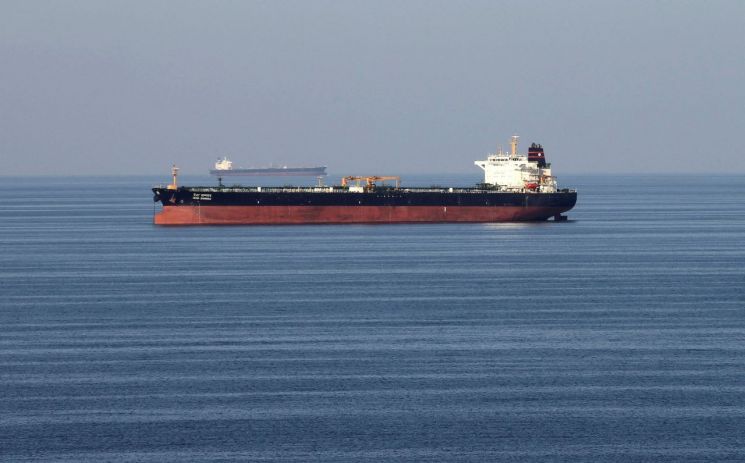
According to Bloomberg, the Coswisdom Lake and South Royalty, which had been sailing along their normal routes, both entered the Strait of Hormuz but then abruptly changed course on the same day, turning back to the southern entrance of the Persian Gulf. Bloomberg reported that these vessels were empty freighters at the time. It is analyzed that they entered the Strait of Hormuz without any cargo but turned back due to heightened tensions.
Since Israel's attack on Iran on the 13th, there have been frequent cases of ships in the Persian Gulf experiencing disruptions to their electronic systems and communication signals. However, the two tankers that changed course this time were sailing along their normal routes without any such communication failures.
Experts have analyzed that, amid heightened tensions near the Strait of Hormuz, some tankers are postponing entry into their destination ports and instead anchoring outside the strait. Bloomberg reported, "The course changes by these two tankers may be the first signs of tankers avoiding the area following the U.S. airstrikes." Previously, on the 17th, the Financial Times (FT) reported that, after Israel's airstrikes on Iran last week, hundreds of ships near Hormuz were observed sailing toward land, circling in loops, or displaying overlapping routes and other abnormal location information.
Tanker owners and oil traders are closely monitoring how the heightened tensions in the Middle East will affect actual vessel movements and oil prices. On the 22nd, the Greek Ministry of Shipping issued instructions to Greek-flagged vessels to review their routes through the Strait of Hormuz and to wait in safe harbors until the situation stabilizes.
Freight rates are on the rise. Even before the U.S. airstrikes on Iran, tanker rates had already risen by about 90%, and prices for shipping derivatives surged sharply from the night of the 22nd. The Guardian and FT forecast that, as vessels passing through the strait reflect risk premiums, both freight rates and insurance premiums will rise significantly, with substantial ripple effects on shipping and global supply chains.
Major oil price indicators also soared to their highest levels since the airstrikes but are now showing signs of stabilization. International oil prices spiked by about 3% in the short term but have since given up some of those gains, currently showing an increase of around 2%. Brent crude futures, the global oil benchmark, are currently trading at $79.22 per barrel, up 2.21% from the previous trading day (as of 8:34 p.m. Eastern Time).
Some observers suggest that, now that Iran's nuclear ambitions have been curbed, Iran may step back or that a less hostile government could come to power through regime change.
However, analysts at JPMorgan warned that, looking at past cases of regime change in the Middle East, international oil prices surged by as much as 76% and tended to rise by an average of 30% over the long term.
MarketWatch and Reuters also projected that, if the Strait of Hormuz is partially blocked, global gross domestic product (GDP) could decrease by 0.8%, and oil prices could surge to between $120 and $130 per barrel.
© The Asia Business Daily(www.asiae.co.kr). All rights reserved.

















