40,000 US Troops Stationed at 19 Bases in 8 Middle Eastern Countries
Daishin Securities: "Iran's Weakened Military Makes Escalation Difficult"
iM Securities: "Even a Hormuz Strait Blockade May Not Be Highly Disruptive"
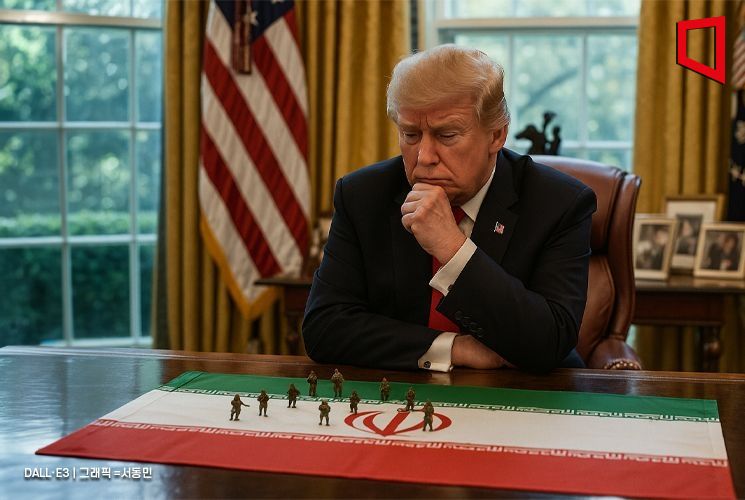
On June 23, Daishin Securities released a report titled "US Airstrike on Iranian Nuclear Facilities: Iran Unlikely to Respond Recklessly for Now," predicting that despite the US attack on Iranian nuclear facilities, Iran would likely limit its retaliation to restricted responses, such as attacks on US military bases in the Middle East.
On June 21 (local time), the United States attacked Iranian nuclear facilities in Fordow, Natanz, and Isfahan, officially marking direct US involvement in the Israel-Iran conflict. Since the anti-US regime came to power after the 1979 Iranian Revolution, this is the first time the US has directly attacked Iranian territory. Iran had previously warned that if the US intervened directly, it would retaliate by attacking US bases in the Middle East. How Iran responds in the coming days will be a critical turning point, determining whether the Middle East war will escalate or come to an early end.
Daishin Securities projected that the most realistic scenario is that Iran would attack US military bases located relatively nearby, as it is not practically feasible, at least in the short term, for Iran to launch military or terrorist attacks on US territory. Currently, the US military has 19 bases in eight Middle Eastern countries?Bahrain, Egypt, Israel, Jordan, Kuwait, Qatar, Saudi Arabia, and the United Arab Emirates?with approximately 40,000 troops deployed.
The Islamic Revolutionary Guard Corps (IRGC), Iran's elite military force, issued a warning of retaliation on June 22, referencing US military bases in the Middle East in response to the US airstrikes on Iranian nuclear facilities. In the past, on January 3, 2020, after the US killed IRGC Quds Force commander Qasem Soleimani, a key military figure, near Baghdad Airport with a drone strike, the IRGC retaliated five days later by launching about 10 ballistic missiles at two US military bases in Iraq.
Although less likely, the scenario that would pose the greatest threat if it were to occur is one in which Iran joins forces with its ally Russia, leading to the outbreak of World War III. However, given Russia's current political situation as it is engaged in the war in Ukraine, and considering that although Russia and Iran solidified a close strategic alliance through a comprehensive partnership agreement in January of this year, they have not reached a mutual defense pact, there is no compelling reason for Russia to intervene militarily immediately.
Moon Namjoong, global strategist at Daishin Securities, analyzed, "Given the symbolic significance of the US military intervention in the Middle East conflict, concerns over further escalation of military tensions between Israel and Iran, a powder keg, will inevitably increase market volatility at the beginning of this week." However, he added, "The US government emphasized that the purpose of the operation was solely to neutralize Iran's nuclear weapons capability and that it is unrelated to regime change, leaving room for future negotiations with the Iranian government. This is a factor that will encourage Iran to maintain a tit-for-tat approach against the US. As the week progresses, volatility is expected to subside, confirming that this was a good investment opportunity."
iM Securities also forecast that a scenario of gradual easing of Middle East risk is likely, given that Iran's military response capability appears weaker than expected. Park Sanghyun, analyst at iM Securities, stated, "The fact that the US military was able to attack Iranian nuclear facilities without significant resistance from Iran, even after publicly announcing the operation, indicates that Iran's military strength or response capability has weakened. The level of Iran's retaliatory response to this US military attack may also fall far short of market concerns." He added, "In particular, even in the case of a blockade of the Strait of Hormuz, which is the greatest concern for financial markets, the destructive power of such a blockade may not be significant, given Iran's military capabilities."
iM Securities also pointed out that it is important to note that the US has little intention to escalate the conflict and that both Israel and Iran would face significant economic burdens if the conflict were to escalate. It has been reported that, despite the US attack on Iranian nuclear facilities, the US has communicated to Iran that this airstrike was the entirety of its plan and that there are no plans for regime change. The Aaron Institute for Economic Policy at Reichman University in Israel estimated that if the conflict with Iran were to last for a month, the cost of war would reach approximately $12 billion (about 16.4 trillion won). Given that Israel's GDP was $540.4 billion last year, a month-long war would require about 2.2% of GDP in war expenditures. Iran, too, is struggling to bear military costs due to its already poor economic situation caused by prolonged economic sanctions.
Meanwhile, following the US attack on Iranian nuclear facilities, the value of the Israeli shekel rose by 0.16% compared to the previous day, and the stock market also closed slightly higher. This is a marked contrast to the instability seen at the start of the Israel-Hamas war in 2023.
© The Asia Business Daily(www.asiae.co.kr). All rights reserved.