AI Global Cooperation Company Meeting
Held to Mark the Launch of the Ulsan AI Data Center
On June 20, the Ministry of Science and ICT announced that it is actively considering expanding tax deductions for AI data centers during the revision process of subordinate laws, following the amendment of the Restriction of Special Taxation Act, which designated AI-related technologies as national strategic technologies. Under the current Restriction of Special Taxation Act, companies are allowed to deduct only 1% of their investment in data center facilities from their taxes.
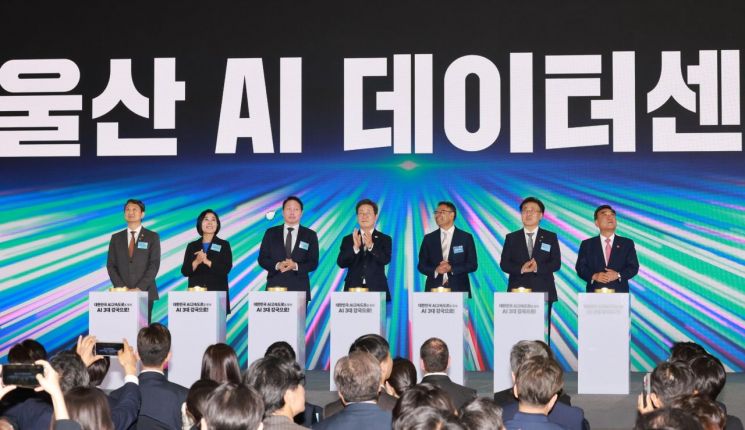 President Lee Jae Myung is participating in a commemorative ceremony with attendees at the launch event of the Ulsan Artificial Intelligence (AI) Data Center held at the Ulsan Exhibition Convention Center on the 20th. Photo by Yonhap News
The Ministry of Science and ICT made this announcement at the 'AI Global Cooperation Company Meeting' held after the launch event for the Ulsan AI Data Center at the Ulsan Exhibition Convention Center that morning. Attendees included Minister Yoo Sangim of the Ministry of Science and ICT, Minister Ahn Deokgeun of the Ministry of Trade, Industry and Energy, Ulsan Mayor Kim Dookyeom, lawmakers Choi Minhee, Choi Hyungdoo, Kim Taeseon, and Kim Sangwook. From the industry, representatives from SK, FuriosaAI, Lunit, Kakao, Naver Cloud, Samsung SDS, LG AI Research Institute, and the Korea AI and SW Association were present.
The government has decided to support the activation of the AI data center ecosystem, which serves as the backbone of the AI era. Since the amendment of the Restriction of Special Taxation Act in March, the government has been actively considering expanding investment tax credits for AI data centers. As a bill to support AI data centers has also been introduced in the National Assembly, the government plans to participate actively in the legislative discussions on this bill.
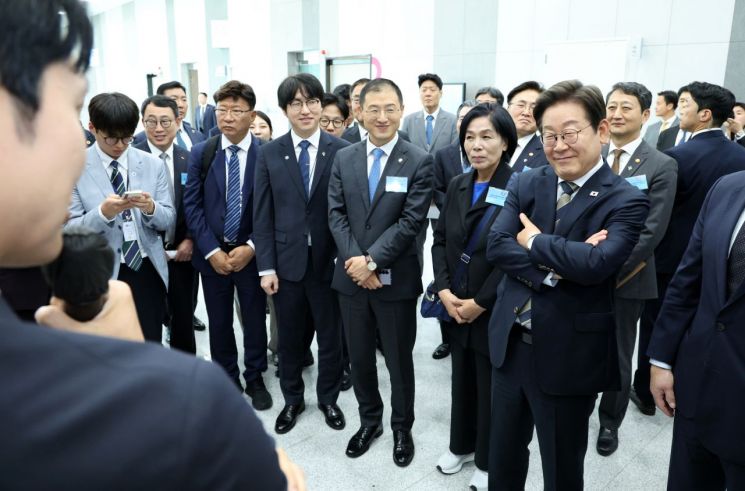 President Lee Jae Myung is attending a demonstration of AI products and services after the AI Global Cooperation Company Meeting held at Ulsan Exhibition and Convention Center on the 20th. Photo by Yonhap News
Companies attending the meeting proposed policies necessary for the growth of Korea's AI industry. SK emphasized the need to create demand in the AI sector, support the growth of AI startups, and innovate education to foster national AI talent. Lunit stated that 93% of its revenue last year came from overseas and stressed the need for practical support such as securing overseas data.
Discussions also continued on securing sovereign AI and strengthening global competitiveness. LG AI Research Institute mentioned that in order to become one of the AI G3 (top three AI powers), policies to strengthen the ecosystem centered on proprietary foundation models are necessary. Naver Cloud also emphasized the importance of active investment to secure sovereign AI. The Korea AI and SW Association stated that possessing a world-class large language model (LLM) has now become an essential national task and called for comprehensive support in this area.
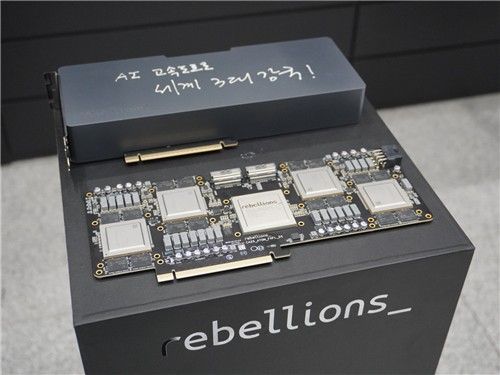
This event also featured presentations of AI devices and product services by domestic AI companies. Notable examples included 'Ultra-Large-Scale Video Understanding AI Service' (Twelve Labs), which automatically analyzes large-scale video data and summarizes key content; 'AI Commerce Service' (Studio Lab), which generates detailed product pages from uploaded product images; and 'Korean AI Semiconductor for Generative AI Services' (Rebellion). FuriosaAI explained its current status and future plans for attracting investment related to mass production of Korean AI semiconductors. Kakao announced plans to expand 'everyday AI services' through a strategic partnership with OpenAI, while Samsung SDS introduced its efforts to expand globally through enterprise AI platforms and solutions.
This meeting was organized to coincide with the launch event for the large-scale Ulsan AI Data Center, a 100MW-class facility with a total investment of 7 trillion won, including SK Group's attraction of a $4 billion investment from Amazon Web Services (AWS). Construction of the data center is scheduled to begin in September, with an initial operation of 41MW planned for November 2027. Full operation is scheduled for February 2029.
© The Asia Business Daily(www.asiae.co.kr). All rights reserved.



















