Continuous Failures in January, March, and May
Signs of Defect in COPV Pressure Tank
Possible Investigation by U.S. Authorities
SpaceX announced on June 19 (local time) that the cause of the explosion of its Mars exploration spacecraft, Starship, during a ground engine ignition test appears to be a defect in a nitrogen tank.
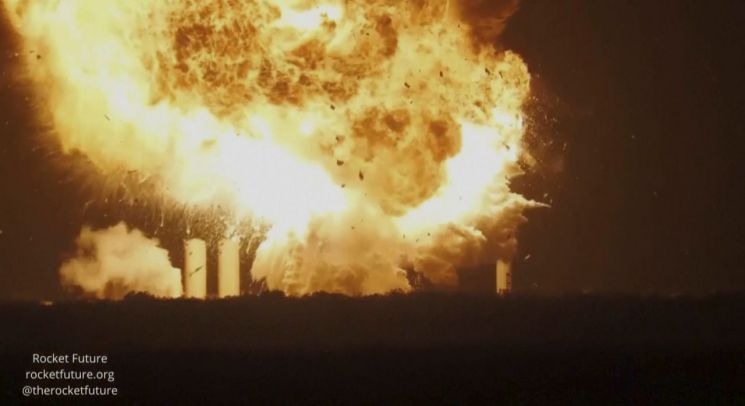
In an update posted on its website, SpaceX explained, "Preliminary analysis has identified a potential defect in the composite overwrapped pressure vessel (COPV), a nitrogen gas charging tank installed in the nose cone (the conical front section) of Starship," adding, "We are still reviewing the complete set of data."
The company also noted that the COPV used in this Starship is entirely different from the COPV used in its other flagship rocket, Falcon.
According to SpaceX, the accident occurred at around 11 p.m. (U.S. Central Time) the previous day during preparations for Starship's tenth test flight at the Starbase launch site in Texas.
The company explained that while extremely cold propellant was being loaded for a 'static fire' test?which involves sequentially igniting six engines while the rocket is secured to the launch pad?a sudden energy release caused the vehicle to explode, followed by additional fires.
SpaceX stated that there were no casualties from this incident and that there was no significant danger to the surrounding area.
U.S. media outlets such as the Washington Post pointed out that, following a series of failed test flights and now an explosion on the ground, both SpaceX and CEO Elon Musk are likely to face further delays in the Starship development schedule.
Previously, SpaceX experienced a series of failures in its 7th to 9th orbital test flights conducted in January, March, and May, with the vehicles either exploding or breaking apart. With this latest ground explosion, it is highly likely that SpaceX will face additional investigations by authorities.
The second stage of Starship is designed to be 52 meters long and 9 meters in diameter, capable of carrying up to 100 people and approximately 100 tons of cargo. When combined with the first-stage rocket, the Super Heavy?which is the most powerful ever built at 71 meters in length?the total launch vehicle reaches a length of 123 meters.
© The Asia Business Daily(www.asiae.co.kr). All rights reserved.
![User Who Sold Erroneously Deposited Bitcoins to Repay Debt and Fund Entertainment... What Did the Supreme Court Decide in 2021? [Legal Issue Check]](https://cwcontent.asiae.co.kr/asiaresize/183/2026020910431234020_1770601391.png)
















