Seven Out of Ten Couples Are Dual-Income... 9% Increase in Three Years
"Chores Shared Equally"... 61.8% of Men, 52% of Women Respond
Seven out of ten married men and women are currently dual-income earners, and eight out of ten consider dual-income to be essential.
Gayeon, a matchmaking company, released the 'Married Couple & Household Chores' section of its '2025 Marriage Perception Survey' on June 20, which was conducted earlier this year with 500 married men and women (250 men and 250 women aged 25 to 39).

According to the survey, when asked about the necessity of dual-income, 77.6% of respondents answered that it is "absolutely necessary." Meanwhile, 13.2% said it is "not really necessary," and 9.2% responded that they "have no particular opinion."
When asked whether their household is currently dual-income, 69.8% answered "yes," while 30.2% said "no." This means seven out of ten respondents are in dual-income households. Compared to the 60.8% of married respondents who answered "dual-income" in Gayeon's early 2022 survey, this figure has increased by 9% over three years. In another 2021 survey, 72.1% of unmarried respondents said dual-income was "absolutely necessary," indicating an upward trend over the past four years.
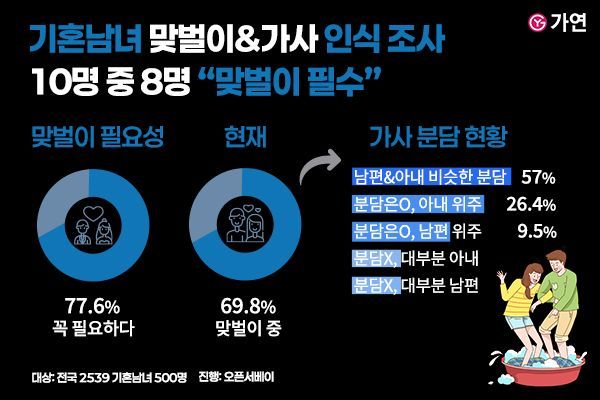 'Married Couple & Household Chores' section from '2025 Marriage Perception Survey' released by Gayeon. Gayeon
Responses regarding the division of household chores varied by gender and age. The most common answer was that "the husband and wife share chores almost equally," at 57%. This was followed by "chores are shared, but the wife does most of them" (26.4%), "chores are shared, but the husband does most of them" (9.5%), "chores are not shared, and the wife does most of them" (4.9%), "chores are not shared, and the husband does most of them" (0.9%), and "other" (1.4%).
Overall, wives were found to bear a higher share of household chores, but 61.8% of male respondents and 52% of female respondents said chores are shared equally. By age group, 60.3% of those in their 20s and 55.4% of those in their 30s reported an equal share. Regarding the higher percentage of respondents in their 30s who felt chores were not shared equally, Gayeon explained, "Traditional values still remain, and the standards and scope of household labor differ by gender and age group."
According to Statistics Korea's announcement on June 19, the total number of dual-income households increased from 2021 to 2023, but decreased by 29,000 households year-on-year to 6,086,000 households in the second half of 2024. The proportion of dual-income households was highest among those in their 30s (61.5%) and 40s (59.2%). About six out of ten couples in their 30s and 40s are dual-income households.
© The Asia Business Daily(www.asiae.co.kr). All rights reserved.


















