Monsoon Begins on the 19th... Rainfall Expected Through the 22nd
Cumulative Rainfall of 125 mm in Geumgok, Incheon
Hourly Rainfall Could Reach 30-50 mm
With the monsoon season in the central region now in full swing, it is expected that the metropolitan area could see more than 150 mm of rainfall. Local governments have begun taking preventive measures to avoid damage such as flooding in low-lying areas.
According to the Ministry of the Interior and Safety's daily national safety management report on June 20, around 100 mm of rain fell between June 19 and the morning of June 20, including 125 mm in Geumgok, Incheon, 107.5 mm in Yeongjongdo, Incheon, and 93.5 mm in Yangchon, Gimpo. As of 7 a.m. on June 20, heavy rain advisories were in effect for Seoul, Incheon, parts of Gyeonggi Province, and Gangwon Province.
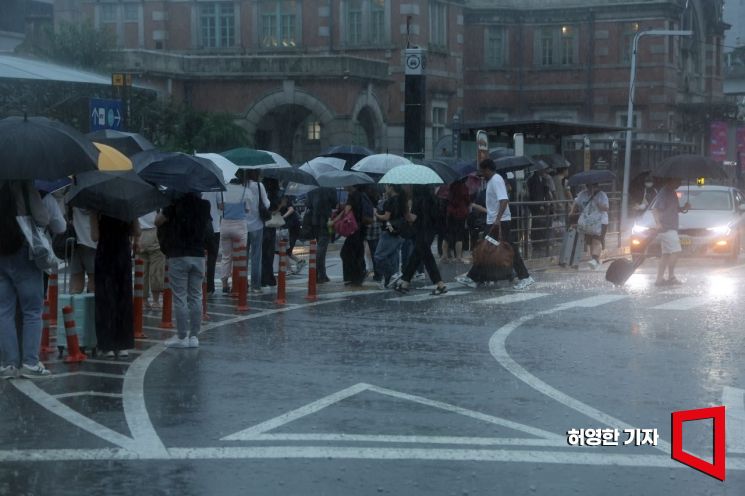 On the 17th, when heavy rain fell in the metropolitan area, citizens lined up to take taxis in front of Seoul Station. 2024.7.17 Photo by Heo Younghan
The heaviest rainfall is forecast from the evening of June 20 through the morning of June 21. Gong Sangmin, a forecast analyst at the Korea Meteorological Administration, stated, "There is a possibility of a mesoscale low-pressure system forming along the stationary front over the West Sea overnight on June 20. If this occurs, there is a chance of heavy rain, with hourly precipitation reaching up to 30?50 mm, and potentially even higher in some areas."
As the monsoon season began, local damage has also started to occur. In Unseo-dong, Jung-gu, Incheon, an underpass was flooded and has been closed since 4:30 a.m. on June 20. Eleven passenger ferry routes and 62 sections of national parks are also currently closed.
The Seoul Metropolitan Government has entered a full emergency response system to prepare for heavy rainfall. To prevent flooding in low-lying and semi-basement areas, the city collects real-time water level data using rain gauges and road water level meters installed throughout Seoul, and issues flood forecasts and warnings based on this information. When a flood forecast is issued, relevant agencies are alerted to the risk, and if a warning is issued, each district government sends disaster text messages to residents.
In addition, when a flood forecast is issued, a designated "companion partner" visits households living in semi-basement units, especially those with people with disabilities, the elderly, or children, to assist with evacuation. Companion partners are disaster prevention personnel made up of local residents and public officials. This year, 2,887 companion partners have been matched with 1,130 households classified as vulnerable to disasters. One hundred underground roadways at risk of flooding are immediately closed if water on the roadway exceeds 10 cm.
To prevent river isolation accidents, from the stage of preliminary heavy rain advisories, river walkways are equipped with entry and exit barriers and automatic warning systems that are activated in advance. The city has assigned two responsible staff members for each underground roadway, as well as a team of four including members of the voluntary disaster prevention corps and police, to respond on-site. In addition, a river patrol team consisting of 936 people, including voluntary disaster prevention corps members and public officials, is conducting patrol and monitoring activities along the rivers.
Furthermore, on June 13 and June 19, the Seoul Metropolitan Government conducted special inspections of approximately 18,000 storm drains located in areas vulnerable to flooding. Out of a total of about 568,000 storm drains, the city focused on checking and cleaning those in vulnerable sections to ensure smooth drainage even during heavy rain.
© The Asia Business Daily(www.asiae.co.kr). All rights reserved.

![Clutching a Stolen Dior Bag, Saying "I Hate Being Poor but Real"... The Grotesque Con of a "Human Knockoff" [Slate]](https://cwcontent.asiae.co.kr/asiaresize/183/2026021902243444107_1771435474.jpg)















