Supplementary Budget of 1.3 Trillion Won Allocated for Job-Seeking Benefits
Total of 1,798,000 People to Receive Support This Year
200 Billion Won Invested in National Employment Support System
3,000 Rental Units Provided for Young People and Newlyweds
Strengthened Medical System for High-Risk Pregnant Women Included
1 Trillion Won Injected to Bolster Local Government Finances
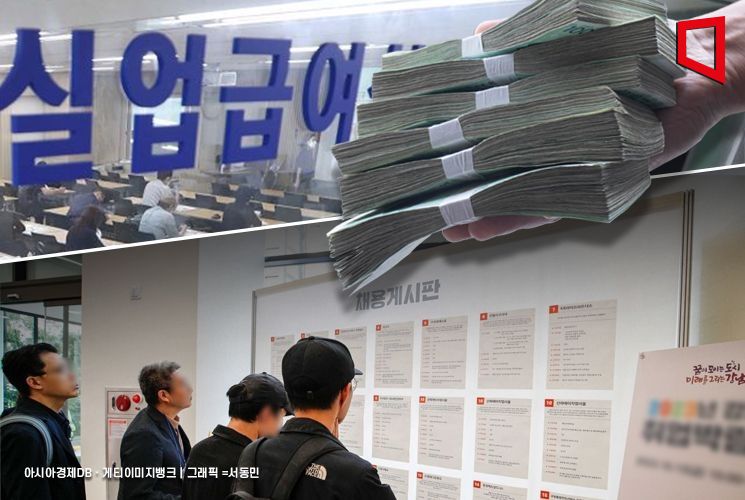
As both domestic demand and exports continue to stagnate, and employment in key sectors such as manufacturing and construction deteriorates, the government has decided to allocate an additional supplementary budget to expand the number of people eligible for unemployment benefits. As a result, the number of beneficiaries will increase by 187,000, with the related budget rising by 1.3 trillion won.
On June 19, the government held the 26th Cabinet Meeting at the Yongsan Presidential Office and announced the "New Government Supplementary Budget Plan." This supplementary budget follows the first supplementary budget of the year (13.8 trillion won), which was passed by the National Assembly last month, and represents the second supplementary budget for the year. It is set at a total of 30.5 trillion won, with the aims of revitalizing the economy, stabilizing people's livelihoods, and adjusting tax revenues.
Supplementary Budget to Address Employment Crisis in Manufacturing and Construction
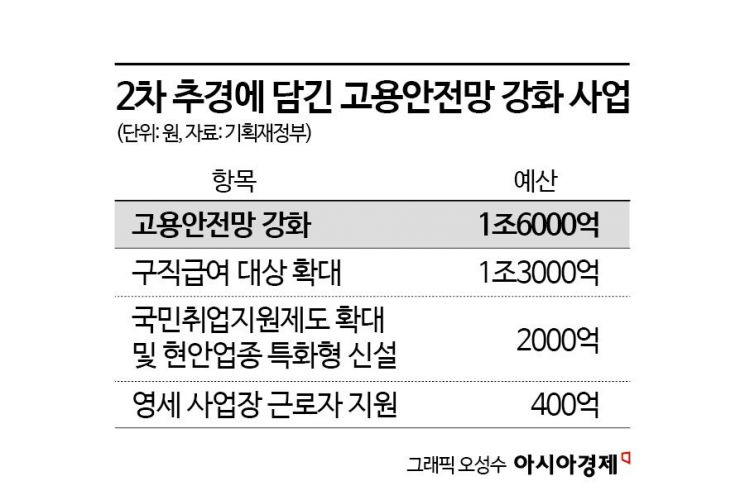
The government has allocated a total of 5 trillion won in this supplementary budget for the purpose of stabilizing people's livelihoods. Of this, 1.6 trillion won will be used to strengthen the employment safety net. Specifically, the funds will be used for: ▲expanding the scope of job-seeking (unemployment) benefits (1.3 trillion won); ▲expanding the National Employment Support System and establishing new programs tailored to specific industries facing urgent issues (200 billion won); and ▲supporting workers at small businesses (40 billion won).
The government decided to take action as the number of people receiving job-seeking (unemployment) benefits in major sectors such as manufacturing and construction increased amid poor economic conditions. Unemployment benefits refer to payments such as job-seeking allowances provided to individuals who have involuntarily lost their jobs and are actively seeking reemployment, in order to support their livelihoods.
The original budget for job-seeking benefits this year was 10.9171 trillion won, and with this supplementary budget, it will increase by approximately 12%. The number of additional people eligible for job-seeking benefits is 187,000, bringing the total number of beneficiaries this year to 1,798,000.
An official from the Ministry of Employment and Labor, which oversees this area, stated, "This allocation was made in case the increased demand for job-seeking benefits observed in the first quarter continues." The official added, "Since the Employment Insurance Fund, which covers job-seeking benefits, is a mandatory expenditure, if there is additional demand this year, the fund can be adjusted to cover any shortfall."
The number of people receiving job-seeking benefits has increased for four consecutive months, from February through last month. As of last month, the cumulative number of beneficiaries this year was about 1.1 million, up from 1.06 million during the same period last year. The total amount paid out in job-seeking benefits during the same period reached 5.3663 trillion won, representing a 7.2% increase.
The government will also expand the National Employment Support System, which provides livelihood and tailored job support to vulnerable groups not covered by employment insurance. In this process, new specialized programs will be introduced for industries facing urgent issues, such as construction. With this supplementary budget, 55,000 people will receive support, with 10,000 of them targeted by the specialized programs.
In the process of increasing support for workers at small businesses, the government will subsidize their social insurance premiums. For low-wage workers at businesses with fewer than 10 employees, 80% of their social insurance premiums will be covered. In addition, for businesses with fewer than 50 employees, the government will subsidize 70% of the cost of introducing equipment to prevent heat-related illnesses during heat waves.
Given the heightened risk of wage arrears due to the economic downturn, related support will also be expanded. However, since the budget for wage arrears was already increased in the first supplementary budget, this time, 8.1 billion won will be allocated to expand loans and temporarily lower interest rates for three months for business owners and victims who are committed to resolving wage arrears. In this case, interest rates for business owners and workers will be reduced by 1 percentage point and 0.5 percentage points, respectively.
Supporting Various Vulnerable Groups and Pursuing Price Stability
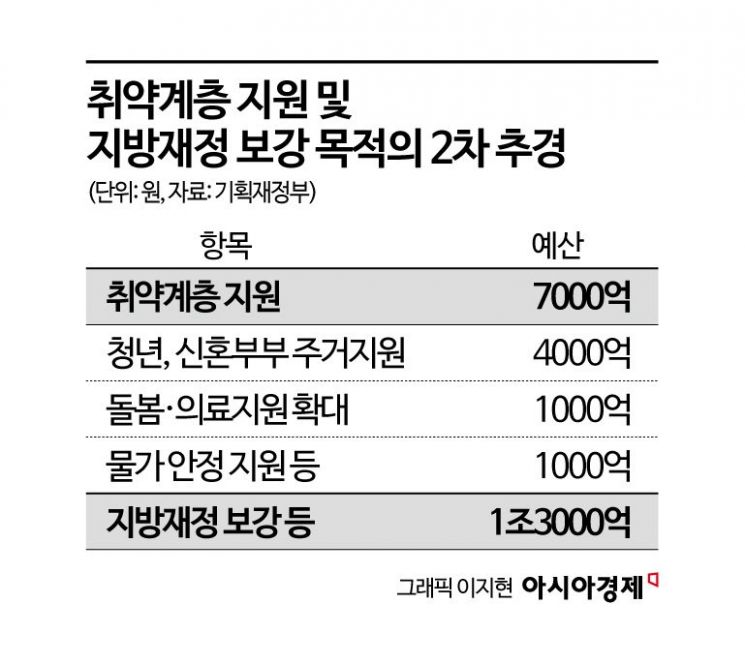
In this supplementary budget, the government also included 700 billion won for supporting vulnerable groups in the area of stabilizing people's livelihoods. Detailed projects include: ▲housing support for young people and newlyweds (400 billion won); and ▲expanding care and medical support (100 billion won). Amid growing concerns about rising perceived inflation, an additional 100 billion won has been allocated for price stabilization support and related measures.
To promote housing stability for young people and newlyweds without homes, the government will supply an additional 3,000 rental units at prices lower than market rates. For young people without homes whose income is at or below 60% of the median, monthly rent support will be expanded. As a result, a total of 157,000 people will be able to receive up to 200,000 won per month for up to 24 months this year.
In expanding care and medical support, 4.3 billion won will be invested to strengthen emergency transport and medical care systems for high-risk pregnant women, as well as to expand support for treatment costs for high-risk groups to prevent suicide. In the process of providing additional care services to households experiencing temporary crises, 10.3 billion won has been allocated. The supplementary budget also includes 22.9 billion won to expand emergency welfare support.
In the area of price stabilization, an additional 48.4 billion won will be invested. The government will support the purchase of domestically produced agricultural raw materials to ease the cost burden on the food industry caused by rising prices, and will also subsidize the costs of improving and replacing livestock facilities and food processing equipment to boost raw material productivity.
The government has also included 1 trillion won in the supplementary budget to strengthen local government finances. This will be done by purchasing local government bonds to help local governments secure investment capacity. Previously, the government allocated 10 billion won for this purpose in the main budget and secured an additional 200 billion won in the first supplementary budget.
The government plans to submit the supplementary budget bill to the National Assembly on June 23 to ensure swift processing. Lim Kigeun, the Second Vice Minister of Economy and Finance, stated, "Timely and bold fiscal input is absolutely essential for the economy to enter an upward trajectory." He urged the National Assembly, saying, "We ask for a prompt passage of the supplementary budget bill in response."
© The Asia Business Daily(www.asiae.co.kr). All rights reserved.













