Amazon Zoox CEO: "Robotaxi Production Facility Now Operational"
Commercial Launch Planned by Year-End
Google Waymo Leads the Race... Tesla to Begin Service This Month
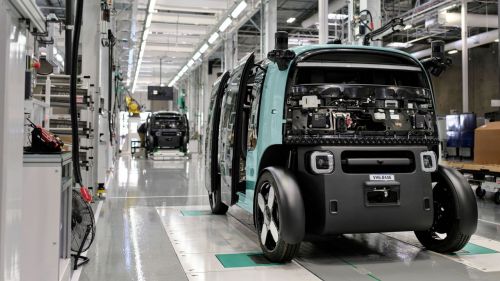 Amazon Zoox robotaxi is being assembled at a California production facility spanning 220,000 square feet (approximately 20,438 square meters) on the 18th (local time). Photo by AP Yonhap News
On June 18 (local time), Amazon, the world’s largest e-commerce company, announced plans to commercialize its robotaxi service within the year, leading to expectations that it will form a “Big Three” in the sector alongside Google and Tesla. The Amazon robotaxi is expected to stand out visually from competitors, featuring a gondola-style design with four seats facing each other and no steering wheel or pedals.
Zoox, Amazon’s autonomous driving division, stated in a press release on June 18 (local time) that it has opened a robotaxi production facility in Hayward, in the San Francisco Bay Area. The facility can produce up to 10,000 custom robotaxis annually. The plant spans approximately 220,000 square feet (about 20,438 square meters), which is equivalent to the size of three and a half soccer fields.
Aicha Evans, CEO of Zoox, said in an interview with Bloomberg Tech on the same day, “We are now ready,” adding, “We plan to gradually expand commercial services city by city while incrementally increasing production capacity.”
CEO Evans also stated that commercial services are scheduled to begin by the end of this year. Zoox is currently testing or operating robotaxis on a limited basis in San Francisco and Las Vegas. Previously, Amazon entered the robotaxi business by acquiring autonomous driving startup Zoox for $1.2 billion (approximately 1.66 trillion won) in September 2020, five years ago.
Unlike Waymo or Tesla, whose robotaxis resemble conventional passenger cars, Zoox’s robotaxi features a gondola-style body with seating for four passengers facing each other. Another distinctive feature is the absence of a steering wheel or pedals inside the vehicle.
Amazon’s announcement of its robotaxi production facility comes as Google’s autonomous vehicle unit Waymo is already expanding commercial services in cities such as San Francisco and Los Angeles, and as electric vehicle maker Tesla prepares to launch its service in Austin, Texas.
Currently, Google subsidiary Waymo leads the robotaxi service market in the United States. Waymo operates in San Francisco, Los Angeles (LA), Silicon Valley, and Phoenix, and plans to expand to eastern regions such as Washington, DC next year. The company has already surpassed 10 million paid rides, with the number of paid trips reaching 250,000 per week.
Tesla, led by CEO Elon Musk, will also launch its robotaxi service in Austin, Texas later this month. This service will operate as an on-demand taxi platform similar to Uber. Initially, 10 to 20 existing Tesla vehicles will be equipped with the latest version of Full Self-Driving (FSD) and will operate autonomously, according to Musk.
In an interview with CNBC last month, CEO Musk stated, “After Austin, we will expand to other cities such as San Francisco, Los Angeles, and San Antonio (Texas),” and predicted, “By the end of next year, hundreds of thousands or even more than one million Teslas will be operating autonomously in the United States.”
© The Asia Business Daily(www.asiae.co.kr). All rights reserved.

















