G6 Discusses Ukraine Issue After Trump's Departure
Fails to Include Agreement in Joint Statement
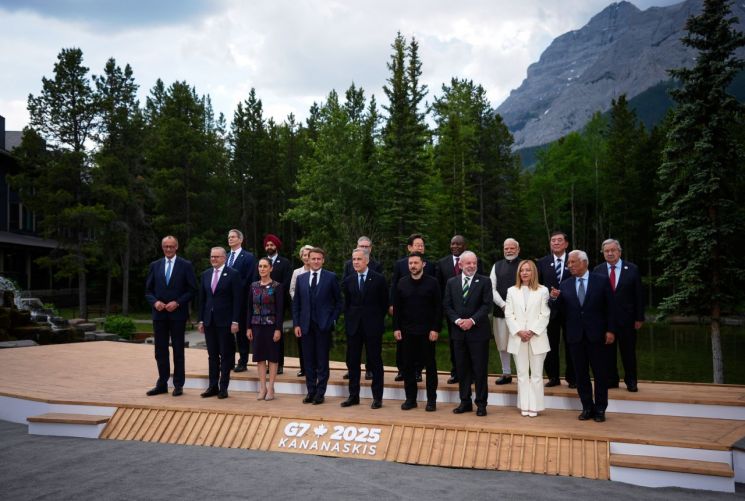 On the 17th (local time), world leaders and invited guests attending the Group of Seven (G7) summit held in Canmore, Alberta, Canada, are taking a commemorative photo. Photo by AP Yonhap News
The Group of Seven (G7) summit ended up offering only a "half-baked solution" as U.S. President Donald Trump returned home early. Leaders from South Korea, Japan, Mexico, and Ukraine, who had been looking forward to meeting with President Trump, were unable to hide their disappointment.
According to the Associated Press and Reuters on the 17th (local time), the leaders of the remaining six countries, excluding the United States, held a meeting to discuss the issue of Ukraine. Each leader met individually with Ukrainian President Volodymyr Zelensky and pledged their support, but they failed to present a unified position through a joint statement. Instead, the leaders promised individual support for Ukraine. Mark Carney, the Canadian Prime Minister and host of the summit, offered Ukraine a package including approximately $1.47 billion (about 2.0223 trillion won) in military aid and additional financial sanctions against Russia.
Initially, the G7 leaders had planned to discuss the Middle East crisis, tariff issues, and the Russia-Ukraine war in depth at this summit. In particular, they intended to issue a joint statement criticizing Russia for invading Ukraine and continuing the war, but even before the summit began, they faced opposition from the United States. From the outset, President Trump made remarks defending Russia, such as saying, "It was a mistake to expel Russia from the G8." Russia was expelled from the G8 in 2014 after forcibly annexing Crimea, which was Ukrainian territory.
On the final day of the summit, President Zelensky, speaking as a guest speaker, urged the G6 leaders to support Ukraine. Referring to a Russian airstrike the previous day, he said, "Our families had a very difficult night," and described it as "one of the largest attacks since the war began." He went on to report that 15 people were killed and more than 150 were injured in the attack. President Zelensky had planned to use a meeting with President Trump to draw international attention to the Russia-Ukraine war, but this too fell through.
The G6 leaders agreed to jointly respond to "non-market policies" that could threaten global access to critical minerals. Although the joint statement did not mention China by name, the move is interpreted as targeting China, which has retaliated against U.S. tariff policies by imposing export restrictions on seven types of rare earths. The leaders also reached a consensus to minimize the negative impact that artificial intelligence (AI) could have on jobs and the environment, while embracing the potential of the "technological revolution."
President Trump was originally scheduled to attend the G7 summit on June 16-17, but returned home early as the Israel-Iran war intensified. While foreign media interpreted this as a measure to address the Middle East situation, President Trump rejected this interpretation via social media the previous day, saying, "It's not because of the ceasefire, but because of something much bigger."
Meanwhile, President Trump's sudden early departure disrupted the plans of other leaders, who had intended to accelerate tariff negotiations with the United States ahead of the July 9 deadline. Japanese Prime Minister Shigeru Ishiba held talks with President Trump but failed to achieve any meaningful results, while Mexican President Claudia Sheinbaum and South Korean President Lee Jaemyung were unable to meet with him at all.
© The Asia Business Daily(www.asiae.co.kr). All rights reserved.
![User Who Sold Erroneously Deposited Bitcoins to Repay Debt and Fund Entertainment... What Did the Supreme Court Decide in 2021? [Legal Issue Check]](https://cwcontent.asiae.co.kr/asiaresize/183/2026020910431234020_1770601391.png)















