Disappeared in the 1690s, Reappeared in 1929
Purchased at Auction for 2.5 Million Pounds in 1980
Fresh suspicions have emerged that 'Samson and Delilah' by Flemish painter Peter Paul Rubens (1577?1640), owned by the National Gallery in the UK, may be a forgery.
On June 17 (local time), The Guardian and The Times reported that the National Gallery is once again facing controversy over the authenticity of 'Samson and Delilah', which it purchased at a Christie's auction in 1980. The National Gallery paid 2.5 million pounds for the painting at the time. Adjusted for current value, this amounts to 10 million pounds (approximately 18.5 billion won).
However, ever since the National Gallery acquired the painting, doubts about its authenticity have persisted. The oil painting depicts the Old Testament story of Samson and Delilah, capturing the moment of Delilah's betrayal of Samson with vivid colors and dramatic contrasts. Measuring 205 cm wide and 185 cm tall, it is believed to have been painted around 1609?1610.
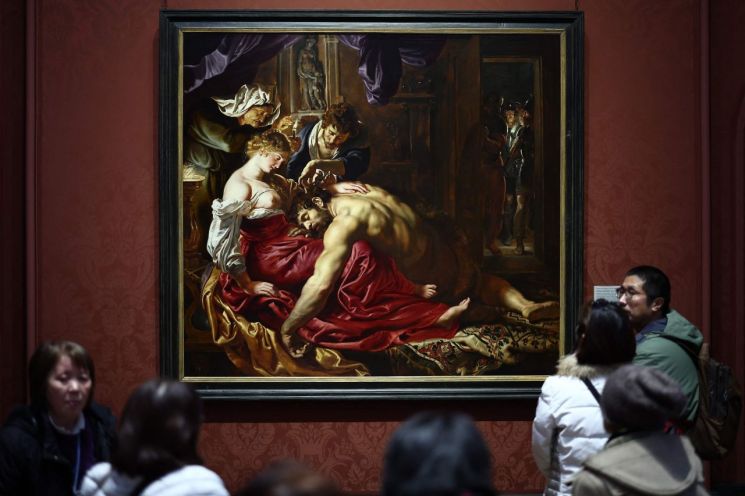 'Samson and Delilah' by Flemish painter Peter Paul Rubens (1577?1640), owned by the National Gallery in the UK Photo by AFP Yonhap News
The painting disappeared from public view in the 1690s and only resurfaced in 1929. German art historian Ludwig Burchard, who attributed the work to Rubens, died in 1960. After his death, it was revealed that he had misattributed many works for commercial purposes, which fueled suspicions that this painting could also be a forgery.
Above all, questions have been raised about the quality of the work itself, such as the crude brushwork, the rough coloring of Delilah's dress, and the anatomically inaccurate depiction of Samson's back muscles. The fact that modern plywood was attached to the back of the painting, obscuring information related to the original work, also raised suspicions. This led to serious allegations that the painting could be a 20th-century copy. In response to these suspicions, the National Gallery stated that it first publicly mentioned the plywood two years after the purchase, in a 1982 board meeting and in a technical report in 1983. The gallery also explained in its exhibition catalog in the 1990s that "the painting was mounted on new plywood before the gallery acquired it in 1980."
Christopher Brown, a former National Gallery curator specializing in Dutch and Flemish collections, recently told The Guardian that he believes the painting is authentic and that it was the National Gallery that attached the plywood to the back. However, after The Guardian requested a comment from the National Gallery, Brown reversed his position, saying, "The gallery says the plywood was attached before the purchase. I have no reason not to believe them." This confusion has further fueled doubts among experts.
Katarzyna Krzyzag?rska-Pisarek, a Rubens expert from Poland who considers the work a forgery, argued, "They (the museum) do not want to have a discussion," adding, "That is because we make arguments they cannot answer." The National Gallery dismissed the suspicions, stating, "Samson and Delilah has long been recognized as a masterpiece by Rubens, and there has never been a single Rubens expert who doubted its authenticity."
© The Asia Business Daily(www.asiae.co.kr). All rights reserved.

















