Launched Last Year to High Praise, Budget Increased
Program Closes Early Despite 9 Billion Won Boost
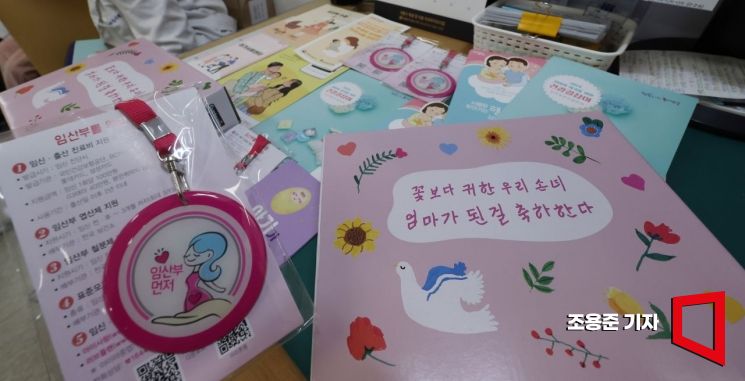 A package containing a guidebook for pregnant women and a badge, given upon registration of pregnancy with the Seoul Metropolitan Government. Reference photo to aid in understanding the article.
The "Preconception Health Management Support Program," which received an enthusiastic response from people planning pregnancy, is facing difficulties due to an unexpectedly high number of applicants. Despite a significant budget increase to 9 billion won this year, some local governments have already closed applications because of the overwhelming demand.
According to Yonhap News on June 18, citing the Ministry of Health and Welfare, the government's "Preconception Health Management" program has been so well received that local governments are closing applications early one after another. As of June 13, five out of the 17 metropolitan and provincial governments nationwide?including Seoul, Busan, and Sejong?have suspended applications for support, either because national funds (on average 50%) or local funds have been exhausted.
This program provides support regardless of marital status or whether the applicant has children, targeting all men and women aged 20 to 49. For women, it covers the cost of ovarian function tests (AMH) and gynecological ultrasounds; for men, it covers semen analysis (sperm morphology tests). Women can receive up to 130,000 won, and men up to 50,000 won in support.
The preconception health management program, which began last year, initially offered a one-time benefit to married couples (including those in common-law marriages) and engaged couples. After receiving a positive response with 130,000 applicants last year, the program expanded this year to include all eligible individuals regardless of marital status, and the number of times support can be received increased to three per life cycle.
The Ministry of Health and Welfare's budget also increased by more than 40%, from 6.25 billion won last year to 9 billion won this year. However, demand has surged, with 201,000 people applying for the program this month alone, according to data collected by the ministry.
As a result, there has been growing disappointment among those who were unable to receive support because the timing did not align with their pregnancy plans. A 29-year-old Seoul resident, identified as Ms. A, told Yonhap News, "I was planning to try for pregnancy around this winter, so I looked into fertility test support, but I was told it had already ended. I heard the program was very helpful and well-designed, so I hope everyone can access it without worry."
© The Asia Business Daily(www.asiae.co.kr). All rights reserved.
![Clutching a Stolen Dior Bag, Saying "I Hate Being Poor but Real"... The Grotesque Con of a "Human Knockoff" [Slate]](https://cwcontent.asiae.co.kr/asiaresize/183/2026021902243444107_1771435474.jpg)
















