Promotion-Oriented AI Policies Over Regulation
"Strengthening National Security Capabilities" in Response to SKT Hacking
"Restoring Basic Research Projects to 15,000"
The Ministry of Science and ICT will report to the National Policy Planning Committee on key ministry issues, including policies to enhance artificial intelligence (AI) competitiveness and the strengthening of national cybersecurity capabilities in light of the SK Telecom hacking incident. In the field of science and technology, the ministry is reportedly planning to restore the research ecosystem that was damaged by research and development (R&D) budget cuts by increasing so-called "grassroots" basic research projects and expanding the R&D budget to 5% of total national expenditure.
According to the National Assembly and other sources, the Ministry of Science and ICT has summarized pending issues and decision-making tasks in the fields of science and technology, AI, and digital policy, as well as plans for implementing campaign pledges, for a report to the Economy Division 2 and Society Division 2 of the National Policy Planning Committee at the Sejong Government Complex at 10 a.m. on June 18.

The Ministry of Science and ICT identified the expansion of AI computing infrastructure, the enactment of subordinate legislation for the Basic AI Act, and the development of general-purpose AI models as core issues in the AI sector. The ministry has decided to reconsider the direction of the National AI Computing Center project, which has stalled recently due to a lack of bidders. As part of a shift toward promotion-oriented rather than regulatory policies, the ministry plans to select and fully support representative AI model development teams, and to foster a domestic neural processing unit (NPU)-based AI semiconductor ecosystem to replace foreign graphic processing units (GPU).
The ministry is also expected to report on plans to strengthen the control tower function of the National AI Committee by focusing on a small group of elite private-sector experts, and to establish an "AI Policy Office" within a dedicated ministry to lead AI policy planning and implementation. The fact that the new AI Policy Office is referred to as belonging to a dedicated AI ministry, rather than the current Ministry of Science and ICT, is interpreted as reflecting the new administration's intention to restructure the ministries overseeing AI. As part of President Lee Jae Myung's campaign pledge implementation, the ministry will also mention a nationwide AI transformation and the launch of AI services based on Korea's own AI models that can be used by all citizens.
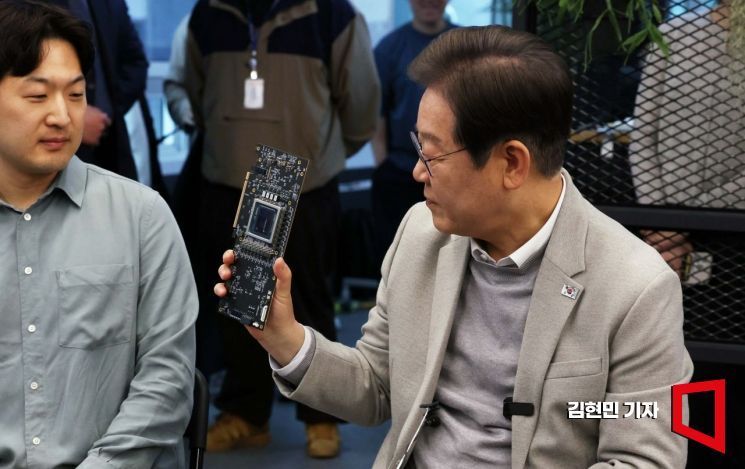 President Lee Jae Myung (right in the photo) is seen visiting Puriosa AI in Gangnam-gu, Seoul, on April 14th during his candidacy, examining a domestic neural processing unit (NPU) designed to replace foreign graphic processing units (GPU). Photo by National Assembly Press Photographers Group
In addition, the ministry cited the ongoing intensive investigation into the SK Telecom USIM information leak incident, emphasizing that minimizing user damage and preventing recurrence, as well as strengthening national cybersecurity capabilities overall, are key issues.
Regarding pledges to reduce the burden of daily living for office workers, the ministry cited measures such as tax deductions for communication expenses and "QoS" support, which allows for continued use at restricted speeds even after the basic data allowance is exhausted.
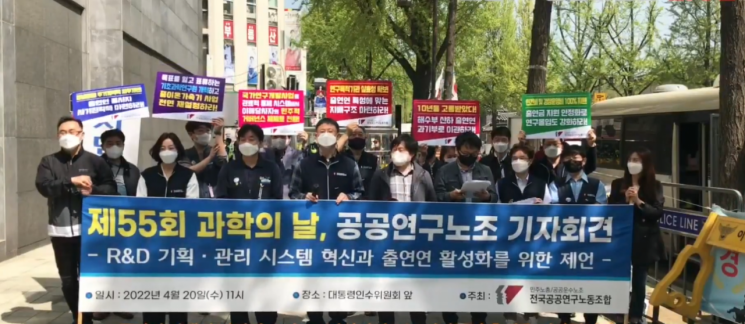 The "National Science and Technology Reform Solidarity Conference," composed of nine labor unions from government-funded research institutes and the Ministry of Science and ICT, was launched in September 2023. In response to the 2024 R&D budget cuts, science and technology labor unions united for the first time ever, regardless of progressive or conservative tendencies, to oppose the reductions. National Public Research Union
In the field of science and technology, the ministry will report on the need for rapid additional R&D funding to restore the research ecosystem damaged by last year's R&D budget cuts and to achieve the goal of allocating 5% of total national expenditure to R&D. The ministry plans to restore the number of basic research projects, which were reduced during the R&D budget cut process and became a source of controversy, to around 15,000 next year, and to strengthen academic diversity and autonomy based on challenge and creativity. The ministry will also work to secure breakthrough source technologies in national strategic technology sectors such as semiconductors and secondary batteries, foster advanced companies, and promote the dissemination of R&D achievements.
To nurture science and engineering talent, the ministry will report plans to strengthen customized support throughout the growth cycle, such as research living allowances for graduate students and support for postdoctoral researchers, and to maximize the utilization of talent, including women and senior scholars. The ministry will also announce plans to encourage regional autonomous R&D and foster regional flagship national universities as research-oriented institutions.
Plans to abolish the preliminary feasibility study for R&D, resolve field issues arising from designation as a sensitive country, and seek removal of such designation through strengthened Korea-US cooperation will also be reported. In the global R&D sector, the ministry will present goals to attract foreign talent and to strengthen cooperation and solidarity with the United States, the European Union (EU), and others.
© The Asia Business Daily(www.asiae.co.kr). All rights reserved.














