U.S. Signs Bilateral Trade Agreement with U.K.; Tariffs Lifted, Quotas Imposed
Industry: "A 50% Tariff Means Halting Exports... Quotas Are More Realistic"
"Export Volumes Differ from the U.K.... Fairness with Japan and the EU Must Be Considered"
Trade Ministry Launches U.S. Negotiation Task Force; "Strategy Should Focus on Practical Gains"
With the Donald Trump administration in the United States deciding to exempt British steel and aluminum products from tariffs and instead apply import quotas, there is a wide range of interpretations within the domestic steel industry regarding which conditions would be most advantageous in future trade negotiations with the U.S. Industry insiders are describing the move as a “reference case for negotiations,” while also expressing caution by emphasizing that “the situations in the UK and Korea are different.”
According to industry sources on June 17, the U.S. formally signed a bilateral trade agreement with the UK during the Group of Seven (G7) summit held in Canada. The two countries agreed to adjust tariffs based on quotas in major industries such as steel, automobiles, and aerospace. In particular, for steel, the agreement stipulates that, under conditions related to supply chain security and ownership, most-favored-nation (MFN) tariff rates will be applied up to a certain import volume.
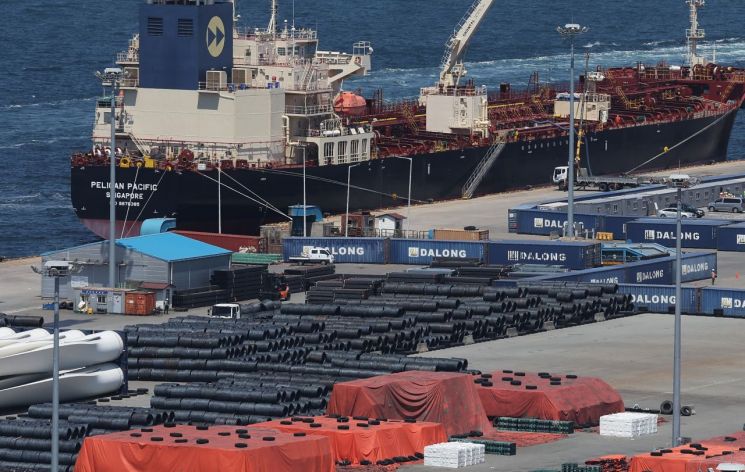
The domestic steel industry is paying close attention to these changes in U.S. policy. There are calls for Korea to also secure a quota system in future negotiations. One industry official noted, “It is noteworthy that the U.S. has officially codified the quota method in the agreement, which it had previously rejected. This could serve as a reference for the Korean government’s future negotiation strategies.” Another official stated, “A 50% tariff is essentially a demand to halt exports. In that case, it would be better to secure a stable quota.”
Some point out that, in reality, quota monitoring is still being maintained. A representative from a steel company commented, “Even if it appears that quotas have been abolished, the U.S. government is still monitoring import volumes, so in practice, exports are only possible at the previous quota levels. In this situation, maintaining quotas with tariff exemptions is actually more advantageous.”
There is also caution regarding whether this agreement can be extended to Korea. Another industry official explained, “The UK ranks only around 18th among U.S. steel import sources, but Korea is a major exporter, ranking around 4th. Fairness in comparison with key countries such as Japan, the European Union (EU), and Taiwan will be an important standard.”
Some industry experts say it is difficult to generalize whether tariffs or quotas are more advantageous. One official emphasized, “Even if tariffs are imposed, exports are possible if domestic U.S. prices rise. The actual benefit of quotas also depends on their volume and composition. The key is the specific conditions, not the system itself.” Some interpret the U.S.-UK agreement as a signal of a shift in trade policy prompted by the G7 summit. The U.S. has already pursued similar agreements with Japan and the EU, and this latest deal is seen as a clear indication of its intent to reorganize supply chains around itself through bilateral agreements with allied countries.
The Korean government has also begun to respond. The Ministry of Trade, Industry and Energy recently launched a U.S. trade negotiation task force (TF) headed by the chief of the Trade Policy Bureau. This TF plans to gather industry opinions and coordinate future negotiation strategies with the U.S. An industry official remarked, “It is a significant change that the U.S. has accepted quotas as an official negotiating tool. For Korea, it is now time to focus on the specific terms and conditions, rather than just the existence of quotas.”
© The Asia Business Daily(www.asiae.co.kr). All rights reserved.











