IMD Ranks South Korea 27th in National Competitiveness
Business Efficiency Plummets from 23rd to 44th
According to the "2025 National Competitiveness Assessment" released by the International Institute for Management Development (IMD) of Switzerland on June 17, South Korea ranked 27th out of 69 countries evaluated. This represents a drop of seven places from last year's 20th position. In particular, business efficiency fell sharply, dropping 21 places from 23rd to 44th.
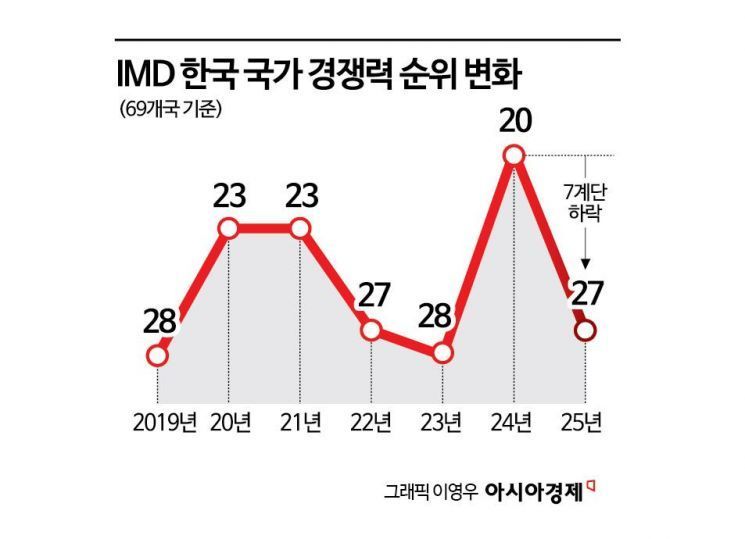
On June 17, IMD announced the results of its international competitiveness assessment. The evaluation was based on major statistics up to 2024 and a survey conducted from March to May 2025. IMD calculates the overall ranking by assessing more than 300 detailed indicators across 20 categories in four main areas: economic performance, government efficiency, business efficiency, and infrastructure.
By category, economic performance (16th to 11th) and government efficiency (39th to 31st) improved in ranking, while business efficiency (23rd to 44th) and infrastructure (11th to 21st) saw significant declines.
Business efficiency, in particular, recorded the steepest drop among all areas, falling 21 places to 44th. Rankings for all subcategories?including productivity, labor market, finance, management practices, and attitudes and values?declined. Survey results for large company competitiveness (41st to 57th) and digital technology usage (11th to 26th) worsened notably.
The infrastructure sector also fell 10 places to 21st. Rankings declined in areas such as recruitment of digital and technical personnel (28th to 59th), urban management (4th to 28th), and education level (19th to 27th), weakening overall competitiveness.
In contrast, the economic performance area showed improvement in international trade (47th to 34th), international investment (35th to 21st), and prices (43rd to 30th). Notably, the growth rate of goods exports jumped from 44th to 10th, and private service exports rose from 62nd to 19th. However, employment (4th to 5th) and the domestic economy (7th to 8th) experienced slight declines.
Government efficiency improved in fiscal policy (38th to 21st), tax policy (34th to 30th), and institutional framework (30th to 24th). In particular, evaluations for "the threat of tax evasion to the economy" (65th to 30th) and "pension management" (55th to 32nd) rose significantly.
Business conditions (47th to 50th) and social conditions (29th to 36th) both declined. The political instability category dropped from 50th to 60th. This appears to be influenced by increased political uncertainty and deteriorating business sentiment following the December 3 Martial Law last year.
The sharp decline in national competitiveness over the past year is analyzed to have been affected by former President Yoon Suk-yeol's martial law and impeachment crisis. IMD's assessment relies on subjective survey responses for 36% of all items, and it is interpreted that the aftermath of the impeachment crisis at the time of the survey dampened business sentiment.
Regarding the decline in South Korea's national competitiveness, the Office of the President stated, "Last year's poor performance and the political and economic uncertainty that led to the insurrection had a significant negative impact on national competitiveness." The office added, "We plan to respond systematically at an inter-ministerial level to enhance national competitiveness and external credibility, including revitalizing the operation of the Ministry of Economy and Finance's National Competitiveness Policy Council."
By country, Switzerland rose one place to take the top spot overall. Last year's leader, Singapore, fell to second, and Hong Kong ranked third. Among Asian countries, Taiwan (6th) and China (16th) ranked higher than South Korea, while Japan was 35th. Among the Group of Seven (G7) countries, Canada ranked 11th, the United States 13th, Germany 19th, the United Kingdom 29th, France 32nd, and Italy 43rd.
© The Asia Business Daily(www.asiae.co.kr). All rights reserved.
![Clutching a Stolen Dior Bag, Saying "I Hate Being Poor but Real"... The Grotesque Con of a "Human Knockoff" [Slate]](https://cwcontent.asiae.co.kr/asiaresize/183/2026021902243444107_1771435474.jpg)

















