"Iran Signals Willingness to Resume Talks If U.S. Does Not Join Attacks"
WTI Down 3.69%, Brent Crude Down 4.01%
99% Expectation for Rate Freeze at FOMC Meeting on the 18th
The three major U.S. stock indexes on the New York Stock Exchange were on the rise in early trading on June 16 (local time). Hopes for possible negotiations between Israel and Iran, which could ease the heightened tensions of the Middle East conflict and reduce the risk of military clashes, are driving the markets higher. International oil prices are trending downward.
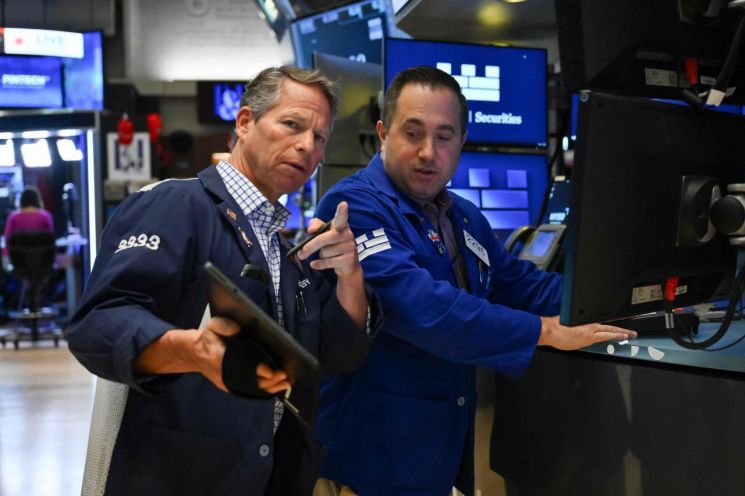
As of 10:26 a.m. on the same day on the New York Stock Exchange, the blue-chip Dow Jones Industrial Average (Dow) was up 472.76 points (1.12%) at 42,670.55. The large-cap S&P 500 index rose 67.95 points (1.14%) to 6,044.92, while the tech-heavy Nasdaq index jumped 285.7 points (1.47%) to 19,692.52.
Oil prices are falling. West Texas Intermediate (WTI) crude was down $2.63 (3.69%) from the previous day at $68.66 per barrel, while Brent crude, the global oil price benchmark, was trading at $71.25 per barrel, down $2.98 (4.01%) from the previous day.
Military clashes between Israel and Iran are ongoing. On June 13, Israel struck Iran's nuclear facilities two days before the sixth round of nuclear talks between Iran and the United States. Iran immediately responded by launching missile and drone attacks on key targets, including the Israeli capital Tel Aviv. Over the weekend, both sides exchanged retaliatory airstrikes and attacked energy facilities. Iran hinted at the possibility of closing the Strait of Hormuz, while Israel claimed to have secured air superiority over Iranian airspace.
However, the possibility of negotiations remains open. According to the Wall Street Journal (WSJ), Iran has conveyed through a mediator that it is open to resuming talks as long as the United States does not participate in Israel's attacks against Iran. This has fueled optimism that military clashes between the two sides may subside.
Krishna Guha, vice chairman at Evercore ISI, said, "The market is relieved by the prospect that the conflict could continue as a limited war," adding, "We believe this is possible, but our base scenario is that the conflict will persist for several weeks, which could impact the energy sector and still poses a high risk of U.S. involvement."
Amid rising instability in the Middle East, all three major indexes fell by more than 1% on June 13. The Dow fell 1.3% for the week, while the S&P 500 and Nasdaq declined by 0.4% and 0.6%, respectively.
Investors are also closely watching the Federal Reserve's Federal Open Market Committee (FOMC) regular meeting scheduled for June 17-18, along with the Middle East conflict. According to CME FedWatch, the federal funds rate futures market is currently pricing in a 99.9% probability that the Fed will keep the benchmark interest rate unchanged at the current 4.25-4.5% level on June 18. If the Middle East conflict drives oil prices higher, the likelihood of a future Fed rate cut is expected to decrease further.
By sector, the decline in oil prices has increased risk appetite, leading to gains among large-cap tech stocks. Meta, the parent company of Facebook, is up 3.34%. Nvidia is showing a 1.8% gain. Tesla is up 1.55%, and Palantir is up 4.13%.
U.S. Treasury yields are moving within a narrow range. The 10-year U.S. Treasury yield, the global benchmark for bond yields, is down 2 basis points (1bp = 0.01 percentage point) from the previous day at 4.4%. The 2-year U.S. Treasury yield, which is sensitive to monetary policy, is down 1bp from the previous day at 3.94%.
© The Asia Business Daily(www.asiae.co.kr). All rights reserved.

![Clutching a Stolen Dior Bag, Saying "I Hate Being Poor but Real"... The Grotesque Con of a "Human Knockoff" [Slate]](https://cwcontent.asiae.co.kr/asiaresize/183/2026021902243444107_1771435474.jpg)















