"Rising Inflation and Labor Shortages...
Fiscal Impact Also Expected"
There are projections that, due to the hardline immigration policies of the Donald Trump administration, the United States could see more immigrants leaving than entering this year for the first time in about 50 years. The Washington Post (WP) reported that this shift in immigration trends could have a significant impact on the U.S. economy.
Wendy Edelberg and Tara Watson, economists at the centrist-left Brookings Institution, conducted joint research with Stan Veuger, a researcher at the conservative American Enterprise Institute (AEI), and concluded that President Trump's immigration policies are likely to be the driving force behind the phenomenon of net emigration.
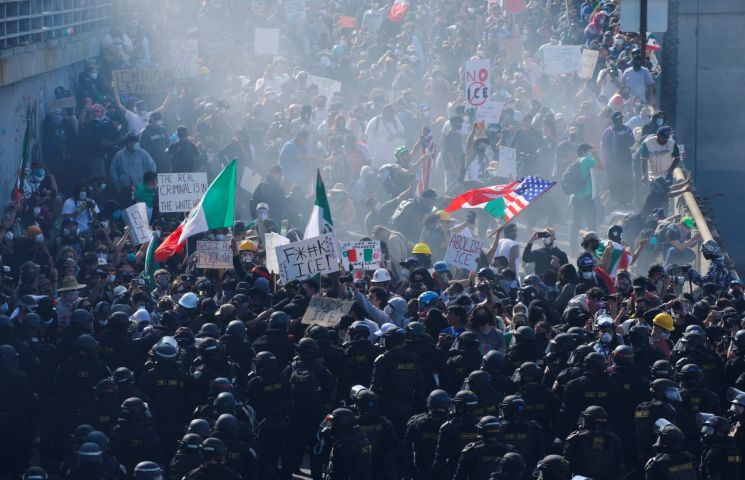 Protest against immigration raids held on the 8th in Los Angeles, California, USA. Photo by Reuters Yonhap News
Net emigration could lead to rising inflation and labor shortages. Edelberg noted that, in the long term, a reduction in tax payments by immigrants could also affect the funding of welfare programs such as Social Security.
WP reported that economists, regardless of political affiliation, expect the U.S. to record its lowest level of immigration in decades this year. Some agreed with the findings of this study, which suggest that emigration could exceed immigration. Veuger stated, "The issue of increased deportations is not that serious," and clarified, "The real problem is that inflows have dropped significantly. This is true not only at the southern border but also through various legal programs."
According to the U.S. Department of Labor, since March, the foreign-born labor force has already decreased by more than one million. This contrasts with the surge in immigration that led to the highest-ever share of foreign-born workers in the U.S. labor force in 2024. This decline is expected to impact industries such as agriculture, construction, and hospitality, which rely heavily on immigrant labor.
Rachel Bloomberg, CEO of a senior care facility in Florida, told WP that she recently had to lay off more than ten workers from Haiti and Cuba following the Trump administration's decision to cancel temporary protected status and work permits. She said that hiring new staff at higher wages would increase annual labor costs by $600,000 (about 819 million KRW), and this cost would be passed on to the facility's residents.
Some workers have chosen to resign on their own. A Venezuelan woman who legally entered the U.S. during the Biden administration in 2023 and worked cleaning restaurants returned to her home country from Colorado with her family in March after her work permit was denied by the Department of Homeland Security, fearing crackdowns under the Trump administration.
The potential scale of mass deportations depends on how much the Trump administration achieves its goal of deporting one million immigrants this year. A Republican-backed spending bill passed the House last month and is pending in the Senate; it allocates $150 billion for immigration enforcement, aiming to expand the speed and scale of mass deportations. However, recent protests against illegal immigration crackdowns in places like Los Angeles could hinder the Trump administration's efforts. Additionally, according to a New York Times (NYT) report on June 13, the Trump administration has ordered a halt to illegal immigration crackdowns in farms, hotels, and restaurants due to concerns about losing core supporters.
Experts believe that if net immigration falls to zero or goes negative, it could mark a turning point in the U.S. demographic and economic trajectory.
Adriana Kugler, a member of the U.S. Federal Reserve Board, stated in a recent speech that the sharp slowdown in immigration since last year could fuel inflation in sectors such as agriculture, construction, and hospitality by the end of the year. However, she cautioned that there is little evidence so far that this phenomenon has led to wage increases.
The White House maintains that there is no shortage of labor in the U.S. Kush Desai, a White House spokesperson, said, "There is no shortage of talent and workforce to expand the American labor force, and President Trump's job creation policies for American workers demonstrate this administration's commitment to maximizing that potential and enforcing immigration laws."
However, if the decline in immigration continues, the labor force could slow economic growth. As the baby boomer generation reaches retirement age, the growth rate of the U.S. labor force has slowed compared to 10 or 20 years ago. Joe Brusuelas, chief economist at RSM, warned, "If we remove these people (immigrants) from the workforce when there are not enough replacements for retired workers, inflation is bound to worsen."
© The Asia Business Daily(www.asiae.co.kr). All rights reserved.
![Clutching a Stolen Dior Bag, Saying "I Hate Being Poor but Real"... The Grotesque Con of a "Human Knockoff" [Slate]](https://cwcontent.asiae.co.kr/asiaresize/183/2026021902243444107_1771435474.jpg)
















