Leading Robotic Surgery for Advanced Colorectal Cancer
Including Single-Port Procedures and Patients with Liver Metastasis
On June 16, the colorectal surgery team at the Colorectal Cancer Center of Asan Medical Center in Seoul announced that it had become the first in Korea to surpass 3,000 cases of robotic colorectal cancer surgery.
Colorectal cancer has the highest incidence rate among cancers in Korea, excluding thyroid cancer. Environmental factors such as a meat-heavy diet, alcohol consumption, obesity, and smoking are reported to be associated with the increasing incidence of colorectal cancer.
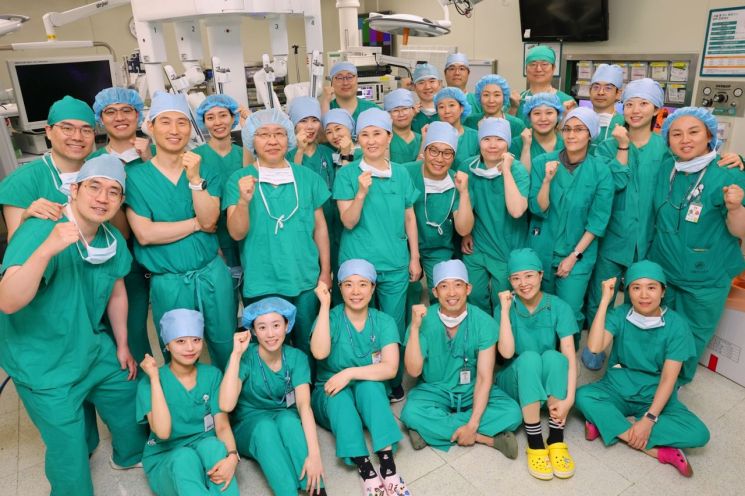 The colorectal surgery team at Asan Medical Center in Seoul is taking a commemorative photo after performing 3,000 cases of robotic colorectal cancer surgery. Photo by Asan Medical Center
The Colorectal Cancer Center at Asan Medical Center, which receives the largest number of colorectal cancer patients in Korea, has performed a total of 39,000 colorectal cancer surgeries to date. Among these, the center has carried out 13,000 laparoscopic colorectal cancer surgeries and 3,000 robotic colorectal cancer surgeries, leading the field in surgical treatment of colorectal cancer.
Based on this extensive surgical experience, the center has achieved world-class outcomes in colorectal cancer surgery. The five-year survival rate for rectal cancer patients who underwent surgery at the center is exceptionally high, at 96.6% for stage 1 and 94.8% for stage 2. For stage 3 patients, who face a higher level of difficulty, the five-year survival rate improved from 83.1% in 2015 to 91.3% in 2017, an increase of 8.2 percentage points.
The incidence rate of serious complications within 30 days after surgery is approximately 3%, a low figure that includes even high-difficulty cases such as recurrent colorectal cancer, colorectal cancer with metastasis to other organs, and simultaneous surgeries.
Since the introduction of robotic surgery in 2010, the colorectal surgery team at Asan Medical Center has seen a steep increase in surgical performance and has expanded the application of robotics to all areas of colorectal cancer surgery. In particular, the team has recently been actively utilizing robotic surgery for highly complex procedures that require precision, such as single-port surgery?which treats colorectal cancer through a single incision?and surgeries for patients with colorectal cancer metastasized to the liver, thereby contributing to improved survival rates and quality of life for patients.
Robotic surgery involves inserting robotic arms through small abdominal incisions and performing the procedure using a high-definition camera. This allows for free movement even in narrow spaces, minimizing damage to surrounding organs.
Park Inja, professor of colorectal surgery and director of the Colorectal Cancer Center at Asan Medical Center, stated, "We were able to achieve 3,000 cases of robotic colorectal cancer surgery thanks to the surgical experience we have accumulated by treating the largest number of colorectal cancer patients in Korea and our ongoing efforts to improve patients' quality of life. We will continue to lead not only in robotic surgery but also in the treatment of severe and complex colorectal cancer cases."
© The Asia Business Daily(www.asiae.co.kr). All rights reserved.

![Clutching a Stolen Dior Bag, Saying "I Hate Being Poor but Real"... The Grotesque Con of a "Human Knockoff" [Slate]](https://cwcontent.asiae.co.kr/asiaresize/183/2026021902243444107_1771435474.jpg)















