A new analytical method that can predict drug inhibition effects with a single experiment during the drug development process has been proposed in Korea, drawing significant attention.
On June 16, KAIST announced that the research team led by Professor Jaekyung Kim from the Department of Mathematical Sciences (IBS Biomedical Mathematics Group CI) has collaborated with the team of Professor Sangkyum Kim from the College of Pharmacy at Chungnam National University and the IBS Biomedical Mathematics Group to propose an analytical method that can predict drug inhibition effects with just one experiment.
 (From left) Sangkyum Kim, Professor at Chungnam National University; Yoonmin Song, PhD; Hyeongjun Jang, Undergraduate Student; Jaekyung Kim, Professor at KAIST; (Top left) Hwiyul Yoon, Professor at Chungnam National University. Provided by KAIST
The drug inhibition effect refers to the phenomenon in which a drug inhibits the action of a specific enzyme, thereby affecting the metabolism (processes of breakdown and handling) or physiological effects of other drugs.
Previously, drug development involved analyzing drug-drug interactions and estimating inhibition constants through repeated experiments under numerous concentration conditions. This method has been widely used and cited in over 60,000 research papers to date.
In contrast, the joint research team proposed a new analytical method called '50-BOA.' By using mathematical modeling and error landscape analysis (a topographical map showing the error for each combination of parameters in optimization), they eliminated inhibitor concentrations that do not contribute to improving accuracy. This enables the accurate estimation of inhibition constants using only a single concentration.
The joint research team applied this technique to actual experimental data and confirmed that it increased experimental efficiency by more than 75% compared to existing methods, while also improving accuracy.
This study is drawing attention as a new approach that reduces resource consumption from repeated experiments and minimizes interpretation bias, thereby increasing efficiency in the drug development process.
In particular, it is significant as a representative achievement demonstrating how mathematical approaches can revolutionize experimental design in life sciences.
The inhibition constant is not only crucial for determining drug efficacy but is also a key indicator used to predict and prevent drug-drug interactions that may occur during combination therapy. In fact, the U.S. Food and Drug Administration (FDA) recommends that, during the drug development process, the inhibitory characteristics of enzymes?including the inhibition constant?be evaluated in advance to predict the possibility of drug interactions.
Traditionally, the inhibition constant has been estimated by applying mathematical models to metabolic rate data measured at various substrate and inhibitor concentrations. However, with this approach, the estimated values for the same substrate-inhibitor combination can differ by more than tenfold between studies, making it difficult to accurately predict the effects and side effects of drugs during development.
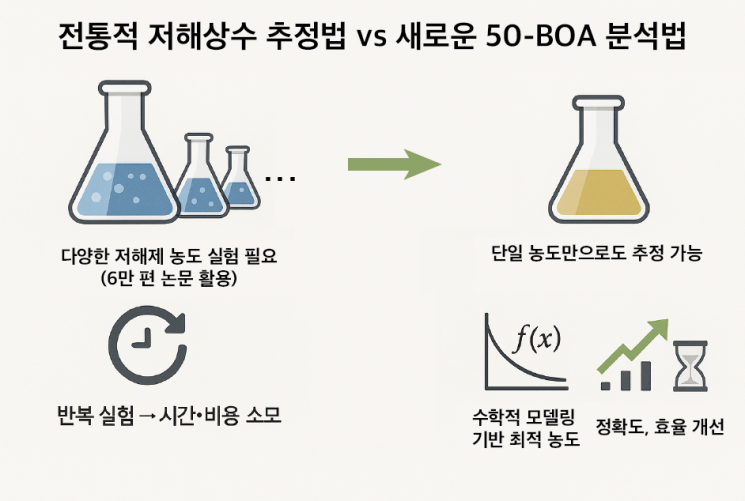
In response, the research team mathematically analyzed the inhibition constant estimation process and discovered that more than half of the data used in existing methods is unnecessary for actual estimation or can even cause distortion. They demonstrated that results estimated from a single, high inhibitor concentration can be more accurate and efficient than those obtained using the traditional approach of varying inhibitor concentrations.
Additionally, they developed a new analytical method called '50-BOA,' which increases accuracy by regularizing (a technique used in optimization to solve ill-posed problems or prevent overfitting) the equation describing the relationship between inhibitor concentration and inhibition constant. 50-BOA enables accurate estimation of the inhibition constant using only one inhibitor concentration, dramatically reducing the number of experiments required while actually improving accuracy.
Jaekyung Kim, Professor at KAIST, stated, "This study is a representative example showing that mathematics can transform experimental design and fundamentally enhance research efficiency and reproducibility in the life sciences."
Sangkyum Kim, Professor at Chungnam National University, said, "I hope that the results of this study will become a new standard that not only improves experimental efficiency but also increases the accuracy of predicting drug efficacy and side effects."
This research was supported by the National Research Foundation of Korea, the Institute for Basic Science, and KAIST. The first authors of the research paper are Hyeongjun Jang, undergraduate student at the School of Transdisciplinary Studies at KAIST, and Yoonmin Song, PhD from the Department of Mathematical Sciences, who participated jointly.
© The Asia Business Daily(www.asiae.co.kr). All rights reserved.













