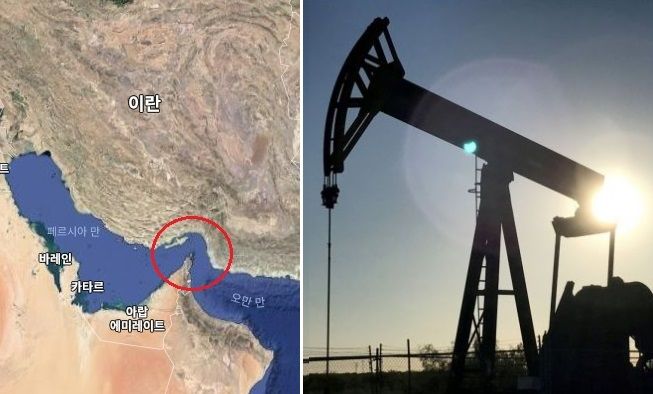
On June 16, Daishin Securities released a report titled "Iran's Blockade of the Strait of Hormuz? Reasons It Is Impossible," analyzing that a blockade of the Strait of Hormuz by Iran?which would have a critical impact on international oil prices?would be impossible. The report cited several reasons: such a blockade would inflict significant damage on Iran's own trade, would mainly have negative effects on Iran's allied countries, and could trigger intervention by the U.S. military.
On June 14, Israel began expanding its range of attacks after Iran lost air superiority. While the initial attacks targeted nuclear fuel enrichment facilities, ballistic missile and air defense bases, and the assassination of military officials, subsequent attacks have expanded to include energy infrastructure such as power facilities. Iran's Ministry of Energy reported that oil storage facilities for domestic use near the capital Tehran were hit, and that the South Pars gas field?which accounts for 70% of Iran's domestic supply?has experienced disruptions in production. As both domestic and international circumstances have turned unfavorable for Iran, the worst-case scenario of a blockade of the Strait of Hormuz is being discussed. The intention behind such a blockade would be to induce foreign pressure on Israel.
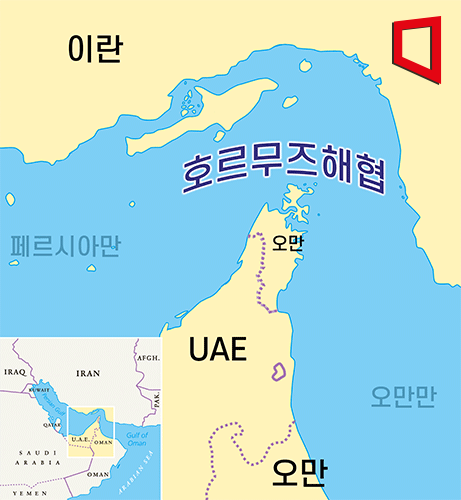
The Strait of Hormuz, located south of Iran, connects the Persian Gulf and the Gulf of Oman. Approximately 20% of the world's maritime crude oil and LNG shipments (85% of which are bound for Asia) pass through this strait. While the strait is 55 kilometers wide and has an average depth of 56 meters, the section navigable by VLCC-class oil tankers (with a depth of 25?30 meters) is only about 3 kilometers wide, and all of this is within Iranian waters. If Iran were to blockade this area, only Saudi Arabia and the UAE have alternative facilities to reroute shipments, making transport disruptions inevitable for Iraq, Kuwait, and Qatar. This could restrict crude oil exports equivalent to at least 7?10% of global supply. Should the Strait of Hormuz be blockaded, oil prices are expected to surpass $85 per barrel. This could recreate scenarios similar to the first oil shock or the Iran?Iraq War.
However, Daishin Securities judged that a blockade of the Strait of Hormuz by Iran is impossible for five reasons. First, although Iran has repeatedly threatened to blockade the Strait of Hormuz in the past, it has never actually attempted it. Second, 85?90% of Iran's trade is conducted via maritime routes, and in a situation where public sentiment is deteriorating due to high unemployment and failures in air defense, a contraction in trade could undermine the political standing of the Supreme Leader and other conservatives. Third, since 85% of the energy transported through the strait is destined for Asia, a blockade would provoke backlash from Iran's allies such as Iraq and Qatar, as well as major customers like China. Fourth, the U.S. Navy's Fifth Fleet, which includes two aircraft carrier strike groups, is headquartered in the Strait of Hormuz, so a blockade could serve as a pretext for U.S. military intervention. Fifth, Iran is a signatory to the "Innocent Passage" treaty (1958), which guarantees freedom of navigation as long as peace and security are not threatened.
Choi Jinyoung, an analyst at Daishin Securities, predicted, "Although oil prices will immediately reflect geopolitical risks, if it becomes clear that a blockade of the Strait of Hormuz by Iran is unlikely, prices will stabilize (at $55?75 per barrel) depending on supply factors such as increased production led by Saudi Arabia and OPEC+."
© The Asia Business Daily(www.asiae.co.kr). All rights reserved.
![Clutching a Stolen Dior Bag, Saying "I Hate Being Poor but Real"... The Grotesque Con of a "Human Knockoff" [Slate]](https://cwcontent.asiae.co.kr/asiaresize/183/2026021902243444107_1771435474.jpg)

















