Expanding Portfolio from CDMO to CRO
Alternatives to Animal Testing... Market Growth Expected
Samsung Biologics is expanding its business portfolio beyond contract development and manufacturing organization (CDMO) services to include contract research organization (CRO) services.
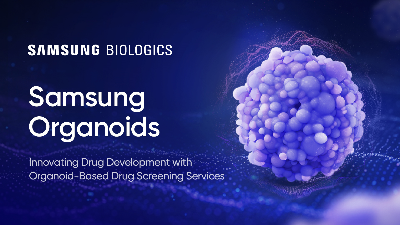
On June 16, Samsung Biologics announced the launch of 'Samsung Organoids,' a drug screening service utilizing organoids. The company aims to achieve an 'early lock-in' effect by starting collaboration with client companies from the drug candidate discovery stage.
Based on its experience operating under Good Manufacturing Practice (GMP) standards?which has resulted in 359 manufacturing approvals from major global regulatory agencies?Samsung Biologics plans to showcase its capabilities in high-quality sample processing and flawless data management.
Initially, Samsung Biologics will focus on screening anticancer drug candidates using 'patient-derived organoids' within the organoid business sector. The company intends to replace conventional candidate screening methods that rely on cell or animal models, which have been limited by low patient similarity, high costs, and ethical concerns.
Organoids, named by combining 'organ' and the suffix '-oid' meaning 'resembling,' refer to 'mini organ models' created by aggregating and culturing stem cells or tissue-derived cells in three dimensions. Compared to traditional experimental methods, organoids offer lower costs and demonstrate a high patient similarity rate of up to 85%. This allows for more detailed and rapid evaluation of drug efficacy and toxicity, which has recently drawn significant market attention.
According to market research firm Research and Markets, the global patient-derived organoid market is estimated to grow from $1 billion (approximately 1.3678 trillion KRW) in 2024 to $3.3 billion (approximately 4.5137 trillion KRW) in 2030, with a compound annual growth rate of 22%. In particular, the industry is expected to grow even faster after the U.S. Food and Drug Administration (FDA) announced in April that it plans to reduce animal testing and promote alternatives such as organoids.
With the launch of its organoid service, Samsung Biologics plans to accelerate its growth strategy aimed at becoming a 'global top-tier CDMO.' The company will continue investing to expand its portfolio?including antibody-drug conjugates (ADC) and adeno-associated viruses (AAV)?based on its 'three-pillar growth strategy' of production capacity, portfolio diversification, and global site expansion.
John Rim, CEO of Samsung Biologics, stated, "By providing fast and accurate screening services from the early development stage, we expect to significantly help our clients reduce development risks and accelerate development timelines. We will continue to focus on developing innovative technologies and services to meet our clients' diverse needs and ensure their satisfaction."
© The Asia Business Daily(www.asiae.co.kr). All rights reserved.

![Clutching a Stolen Dior Bag, Saying "I Hate Being Poor but Real"... The Grotesque Con of a "Human Knockoff" [Slate]](https://cwcontent.asiae.co.kr/asiaresize/183/2026021902243444107_1771435474.jpg)















