Interview with Kim Deokhyun, Governor of Yeoncheon County
"Special Compensation Needed for Yeoncheon to Achieve National Balanced Development"
Yeoncheon, a Symbolic Border Region, Prepares to Leap Forward with the Green Bio Cluster
Second Home Policy, Expressway, Subway Line, and National Cemetery Expected to Revitalize the Region
"Yeoncheon County has endured special sacrifices as a border region on the front lines of national security for over 70 years. Now is the time for corresponding compensation."
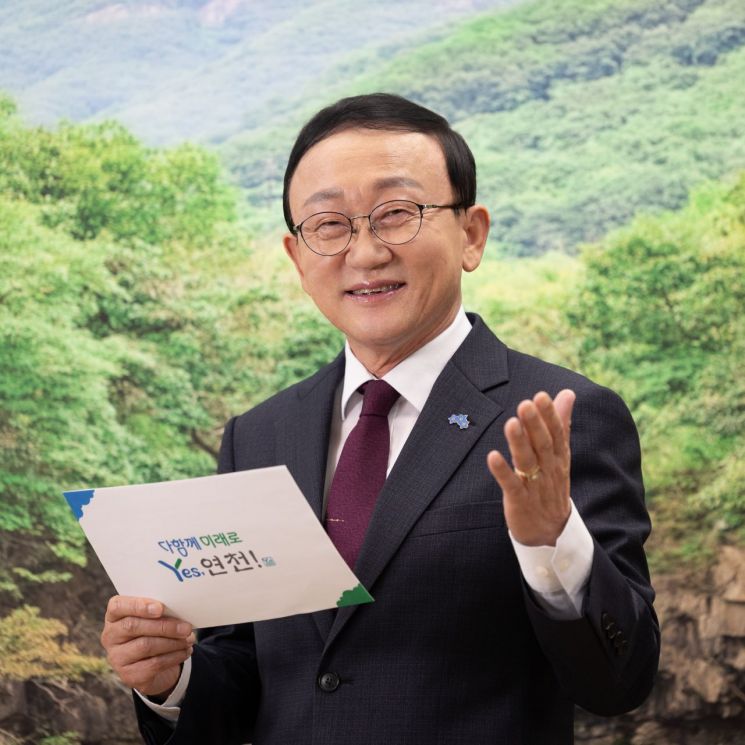 Kim Deokhyun, Governor of Yeoncheon County, Gyeonggi Province, stated in an interview with Asia Economy on the 13th, "According to the government's policy direction of 'special compensation for special sacrifices,' Yeoncheon County must be designated as an opportunity development zone." Provided by Yeoncheon County
Kim Deokhyun, Governor of Yeoncheon County in Gyeonggi Province, stated in an interview with Asia Economy on the 13th, "In line with the new government's policy direction of 'special compensation for special sacrifices' for the northern Gyeonggi region, Yeoncheon County must be designated as an opportunity development zone," expressing this view.
The following is a Q&A with Kim Deokhyun, Governor of Yeoncheon County.
- What are the reasons Yeoncheon County should be designated as an opportunity development zone, and what effects are expected if it is designated?
"The government plans to use opportunity development zones to promote mutual growth between local governments and businesses, as well as to ease the concentration of population in Seoul, thereby revitalizing the regional economy and achieving balanced development. Since 2022, the 8th popularly elected administration of Yeoncheon County has continuously appealed to the relevant National Assembly committees and ministries about the reality faced by population-declining areas in the Seoul metropolitan region, and has consistently proposed amendments to the 'Special Act on Decentralization and Regional Balanced Development.'
As a result, the opportunity to apply for special zone designation, which was originally limited to non-metropolitan (regional) areas, has now been extended to include population-declining metropolitan areas and border regions such as Yeoncheon County. For the application and designation of special zones, the role of Gyeonggi Province, the main applicant, is especially important. In the remaining period, we will actively communicate and cooperate with Gyeonggi Province to prepare concrete, feasible business plans in Yeoncheon, such as the Green Bio Cluster, so that we can be designated as a special zone."
- What are the plans for utilizing the second home policy, and what effects are expected?
"The second home special provision is a policy that allows a person who owns one home to acquire an additional home in Yeoncheon County and still be recognized as a 'single-home owner.' If a single-home owner in the Seoul metropolitan area purchases one home in Yeoncheon County, which is a designated second home special area, they will still be recognized as a single-home owner and will be eligible for reductions in acquisition tax and capital gains tax when selling their long-held home.
Yeoncheon County is the ideal place for middle-aged and older people approaching retirement who wish to enjoy a rural lifestyle. Its strength lies in superior accessibility compared to other regions, thanks to the opening of Seoul Subway Line 1 and National Road No. 3. Going forward, we plan to focus on expanding transportation infrastructure to increase both the resident and daily populations."
- What is the current status of the National Yeoncheon Cemetery for Patriots and Veterans?
"The 'National Yeoncheon Cemetery for Patriots and Veterans,' which will be the third national cemetery in the country after those in Seoul and Daejeon, broke ground on April 24, 2025. The cemetery is being built by the Ministry of Patriots and Veterans Affairs with an investment of approximately 100 billion won, on a site of about 959,000 square meters in Daegwang-ri, Sinseo-myeon. It will include a columbarium with 25,000 niches, and a total capacity for 50,000 remains.
Once the National Yeoncheon Cemetery for Patriots and Veterans is completed, it is expected to revitalize the local economy, which has stagnated due to the relocation of military units. We will do our best to ensure that the project is completed as planned by 2027."
- How is the Seoul-Yeoncheon Expressway project progressing?
"The Seoul-Yeoncheon Expressway is included in major national plans such as the 2nd National Road Network Comprehensive Plan and the 2nd National Backbone Network Plan, as part of the north-south axis. Of these, the Seoul-Yangju section began full-scale implementation in January 2024, when a preferred bidder for the private investment project was selected. The Yangju-Yeoncheon section is included in the higher-level plans, and in order to improve Yeoncheon County's accessibility and economic development through its connection with the Seoul-Yangju section, prompt progress is needed.
The Seoul-Yeoncheon Expressway is essential infrastructure for preparing for inter-Korean exchange and cooperation, as well as for balanced national development. Originally, the expressway was planned only up to Yangju from Seoul, but due to our county's efforts, the budget for a preliminary feasibility study for the Yangju-Yeoncheon section was secured. This result was achieved by continuously communicating with central government ministries and the National Assembly, persistently voicing the concerns of Yeoncheon as a population-declining and border area.
In February and October of last year, we proposed to the government the prompt implementation of the expressway and exemption from the preliminary feasibility study. This year, our county has independently launched a strategic response study. The Seoul-Yeoncheon Expressway should not be approached solely from an economic perspective, but should also be pursued as compensation for the special sacrifices Yeoncheon County has made as an underdeveloped area for more than half a century, and as a measure to overcome the crisis of regional extinction.
Currently, our county is conducting a response study for exemption from the preliminary feasibility study and is proactively preparing for the early start of the expressway construction. We will continue to voice our demands to the government for the early commencement of the Seoul-Yeoncheon Expressway."
- What changes has the region experienced following the opening of Seoul Subway Line 1?
"With the opening of Seoul Subway Line 1 in December 2023, the use of public transportation has increased and the number of visitors to Yeoncheon has grown, revitalizing the local economy. Not only has Yeoncheon’s recognition increased both domestically and internationally, but tourist attractions such as Jaein Falls, the Paleolithic site, Horogoru Fortress, and the Hantangang campsite are drawing more visitors. Yeoncheon County, known as the 'open-air museum,' is emerging as a tourist city with pristine natural beauty, extending beyond its identity as a border region.
In fact, from January to December 2023, the total number of passengers using Yeoncheon Station, Jeongok Station, and Cheongsan Station on Line 1 reached approximately 1,918,000. Of these, Yeoncheon Station had the highest number at about 949,000, followed by Jeongok Station with about 867,000, and Cheongsan Station with about 102,000. The increase in visitors due to the subway opening has had a positive impact on the local economy.
In 2024, the number of tourists visiting Yeoncheon reached about 2 million, and sales in local commercial districts such as Yeoncheon-eup and Jeongok-eup have increased significantly. The rise in sales near the subway stations is seen as a positive result of the subway opening, attributed to the increase in floating population, and it is analyzed that the local economy is gradually regaining vitality through the increased sales of local shops."
© The Asia Business Daily(www.asiae.co.kr). All rights reserved.