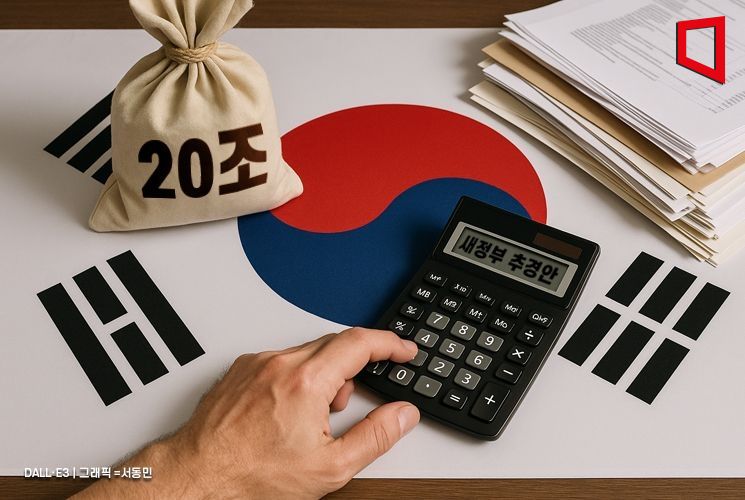
The government is set to soon announce a supplementary budget (extra budget) worth at least 20 trillion won to boost the economy and support the recovery of livelihoods. It is also pursuing a revenue adjustment (revenue revision) plan to realign this year's budget in line with decreased tax revenues.
According to related ministries on June 15, the Ministry of Economy and Finance is preparing a supplementary budget of at least 20 trillion won, which will include livelihood recovery support funds. The size of the second supplementary budget, which had ballooned to 35 trillion won during the June 3 early presidential election period, has now been narrowed to the 20 trillion won range. Even with a 20 trillion won supplementary budget, the total extra budget for this year would amount to 1% of the nominal GDP, qualifying as a large-scale supplementary budget.
President Lee Jaemyung formed an emergency economic monitoring task force immediately after taking office to accelerate the preparation of the second supplementary budget. At a meeting on June 9, he instructed the team to swiftly draw up the extra budget to support economic recovery, stimulate consumption, and assist vulnerable groups and small business owners.
The government is also moving forward with a revenue revision that would reflect lower-than-expected tax revenues in the budget in advance. Revenue revision refers to changing the revenue budget when actual revenues fall short of or exceed the original budget plan. If revenues are lower than initially expected, the government can either reduce its spending plans accordingly or maintain spending levels and cover the shortfall by issuing deficit-financing government bonds.
This year, a tax revenue shortfall is now certain, as actual tax receipts are falling short of last year’s projected revenue budget of 382.4 trillion won, making a revision to the revenue budget unavoidable. There were tax revenue shortfalls of 56.4 trillion won in 2023 and 30.8 trillion won last year, marking two consecutive years of deficits.
The shortfall in tax revenue will be covered by issuing additional government bonds. There are concerns that if the government continues to draw up supplementary budgets and revise revenue downward, the volume of government bond issuance will increase, potentially causing bond yields to surge. Fiscal soundness could also deteriorate further amid chronic deficits.
Ryu Deokhyun, Presidential Secretary for Fiscal Planning, has consistently emphasized the need for revenue revision since his time in the private sector. The scale of revenue revision he proposed was 10 trillion won.
An official from the Ministry of Economy and Finance said, "We are currently compiling the tax revenue results for May, and after reviewing them, we will decide whether a revenue revision is necessary," adding, "Nothing has been decided yet."
© The Asia Business Daily(www.asiae.co.kr). All rights reserved.
![Clutching a Stolen Dior Bag, Saying "I Hate Being Poor but Real"... The Grotesque Con of a "Human Knockoff" [Slate]](https://cwcontent.asiae.co.kr/asiaresize/183/2026021902243444107_1771435474.jpg)
















