Prime Minister nominee Minseok Kim stated on June 13, "Living costs have soared to the point where the suffering of ordinary people is indescribable," adding, "For items with opaque distribution processes, we must enhance the transparency of transactions."
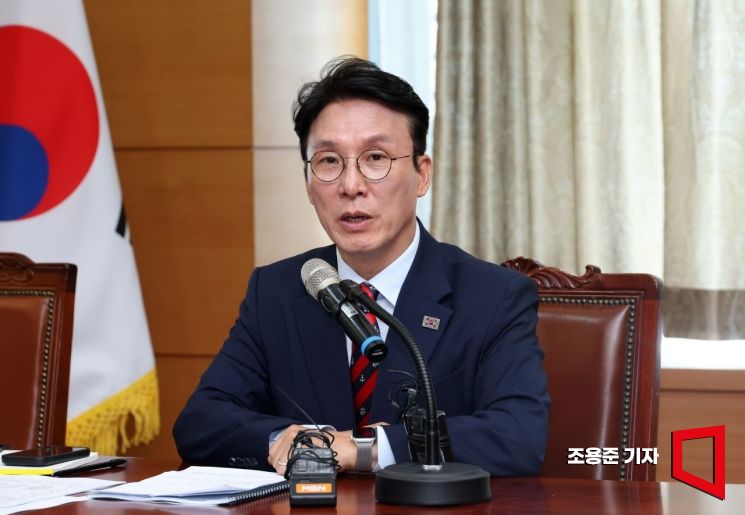 Prime Minister nominee Minseok Kim is speaking at a listening meeting to stabilize meal prices held at the hearing preparation office set up at the Financial Supervisory Service Training Institute in Tongui-dong, Jongno-gu, Seoul on June 13, 2025. Photo by Yongjun Cho
On the morning of the same day, at the Financial Supervisory Service Training Institute in Jongno-gu, Seoul, Kim presided over a roundtable attended by representatives from the food and restaurant industries as well as consumer organizations. He said, "Passing the burden onto the public due to the opacity of transactions is something that must be corrected as we move toward a more rational market," reiterating his stance. The meeting was also attended by Democratic Party lawmakers Byungdeok Min and Seongon Wi.
Kim introduced examples from his tenure as head of the Democratic Research Institute and Policy Committee Chair of the Democratic Party, such as the "1,000-won breakfast for university students" and "five-day-a-week lunch at senior centers." He suggested, "Why not further develop policies that address the quality of life and meals for all citizens, including students, seniors, and workers?"
Addressing the issue of delivery fees, Kim directly criticized the Yoon Suk-yeol administration, stating, "The self-regulation policy of the Yoon government has failed." He added, "Discussions, including legislative measures, have already begun on how to set reasonable limits for delivery brokerage fees, and the government is also closely monitoring the situation."
However, Kim noted, "The era when the government could directly suppress corporate sales prices through price controls, as in the past, is over." He continued, "While we must preserve the autonomy of reasonable market prices, there is still a policy imperative for the government to stabilize prices for ordinary people. Therefore, social dialogue among businesses, the government, and the public is necessary."
Kim further emphasized, "(President Jae-myung Lee)'s ongoing visits to markets and daily attention to the surge in food prices at the beginning of his term are not coincidental," adding, "President Lee dislikes working in a perfunctory manner." He continued, "The Lee Jae-myung administration aims to be a government focused on practicality, results, and the livelihoods of the people?a government that tackles problems intensively and delivers outcomes. As such, I will serve as a 'Prime Minister for the People,' supporting the President in building such a government."
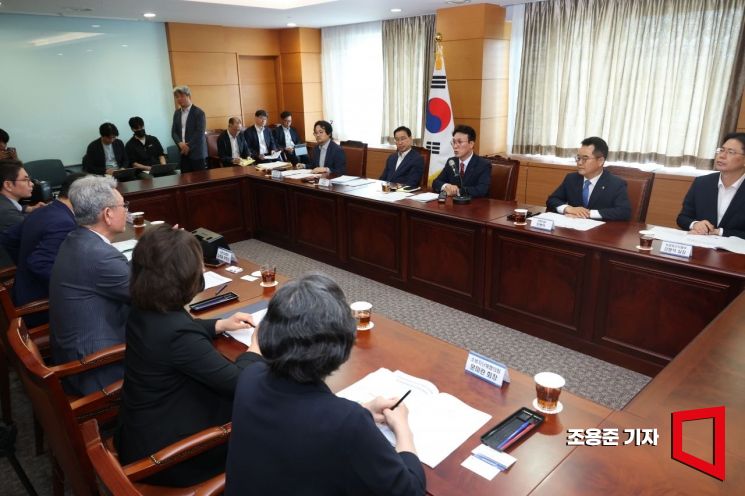 Prime Minister nominee Minseok Kim is speaking at a listening meeting to stabilize meal prices held at the hearing preparation office set up at the Financial Supervisory Service Training Institute in Tongui-dong, Jongno-gu, Seoul on June 13, 2025. Photo by Yongjun Cho
According to an official from the Office for Government Policy Coordination, consumer organizations at the meeting pointed out that while it is true that raw material prices have recently risen, restaurant and food prices have increased by an even greater margin. They stressed the need to improve the distribution structure. Additionally, there were calls for companies to disclose the prices of the foods they produce so that such information is accessible to the public.
Representatives from the food industry explained that due to the "time lag" in the prices of imported raw materials, it is difficult to immediately reflect these changes in food prices. They requested tax support and incentives to help reduce cost burdens. The Korea Foodservice Industry Association identified "delivery fees" as a major factor in the rise of restaurant prices and emphasized that a solution is absolutely necessary. Academia also suggested that continuous government monitoring is required in this area.
After listening to the various opinions, Kim stated, "Meal prices are affected by multiple intertwined factors, making them difficult to resolve easily. Therefore, it is necessary to systematically analyze the data." He added, according to the Office for Government Policy Coordination, "We need to develop a model that uses AI (artificial intelligence) to simulate supply and demand as well as price relationships for agricultural products, in order to find ways to mitigate sharp price fluctuations." He further pointed out, "Consumers should be able to easily access information on food and restaurant prices at a glance and make rational choices on their own, but this is still insufficient."
Kim's team announced that, taking this roundtable as a starting point, they plan to continue holding similar meetings and field visits as part of ongoing efforts to stabilize prices.
© The Asia Business Daily(www.asiae.co.kr). All rights reserved.


















