Defeats Seo Youngkyo, Vows to Lead with Overwhelming Majority
Proposes Two-Track Strategy: Ending Insurrection and Economic Growth
Forecasts of Adjusted Pace Through Cooperative Governance
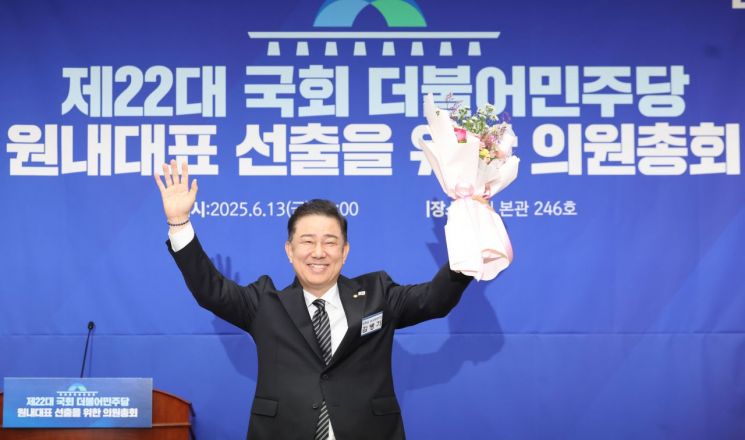
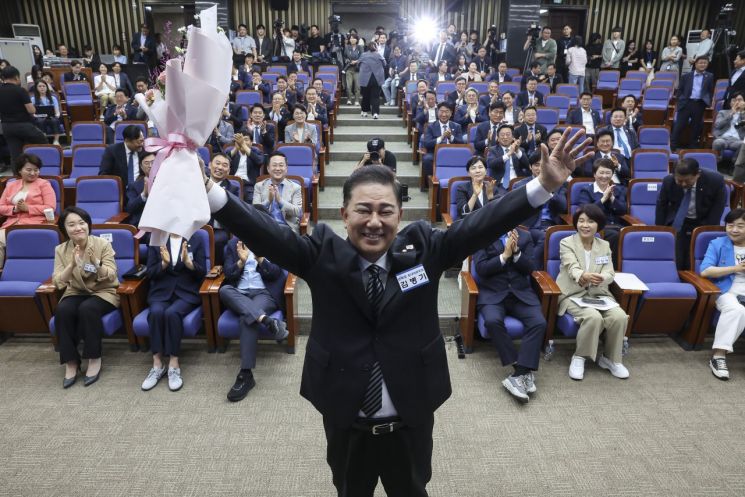
Kim Byungki has been elected as the first floor leader of the ruling party under the Lee Jaemyung administration.
Kim, a three-term lawmaker closely aligned with Lee, won the Democratic Party's floor leader election held after the presidential election, defeating Seo Youngkyo. As the first parliamentary leader of the Lee Jaemyung administration, which was launched without a transition committee, he will take the lead on reform agendas and other key tasks.
On June 13, Kim was officially elected as floor leader based on a combined result of 20% from an online vote by party members with voting rights and 80% from a vote by party lawmakers at the general assembly.
In his acceptance speech, Kim stated, "I will embrace all the good words and unexpected suggestions that Representative Seo offered during the campaign, and I will fulfill my duties as the first floor leader of the ruling party with an overwhelming majority without shame." He continued, "The fact that fellow party members and senior lawmakers have elected me is likely a call to serve as a bridgehead for the success of the Lee Jaemyung administration. I will pursue the end of insurrection and the restoration of constitutional order, as well as the reform of power institutions on one track; the recovery of livelihoods and economic growth on another track; and the rebuilding of the Republic of Korea on yet another track. Together with our five million party members and 167 fellow lawmakers, I will do my utmost to support the success of the Lee Jaemyung administration and dedicate everything to the reconstruction of Korea."
He also pledged, "I promise to help each lawmaker grow as a representative of the people," and added, "I will lay the foundation for livelihood recovery, economic growth, and national unity."
Earlier, in his policy presentation, Kim stated regarding parliamentary operations, "I will make party-government consultative meetings by ministry more substantive," adding, "We will institutionalize monthly meetings between ministers, vice ministers, and lawmakers by each standing committee." He also said, "Through a task force for implementing presidential campaign pledges, we will thoroughly address local issues in each lawmaker's constituency." To support lawmakers' constituency activities, he explained, "Weeks one to three will be designated as National Assembly operation weeks with standing committee plenary sessions, and the fourth week will be focused on constituency activities to allow lawmakers to concentrate on their districts."
To enhance communication between lawmakers and the floor leader, Kim promised, "We will establish a chief communications officer to strengthen communication," and added, "We will hold regular meetings with lawmakers by seniority-first-term, second-term, third-term, and fourth-term or higher-to listen to valuable opinions and advice."
As the first ruling party floor leader under the Lee Jaemyung administration, Kim now faces a political environment completely different from his time in the opposition. He is tasked with the heavy responsibility of leading a stable majority and driving forward various national reform agendas.
The Democratic Party currently holds 167 seats in the National Assembly, making it a major ruling party. Including allied and friendly seats, the ruling bloc controls up to 190 seats, ensuring a stable majority. This means that, as floor leader, Kim has a sufficient environment to pass major bills in plenary sessions if he is determined to do so.
The immediate challenges facing Kim include handling the supplementary budget and addressing a host of contentious legislative issues. In particular, the key reform tasks emphasized by President Lee Jaemyung since his time as party leader-ending insurrection, dismantling vested interests, protecting the socially vulnerable, and transitioning to the era of artificial intelligence (AI)-are central. Additionally, bills that were pushed during the opposition period, such as prosecution reform, the suspension of trial bill, amendments to the Commercial Act, the three broadcasting bills, and the Yellow Envelope Act and Grain Management Act, which were all opposed by the Yoon Sukyeol administration, remain pressing issues.
However, attention is focused on whether Kim, now in a different political position from his time in the opposition, will take a more cautious approach. As the ruling party, there is a fundamental responsibility for state administration. For this reason, there are mixed expectations: some predict a legislative drive for speed, while others expect a focus on dialogue and compromise in line with the president's approval ratings, emphasizing cooperative governance. While the party previously sought to differentiate itself with distinctive bills and policies during its time in opposition, the current situation requires persuasion and dialogue to ensure stable governance under the Lee Jaemyung administration. Regarding the Commercial Act amendment, Kim stated, "We will handle it in consultation," but also said, "We will process it quickly."
In fact, the decision not to address contentious issues such as the suspension of trial bill and the Commercial Act amendment during the tenure of former floor leader Park Chandae, leaving them to the new leadership, is interpreted as a move to adjust the pace.
Um Kyungyoung, head of the Zeitgeist Institute, commented, "In the past, former President Lee Myungbak, who won the presidential election by a landslide, saw his approval ratings vanish in an instant due to controversial appointments from Korea University, Somang Church, and Yeongnam, as well as the mad cow disease crisis. While the end of insurrection should be pursued as a matter of principle, in other areas, the administration is likely to adjust its pace through cooperative governance."
© The Asia Business Daily(www.asiae.co.kr). All rights reserved.

![Clutching a Stolen Dior Bag, Saying "I Hate Being Poor but Real"... The Grotesque Con of a "Human Knockoff" [Slate]](https://cwcontent.asiae.co.kr/asiaresize/183/2026021902243444107_1771435474.jpg)















