Korean Medical Association Stresses Need for Continuous and Specialized Resident Training
Improving Training Quality with "Faculty Specialists" and Evaluating Training Institutions
As a significant number of residents who left their training sites in protest against the Yoon Suk-yeol administration's policy to increase medical school admissions have not yet returned, there are growing calls for the establishment of a "Resident Training Education Institute" (tentative name) that can provide specialized and continuous functions to ensure high-quality training and education.
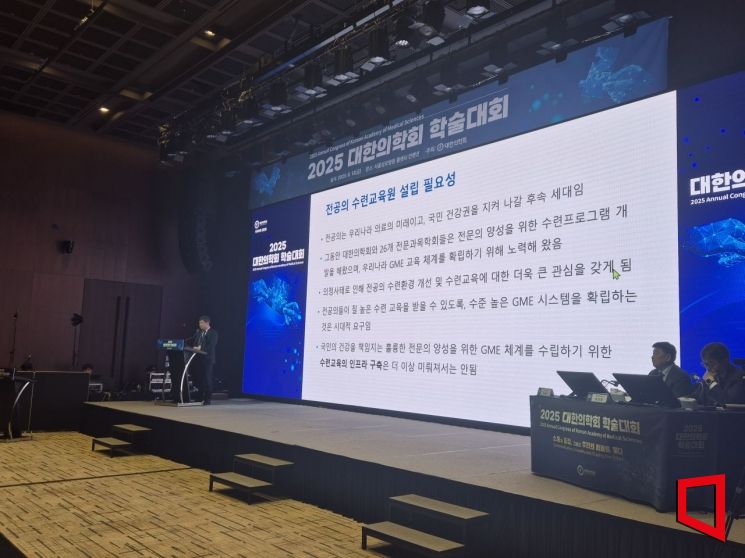 At the '2025 Korean Medical Association Academic Conference' held on the 13th at Plenty Convention in Seocho-gu, Seoul, Yongbeom Park, Training and Education Director of the Korean Medical Association, is explaining the necessity of establishing the Resident Training Evaluation Institute (tentative name). Photo by Taewon Choi
At the "2025 Korean Medical Association Academic Conference" held on the 13th at Seoul St. Mary's Hospital Plenty Convention in Seocho-gu, Seoul, Yongbeom Park, Training and Education Director of the Korean Medical Association, stated, "Due to the recent conflict between the government and the medical community, there is growing public interest in improving the training environment for residents," and emphasized, "It is absolutely necessary to establish a permanent, specialized organizational system to ensure high-quality resident training and education."
Park explained, "Although various academic societies have operated training and education programs, they have lacked continuity, and there have been limitations in accumulating knowledge and experience or deepening expertise. There is a need for an organization that can oversee and standardize fragmented resident training and evaluation, as well as propose directions for standardization. Such an institute could also conduct research on national healthcare policies related to resident training and participate in policy development."
The roles proposed by the Medical Association for the Resident Training Education Institute include: research and development of training curricula, evaluation of training, development of faculty competencies, evaluation and accreditation of training institutions, and educational workshops.
There were also calls for the introduction of a Korean-style "faculty specialist system" to improve the quality of resident training. Sinae Park, a professor at the Catholic University College of Medicine, said, "There is a need for national support for a faculty specialist system that reflects the realities of Korean healthcare," and demanded, "In order to ensure responsible training, specialists who have completed faculty specialist education should be able to dedicate sufficient time to resident education and evaluation."
The Korean-style faculty specialist system proposed by Professor Park is divided into "Chief Faculty Specialists," and under them, "Dedicated Faculty Specialists" and "Training Faculty Specialists." Chief Faculty Specialists are those with more than 10 years of experience as faculty specialists and have completed faculty specialist education provided by academic societies. One Chief Faculty Specialist is assigned for every 20 residents.
Dedicated Faculty Specialists and Training Faculty Specialists are required to allocate a certain minimum amount of time to resident education. Dedicated Faculty Specialists must devote at least 30% of their working hours to resident education and evaluation, in addition to research, academic presentations, and writing papers. Training Faculty Specialists must dedicate at least 10% of their clinical and surgical working hours to resident education.
There were also opinions that not only the evaluation system for residents during their training, but also the evaluation of training institutions themselves, is necessary. Hyunmi Park, a professor at Korea University College of Medicine, pointed out, "In Korea, residents are promoted from first-year to second-year simply by the passage of time, without any significant evaluation," and added, "The only way to check the competencies acquired during these processes is the final board exam."
Jungshin Park, Vice President of the Korean Medical Association, argued, "Until now, even hospitals that did not meet qualification standards have been allocated resident quotas," and insisted, "We must strengthen the accreditation of training programs so that only institutions capable of providing proper training are assigned residents."
© The Asia Business Daily(www.asiae.co.kr). All rights reserved.
![Clutching a Stolen Dior Bag, Saying "I Hate Being Poor but Real"... The Grotesque Con of a "Human Knockoff" [Slate]](https://cwcontent.asiae.co.kr/asiaresize/183/2026021902243444107_1771435474.jpg)
















