You Can Check Laying Environment by Looking Up the Shell Number
Also Consider Egg Grading Based on Weight and Quality
You may have noticed a 10-digit number printed on the shell when purchasing eggs. This is the shell number, which contains information such as the date the egg was laid and the production environment. Although the shell number system has been in place for six years, many consumers are still unfamiliar with the details. If you make good use of the shell number system, you can make smarter choices when buying eggs, which are an affordable and protein-rich essential ingredient.
The shell number system was introduced in 2019. The background was the so-called "pesticide egg" incident. In August 2017, it was revealed that eggs containing the pesticide ingredient fipronil had been distributed from domestic layer farms. At that time, major supermarkets across the country suspended egg sales, and consumer distrust of eggs reached its peak. In response, the government introduced this system to ensure food safety and guarantee consumers' right to know.
In the early days of implementation, different numbers were assigned to the packaging and the eggs themselves. Egg distributors would print a 12-digit egg traceability number containing information such as breed code and processing plant code on the packaging, while a 10-digit number indicating the laying date and rearing environment would be printed on the egg shell. However, as it was pointed out that using two separate numbers was inconvenient for producers and confusing for consumers, the government unified the system to use only the shell number, allowing for tracking of production and distribution history.
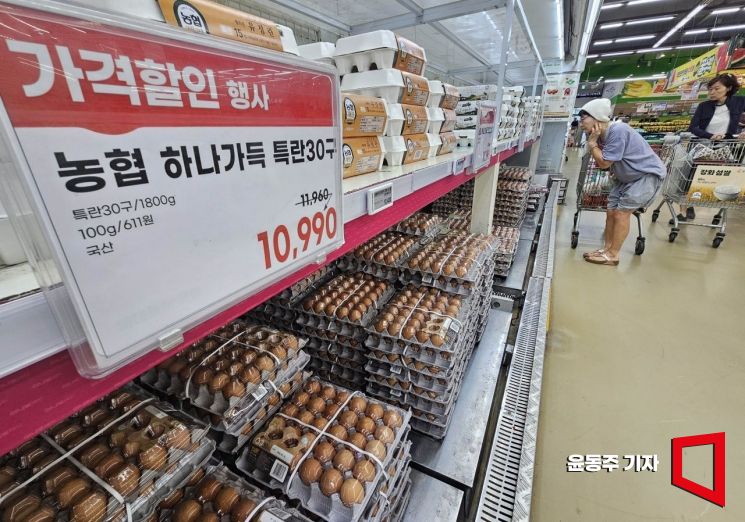 Egg prices have risen by 11.5% compared to last year, with the average price of a carton exceeding 7,000 won, causing a surge in "table prices." The photo shows the egg display at a large supermarket in Seoul on the 10th. Photo by Yoon Dongjoo
The shell number contains information about the laying date, farm, and rearing environment. Egg producers or distributors use edible ink to print the number on the shell. Of the 10 digits, the first four numbers indicate the laying date, the following five letters represent the unique farm code, and the final digit indicates the rearing environment: 1 for free-range, 2 for barn, 3 for cages with at least 0.075 square meters per bird, and 4 for cages with at least 0.05 square meters per bird.
By searching the shell number, you can find more detailed information about the producer. On the Livestock Product Traceability System website operated by the Ministry of Agriculture, Food and Rural Affairs, entering the shell number allows you to check the farm owner, location, as well as the egg packaging and sales company. The number can also be checked on the "Food Safety Korea" website run by the Ministry of Food and Drug Safety.
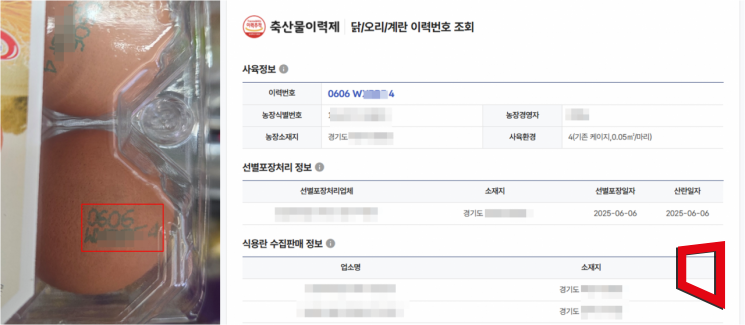 Eggs purchased at a convenience store (left) and the result of searching the shell number in the Livestock Product Traceability System. You can check the farm owner, location, breeding environment, as well as packaging and sales information. Screenshot from the Livestock Product Traceability System website.
Although eggs labeled with a "1" are commonly called "animal welfare eggs," the reality is more complex. While eggs from chickens raised in more spacious environments than narrow cages might be considered to come from better conditions, animal welfare certification can only be obtained by meeting the strict standards of the Animal Welfare Livestock Farm Certification System. Even if chickens are raised and eggs are laid in a free-range environment, they cannot receive animal welfare certification unless all requirements are met.
To obtain animal welfare certification, the farm manager must have knowledge of animal feeding, watering, ventilation, heating, and disease management, and must complete at least four hours of annual training on animal welfare regulations and feeding management methods. In addition, the animals on the farm must be generally active, have glossy feathers, walk energetically, and show vitality in feed and water intake. Furthermore, antibiotics, synthetic antimicrobials, growth promoters, and hormones must not be added to feed or water as veterinary drugs.
When choosing eggs, it is also helpful to refer to the egg grading system. Introduced in 2003, the egg grading system classifies eggs into four grades (1+, 1, 2, 3) based on weight and quality. The weight categories are: extra-large (68g or more), large (60g or more and less than 68g), medium (52g or more and less than 60g), small (44g or more and less than 52g), and very small (less than 44g), for a total of five categories. Quality is evaluated by considering the breed and age of the laying hens at each farm, as well as the strength of the shell and internal freshness.
© The Asia Business Daily(www.asiae.co.kr). All rights reserved.













