World Economic Forum Releases 'Gender Gap Report'
South Korea Drops from 94th to 101st
Widening Gender Inequality in Politics and Economy
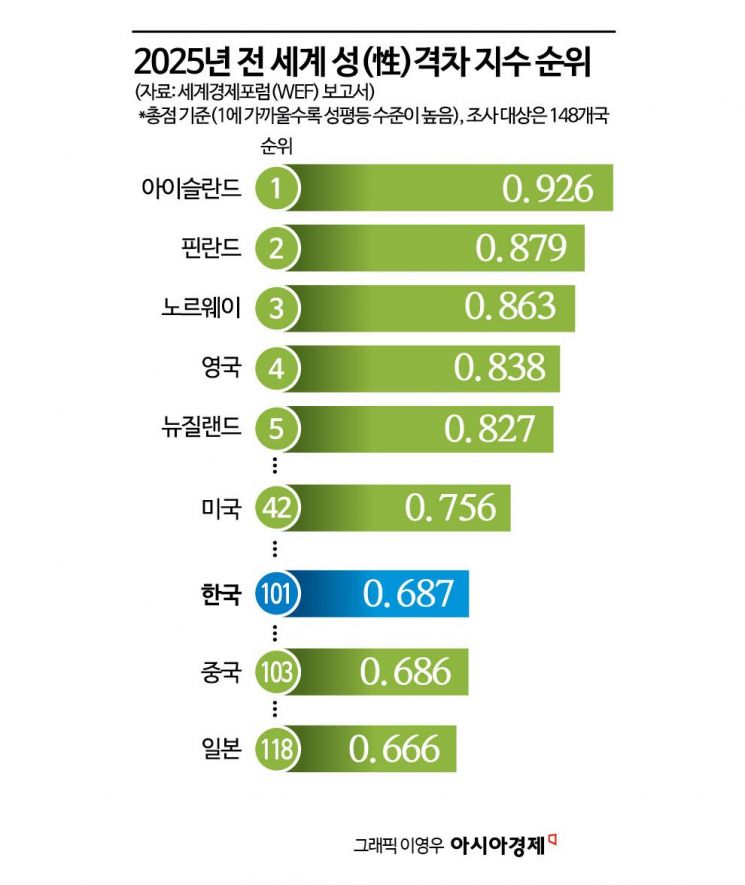
South Korea ranked 101st in the World Economic Forum (WEF)'s annual Gender Gap Report, dropping seven places from last year. While the country saw improvements in education and health, it fell further behind in the economic and political sectors, resulting in a lower overall score.
On June 12 (local time), the WEF released its 2025 Gender Gap Report, which quantifies the level of gender equality achieved in countries around the world. The report analyzes gender gaps in 148 countries across four areas: education, health, politics, and the economy, and assigns a score. A score closer to 1 indicates greater gender equality.
According to the report, South Korea is close to achieving gender equality in education and health, but performs poorly in the economic and political sectors. The economic sector, which is the lowest-ranked, fell two places from 112th last year to 114th this year. While it is positive that women's participation in professional and technical fields is notable and the female labor force participation rate is relatively high, the report finds that gender wage discrimination, estimated female income compared to men, and the proportion of women in senior positions remain unequal.
Looking at individual indicators, the gender wage gap narrowed from 31.24% last year to 29.3% this year, a decrease of 1.94 percentage points. The proportion of women on boards remained the same at 12.8%. The share of women in leadership positions also increased. However, the quality of employment deteriorated for both genders. The unemployment rate rose by 0.05 percentage points for women to 2.76%, and by 0.1 percentage points for men to 2.75% compared to the previous year. In the part-time sector, the proportion of women increased by 7.2 percentage points to 41.01%, while the proportion of men increased by 6.49 percentage points to 24.62%. The share of non-regular workers remained the same as last year, with women (31.03%) outnumbering men (23.58%) by 7.45 percentage points.
In the political sector, South Korea dropped significantly from 72nd last year to 92nd this year. The extremely low proportion of women in the National Assembly and the small number of female ministers were cited as key issues. In fact, Park Geun-hye is the only female president in South Korean history, and Han Myeong-sook, who served as the 37th Prime Minister, is the only female prime minister. However, the WEF assessed that institutional mechanisms for women's political participation, as well as equal access to justice and freedom of movement, are fully equal for both genders.
Compared to the global average (0.688), South Korea's gender equality achievement rate is in the lower ranks. Among the top 10 countries, eight are in Europe, with Iceland ranking first for the 16th consecutive year and remaining the only country to achieve over 90% gender equality. In the East Asia and Pacific region, New Zealand is the only country included in the top ranks. South Korea (101st), China (103rd), and Japan (118th) are all ranked in the lower tier among East Asian countries.
The WEF, which has published this report for 19 years, projects that at the current pace, it will take 123 years to achieve complete gender equality. Saadia Zahidi, a WEF executive director, emphasized in the report, "Gender equality is both a principle and a strategy," adding, "Countries that make the most of their entire human capital are better able to navigate times of change, increase productivity, and accelerate prosperity."
© The Asia Business Daily(www.asiae.co.kr). All rights reserved.


















