Discussion of Business Challenges and Economic Issues Ahead of the G7 Summit... Only 9 Days After Inauguration
President Lee Meets with Heads of Five Major Conglomerates and Key Economic Organizations
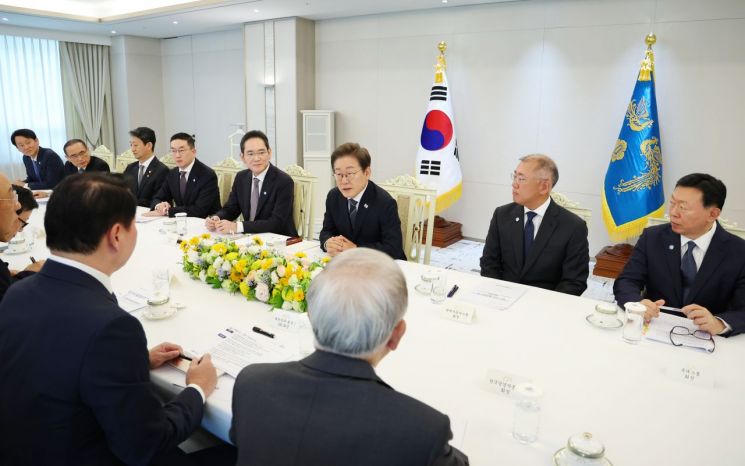 President Lee Jae Myung is holding a meeting with six economic organizations and business leaders at the Presidential Office in Yongsan, Seoul, on the 13th. Photo by Yonhap News
On the 13th, President Lee Jae Myung met with the heads of the five major conglomerates and key economic organizations and stated, "We also intend to focus on rationalizing regulations," adding that he plans to "boldly eliminate unnecessary regulations or those implemented merely for administrative convenience." This meeting took place just nine days after his inauguration, and ahead of his departure for the G7 Summit in Canada scheduled for June 15-17 (local time), where challenges faced by businesses and current economic issues were brought to the discussion table.
In his opening remarks at the meeting held at the Presidential Office in Yongsan, President Lee addressed the business leaders and heads of economic organizations, saying, "You are probably very interested in what the government can do for our companies, and we are committed to doing our utmost for anything that benefits the national economy."
The meeting was attended by Choi Tae Won, Chairman of the Korea Chamber of Commerce and Industry; Ryu Jin, Chairman of the Federation of Korean Industries; Sohn Kyung Shik, Chairman of the Korea Employers Federation; Yoon Jin Sik, Chairman of the Korea International Trade Association; Kim Ki Moon, Chairman of the Korea Federation of SMEs; and Choi Jin Sik, Chairman of the Korea Federation of Middle Market Enterprises. The heads of the five major conglomerates also joined: Lee Jae Yong, Chairman of Samsung Electronics; Choi Tae Won, Chairman of SK Group; Chung Eui Sun, Chairman of Hyundai Motor Group; Koo Kwang Mo, Chairman of LG Group; and Shin Dong Bin, Chairman of Lotte Group.
President Lee stated, "Public safety and security are, of course, the government's fundamental responsibilities, but beyond that, the most important issue is ultimately the livelihoods of our people," adding, "The core of that is the economy, and at the heart of the economy are businesses." He emphasized, "The most important role of the government is to actively support and cooperate so that each company can contribute to economic growth and development and successfully run its business."
On this day, President Lee also shared his thoughts on the issue of unfair competition. He said, "Establishing a fair economic ecosystem is also quite important," and pointed out, "Given the current state of the Korean economy, continued growth is no longer possible through unfair competition, preferential treatment, or any form of exploitation as in the past." He appealed to the business leaders present, "There is still some mistrust. I hope you can help alleviate these doubts."
President Lee further noted, "Companies are currently facing difficulties in international competition," and added, "We intend to focus on minimizing the challenges they face in global competition and on expanding their operational scope through diplomatic and security efforts." He continued, "If you can specify what needs to be done regarding overseas trade situations, we will do our utmost to respond accordingly."
This meeting with the heads of the business world took place just nine days after President Lee's inauguration, which is unusually swift compared to previous progressive presidents. Former President Moon Jae In met with the leaders of major groups 49 days after taking office, while former President Roh Moo Hyun met with the heads of the four major groups three months after his inauguration. Former President Kim Dae Jung also met swiftly with the heads of the four major groups as president-elect, but that was a reflection of the exceptional circumstances of the foreign exchange crisis at the time.
This meeting was arranged for President Lee to request the business community's cooperation with the new administration's policies aimed at revitalizing the stagnant economy. Currently, the Korean economy is facing increasing difficulties externally due to international trade conflicts exacerbated by tariff policies led by U.S. President Donald Trump. Domestically, the economy is experiencing a dual hardship, struggling with a recession and sluggish domestic demand caused by the aftermath of the 12·3 Martial Law incident.
Going forward, President Lee plans to regularize an economic security review meeting (tentative name) involving ministers from economic and security-related ministries and the heads of the four major economic organizations, as outlined in his campaign pledges. This is to enable the public and private sectors to join forces in overcoming U.S. tariff pressures and the global protectionist trend. President Lee also intends to establish a control tower to oversee and coordinate economic security, while setting up a joint public-private response system.
There was also attention on whether President Lee would discuss the Commercial Act amendment with the heads of the business world at this meeting. The government and the ruling party are currently pushing for amendments to the Commercial Act aimed at strengthening oversight of corporate decision-making and enhancing transparency. The main points include codifying directors' fiduciary duties to shareholders, mandating the appointment of a certain proportion of independent directors, expanding separate election of audit committee members, and promoting cumulative voting. The business community is concerned that such amendments could make corporate management more difficult.
However, since this was President Lee's first meeting with the industrial sector, many believed he would avoid mentioning the sensitive topic of the Commercial Act amendment. According to the Presidential Office, the immediate priority is addressing the economic downturn, so the focus is on finding ways to revitalize the economy. Historically, previous presidents have often expressed their intention to support industry and requested investment and hiring, rather than emphasizing regulation, in their initial meetings with the business community. Subsequently, major groups have responded by announcing large-scale investment plans and recruitment drives.
There is also interest in whether the "21st Presidential Election - Proposals from the People and Companies for Future Growth," a set of recommendations compiled by the five major economic organizations and delivered on May 8 during the presidential campaign, will be discussed. The proposal booklet includes 14 agendas across four key areas: driving growth (AI development, regulatory reform, energy, carbon neutrality, entrepreneurship), implanting new industries (new businesses, service industry, scale-up), expanding economic territory (trade, export policy), and securing the foundation for growth (finance, workforce, labor, industrial regeneration).
© The Asia Business Daily(www.asiae.co.kr). All rights reserved.












