First Attempt by a Public Institution, to Be Used for Economic Research and Analysis
"If AI Use Expands to Mobile Devices, New Opportunities Will Arise for Korea's Semiconductor Industry"
The Bank of Korea will introduce its exclusive generative AI platform in the second half of this year. This is the first such attempt among public institutions. The platform will be built by Naver Cloud, which will provide the service based on the Neurocloud for HyperCLOVA X.
On June 12, at the ceremony marking the 75th anniversary of the Bank of Korea held at its annex in Jung-gu, Seoul, Governor Lee Changyong stated, "We are developing AI specialized for the Bank of Korea, based on 'sovereign AI' built by a domestic company. Our goal is to introduce it in the second half of this year." He added, "I hope this project will become a model case of public-private cooperation for the advancement of the domestic AI industry." Lee emphasized, "Our country is one of the few developing sovereign AI based on its own language. If AI utilization expands from centralized large-scale servers to smaller devices such as mobile devices, it could create new opportunities for our semiconductor industry."
The Bank of Korea plans to work with Naver Cloud to train the HyperCLOVA X model using its own data, thereby creating a generative AI model specialized in finance and economics. This model is expected to be widely used for research and analysis on economic issues. A cloud infrastructure will be installed within the Bank of Korea’s data center, and generative AI will be trained within a closed network, fundamentally blocking any external data leakage. The target for launching the service is October.
The Bank is also conducting a 'network improvement pilot project,' moving away from the existing 'network separation policy.' While the network separation policy was deemed necessary for cybersecurity, it has also restricted the use of new technologies. Governor Lee stated, "Cloud computing is essential for the proper utilization of AI technology," and added, "As the Bank of Korea pursues its own AI adoption project, it is also working with the government to conduct the network improvement pilot project."
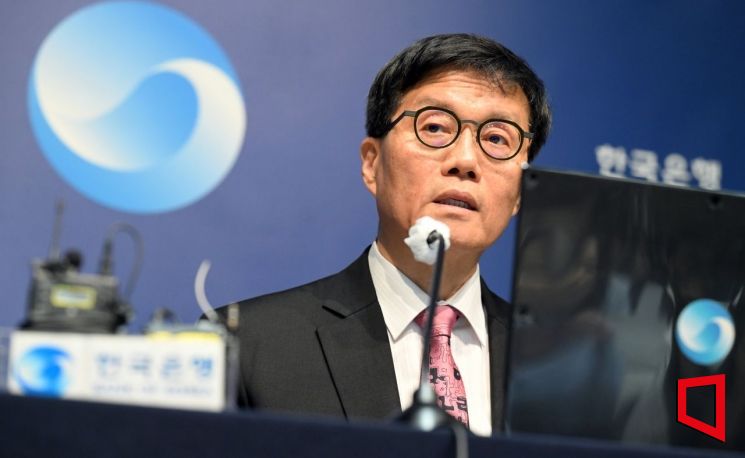
Meanwhile, at the ceremony, Governor Lee once again emphasized the importance of the Bank of Korea’s digital currency (institutional CBDC), which is currently undergoing its first phase of testing. He said, "Although current payment and settlement systems such as credit cards and simple payment services are operating efficiently, we cannot remain complacent with today’s convenience." He continued, "The digital transformation of finance is entering a new phase that requires not just a race for speed, but structural change and connectivity."
He explained, "The Bank for International Settlements (BIS) proposes the 'Finternet' as the future of finance," and added, "This is a system that connects fragmented services such as banking, securities, simple payments, and insurance into a single integrated interface, enabling user-centric real-time financial management." He further stated that in order to implement this, a common digital currency infrastructure connecting all financial institutions is needed, with central bank digital currency and deposit tokens at its core. The Bank of Korea’s digital currency experiment will undergo further testing at the end of this year, after which commercialization will be considered. Through 'Project Agora,' the Bank is also working with major central banks and global financial institutions to build a global digital financial infrastructure that could significantly reduce the cost of cross-border remittances.
Governor Lee stressed the importance of a common payment unit that all participants can trust. He reiterated that institutional measures must be established to ensure that the recently debated 'KRW-denominated stablecoin' does not circumvent foreign exchange market regulations. He stated, "Since KRW-denominated stablecoins have the potential to function as a substitute for legal tender, we will ensure both stability and utility, while also establishing institutional measures to prevent the circumvention of foreign exchange market regulations, and will work closely with relevant authorities."
© The Asia Business Daily(www.asiae.co.kr). All rights reserved.












