'2030 Gwangju Talent Development Strategy Meeting' with 87 Education, Industry, and Public Institutions
Focusing on AI, Digital Technology, Semiconductors, and Cultural Content
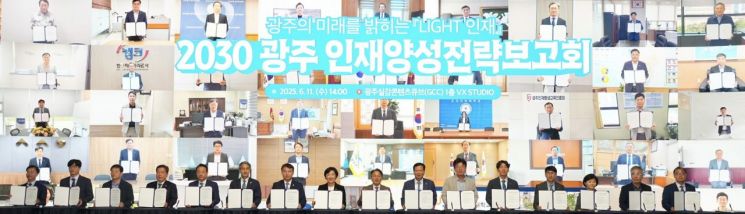 Gwangju Mayor Kang Kijeong attended the '2030 Gwangju Talent Development Strategy Meeting' held at the Gwangju Content Cube (GCC) VX Studio on the 11th. After signing a joint resolution pledging the development of Gwangju through the cultivation of 810,000 talents, he is taking a commemorative photo. Photo by Gwangju City
The city of Gwangju is launching a project to cultivate 810,000 talents by 2030, focusing on developing industrial technology professionals for strategic industries such as artificial intelligence (AI), digital technology, semiconductors, and cultural content, as well as talents to form the foundation for future education.
On June 11, Gwangju City held the '2030 Gwangju Talent Development Strategy Meeting' at the Gwangju Content Cube (GCC) VX Studio, in collaboration with 87 organizations and institutions from the education sector, economic associations, industry, and public agencies.
Through this meeting, the city presented a vision of advancing together with local talent and aims to use the occasion to inspire confidence in companies that they can grow alongside Gwangju, thereby attracting investment.
Approximately 250 participants from 87 organizations and institutions attended the meeting, including local universities such as Chonnam National University, Chosun University, Gwangju University, Honam University, and GIST; educational institutions such as vocational high schools and Gwangju Human Resources Development Institute; economic organizations like the Gwangju Employers Federation, Gwangju-Jeonnam Venture Business Association, and Gwangju Industry-Academia-Research Council; financial public institutions such as the Korea Asset Management Corporation Gwangju-Jeonnam Branch, Bank of Korea Gwangju-Jeonnam Branch, Financial Supervisory Service Gwangju-Jeonnam Office, and Korea Technology Finance Corporation Honam Regional Headquarters; central government agencies such as the Gwangju Regional Small and Medium Business Administration and Gwangju Regional Labor Office; local government agencies including Gwangju City, district offices, the city council, and the office of education; and representatives from industry.
Under the vision of "LIGHT Talent Development to Brighten Gwangju's Future," the city set a goal of cultivating a total of 810,000 talents by 2030, including 350,000 industrial technology professionals to lead strategic industries such as AI, digital technology, semiconductors, and cultural content, and 460,000 talents to expand the foundation of a future education city.
The city plans to establish a solid talent development ladder, spanning from early childhood, elementary, middle, and high schools to universities, graduate schools, and practical professional training. It also aims to create an education-industry cooperation ecosystem linked to regional core strategic industries such as AI, digital technology, semiconductors, and cultural content.
Additionally, the city will build a platform to resolve talent-company workforce mismatches and plans to enhance customized practical skills by reflecting feedback from the field. The city will also expand recruitment-type internship programs that supply talent to startups with technological capabilities and growth potential but insufficient capital, making immediate full-time hiring difficult.
The city plans to strengthen the governance system among government, industry, academia, and research sectors, and will promote "Matching Day," a pilot project to realize a virtuous cycle in which talents learn, start businesses, and settle in Gwangju.
Mayor Kang Kijeong stated, "In the past, companies would say, 'Who would go all the way to Gwangju to cultivate talent?' But now, companies say, 'We go to Gwangju because of the talent.' Over 300 AI companies have chosen Gwangju. While infrastructure such as the National AI Data Center is one reason companies choose Gwangju, they unanimously agree that the greatest attraction is the talent pool."
Mayor Kang further emphasized, "Ultimately, we must nurture talent to make Gwangju even more prosperous. Talent is our strength. We need to ensure that young people no longer leave Gwangju due to a lack of jobs, and that more companies come to Gwangju in search of talent."
During the meeting, representatives from ten educational institutions, companies, and student bodies?including Go Mia, CEO of Witches Co., Kim Changsu, CEO of Aimfuture Co., Yoon Heejin, team leader at ASICLAND, Lee Seongwan, CEO of Ghostpass, Kim Suhyeong, head of the AI Industry Complex at Chonnam National University, Son Yuncheol, professor of Semiconductor Convergence at Chosun University, Kim Seongcheol, group leader at Gwangju Human Resources Development Institute, Kim Daedeul, vice principal of Gwangju Meister High School, Park Seongjin, GCC Academy trainee, and Song Jayeon, CEO of Neulbom Mind (graduate of AI Academy)?shared their efforts in talent cultivation and vivid voices from the business field via video messages.
Meanwhile, at the meeting, Jeong Jepyeong, director of the Industry-Academia Cooperation Foundation at Honam University, Seon Mijeong, head of the University Policy Team at Gwangju City, and Seo Hyeongseop, director of the Gwangju Employers Federation, read a "Joint Resolution" pledging Gwangju's development through the cultivation of 810,000 talents, focusing on ▲ fostering outstanding talent ▲ local settlement through job creation ▲ building a sustainable talent development ecosystem. Representatives from 17 organizations and groups signed the resolution.
© The Asia Business Daily(www.asiae.co.kr). All rights reserved.












