Strict Punishment for Stock Price Manipulation and Use of Undisclosed Information...
President Lee: "We Must at Least Restore Normalcy"
"Even Long-Term Investment in Blue-Chip Stocks Is Difficult...
Stock Investment Should Become a Viable Alternative to Real Estate"
On June 11, President Lee Jaemyung visited the Market Surveillance Committee of the Korea Exchange for the first time since taking office to discuss measures to eradicate unfair trading in the stock market and to advance the stock market. President Lee had previously pledged to usher in the "KOSPI 5000 era," vowing to strictly punish stock price manipulation and the use of undisclosed information.
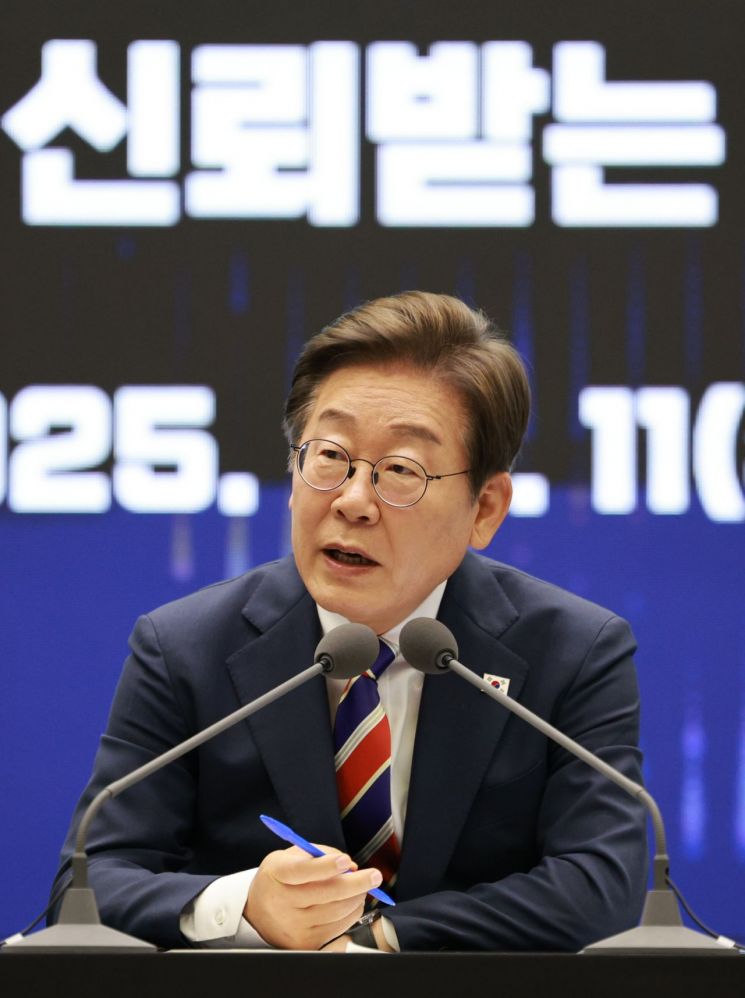
During his opening remarks at the Korea Exchange in Yeouido, Seoul, President Lee stated, "The stock market is the core of a capitalist market economy," adding, "The Korean stock market is extremely unfair and opaque, and when other countries look at it, they wonder how anyone could trust such a market." He continued, "The most important task is to resolve, or at least alleviate, the unfairness and opacity of the market," and suggested, "Even if we can't reach a premium level, let's at least discuss how we can bring the market back to normalcy."
In his closing remarks, President Lee further emphasized, "It has now become difficult to even make long-term investments in blue-chip stocks," and added, "I couldn't bring myself to recommend investing in the Korean stock market to people around me. We need to change everything and create a market that is worth investing in and will be favorable in the long run."
He also revealed that tax reforms or system changes are being prepared to improve the stingy dividend environment. President Lee pointed out that Korea pays fewer dividends than China, saying, "In other countries, people buy blue-chip stocks, receive interim dividends, and use them for living expenses, which also helps domestic demand and contributes to a virtuous economic cycle. However, in Korea, dividends are not paid." He continued, "We are preparing tax reforms or system changes to promote dividends."
President Lee went on to say, "I understand that Lee Soyoung, a lawmaker from the Democratic Party, has proposed a bill to lower the dividend income tax only in cases where the payout ratio exceeds 35%. In any case, including such measures, if companies pay proper dividends without causing significant damage to the tax base, it would be better to lower taxes and encourage more dividend payments." He added that he intends to explore many possible options.
President Lee also stated, "If we can make stock investment a viable alternative to real estate, allowing people to receive interim dividends and cover living expenses, it will make it easier for companies to raise capital, and the entire Korean economy could benefit from a virtuous cycle. The securities market is at the core of this."
This visit by President Lee to the Market Surveillance Committee of the Korea Exchange is seen as an effort to demonstrate a firm stance against recent disruptive activities in the financial markets and a commitment to restoring fairness in the capital market. In particular, the visit focused on reviewing three main principles: eradicating unfair trading, restoring market order, and protecting financial investors. It also served as an opportunity to inspect the market surveillance system that monitors and detects distortions in the capital market.
Since his presidential candidacy, President Lee has consistently expressed a strong commitment to creating a fair market. In April, he stated on his social media that he would introduce a "one-strike-out" system, under which anyone involved in stock price manipulation would be permanently banned from the stock market. To this end, he pledged to strengthen the recovery of short-term trading profits, enhance preemptive monitoring of unfair trading, and establish a system for strict punishment of financial crimes, including unfair practices using undisclosed information by executives and major shareholders. He has repeatedly declared his intention to usher in the "KOSPI 5000" era, stressing the need for an advanced stock market where Korean citizens can properly grow their assets. This reflects his determination to resolve the so-called Korea Discount (undervaluation).
President Lee has also emphasized that he himself is a capital market investor, not just in words or pledges. He has revealed that his first stock purchase, at the recommendation of a friend from a securities company, was a speculative stock, and that he once "invested all in small-cap stocks." At the end of May, he appeared on YouTube to directly show himself purchasing KOSPI200 and KOSDAQ150 exchange-traded funds (ETFs).
In November last year, when he was the leader of the Democratic Party, President Lee also visited the Korea Exchange to explain the need for amendments to the Commercial Act, including expanding the fiduciary duty of corporate directors. This latest visit is interpreted as more than just a gesture of encouragement; it signals possible reforms to the financial supervisory system, swift legislative responses, and improvements to restore investor confidence.
The President's decision to specifically visit the Market Surveillance Committee of the Korea Exchange may also influence future discussions on enhancing the independence and transparency of capital market oversight. The Market Surveillance Committee is an independent body dedicated to reducing information asymmetry between listed companies and investors, and to monitoring and detecting unfair trading. As a quasi-judicial surveillance organization within the exchange, it notifies financial authorities when it detects suspected violations of capital market law and, if necessary, can even request investigations by the prosecution.
© The Asia Business Daily(www.asiae.co.kr). All rights reserved.