White House AI and Virtual Asset Chief Speaks at AWS Summit
"Mistaken Belief That the U.S. Is Ahead of China"
Emphasizes Crisis... Calls for Removing Barriers to AI Innovation
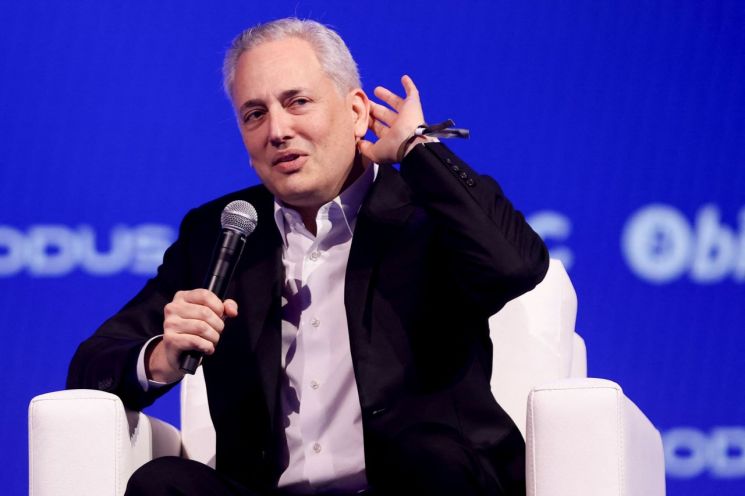 David Sax spoke at the 'Bitcoin Conference' held in Las Vegas, Nevada on the 27th of last month (local time). Photo by AFP Yonhap News
The White House and Huawei, which is considered a symbol of China's information technology (IT) industry, expressed differing views regarding the technological gap in artificial intelligence (AI) between the United States and China. While Huawei stated that the technological gap between the two countries spans an entire generation, the White House emphasized a sense of crisis, asserting that the difference is only about three to six months.
David Sax, who oversees AI and virtual asset policy under the Donald Trump administration, said at the AWS Summit held in Washington, D.C. on the 10th (local time), "About a year ago, there was a mistaken belief that the United States could do anything it wanted, that we could regulate the world if we wished, and that we were so far ahead of China that China could never catch up."
He continued, "However, in January, there was a 'DeepSeek moment' in China (referring to the AI startup), which revealed that this belief was wrong. The gap between the United States and China in AI is not a matter of years. It may be only three to six months. The competition is extremely fierce," he added.
He also said, "There is a lot of talent in China. For example, half of the world's AI researchers are Chinese. While China is behind in chips, Huawei will undoubtedly do everything it can to catch up," emphasizing, "We must take this threat seriously."
Regarding the AI race, he stated that if, within the next five years, American AI chips account for 80% of the market, the United States will have won; but if Huawei accounts for 80%, "that would mean the United States has lost," adding, "We must not let that happen."
Sax also stressed that, as China has made significant progress in AI models, it is urgent for the United States to remove obstacles to AI innovation.
This approach shows a significant difference in perspective from China. Previously, Ren Zhengfei, founder and CEO of Huawei, China's largest telecommunications equipment company, commented on the company's AI chip 'Ascend,' stating that the United States is exaggerating its achievements and that "Huawei's chips are still a generation behind those of the United States."
In an interview with People's Daily, the official newspaper of the Communist Party of China, CEO Ren responded to a question about the impact of U.S. export controls on the Ascend chip, saying, "There are many companies in China that make chips, and many of them are doing well. Huawei is just one of them," and "The United States has exaggerated Huawei's achievements."
He further emphasized, "Huawei is not that great yet, and we must work hard to reach their evaluation," adding, "Our single chip is still a generation behind those of the United States."
CEO Ren's remarks are closely related to the U.S. government's recent move to strengthen export restrictions, prohibiting all countries from using Huawei's Ascend chips. Since 2019, after U.S. sanctions made it difficult for Huawei to acquire advanced semiconductor technology from abroad, the company has been striving to strengthen its own semiconductor capabilities.
© The Asia Business Daily(www.asiae.co.kr). All rights reserved.












