From Simple Logistics to a "Global Integrated Logistics" Hub
Zone Port Hinterland Complex Drives Industrial Paradigm Shift
FEZ Authority Takes On Regulatory Barriers to Manufacturing
The Busanjin-Hae Economic Free Zone has announced a strategy to transform its port hinterland complex from a simple logistics hub into a "global coffee hub." By focusing on regulatory innovation and attracting investment as its two main pillars, the zone is accelerating its transition to a high value-added industrial ecosystem.
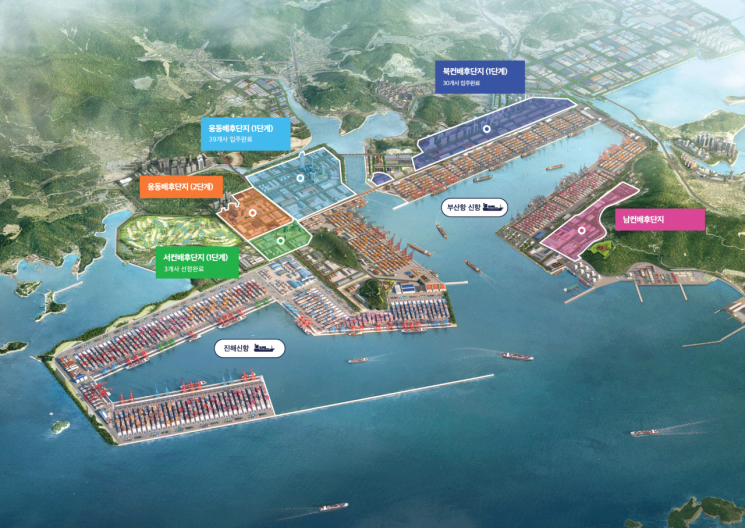
The Free Economic Zone Authority is currently developing five hinterland complexes centered around the Busan New Port?Ungdong, North Container, West Container, South Container, and New Port Hinterland?covering a total area of 9.7 million square meters.
Among these, the first phase of the Ungdong Hinterland Complex and the first phase of the North Container Hinterland Complex are already in operation, with 39 and 30 companies, respectively. The selection of tenants for the first phase of the West Container Hinterland Complex has been completed, with operations scheduled to begin in the second half of 2026. The second phase of Ungdong is 58% complete and is expected to be finished by March 2027. The South Container Hinterland Complex is set to begin leasing announcements next year.
Although development of the hinterland complexes is progressing smoothly, various regulations have hindered the advancement of the industry. This is why, despite excellent location and infrastructure, corporate investment has been slow. In response, the Free Economic Zone Authority has started to address issues such as building height restrictions and limits on leasable area.
Initially, the first phase of the Ungdong Hinterland Complex had a building height limit of 40 meters and a maximum leasable area of 150,000 square meters per company. These restrictions made it difficult to construct large-scale automated logistics facilities. After discussions with the Office for Government Policy Coordination, the Ministry of Economy and Finance, the Ministry of Oceans and Fisheries, and the Ministry of Trade, Industry and Energy, the authority succeeded in securing a relaxation of the height restriction (from 40 meters to 60 meters) and the removal of the leasable area limit.
Following these measures, Mitsui Soko Korea, a Japanese logistics company, decided to increase its investment by 48.2 billion won. Existing one- to two-story warehouses are now being replaced by high-density logistics centers with four or more stories. This has improved land utilization and increased logistics throughput.
Improvements to customs regulations have also been pursued. Although Busan Port handles 94% of green coffee bean imports, high tariffs on coffee products processed in the port hinterland complex had entrenched a structure in which manufacturing and distribution were concentrated in the Seoul metropolitan area.
The Free Economic Zone Authority, in cooperation with customs authorities, has introduced a "raw material taxation" system. Previously, taxes were levied on finished products, but now they are imposed only on raw materials, reducing the customs burden on companies. Since the Korea Customs Service institutionalized this change in March, manufacturers in the free trade zone can now choose the more favorable taxation method between raw materials and finished products.
The authority believes that such regulatory innovations will transform the role of the port hinterland complex from a simple logistics hub into a multi-functional manufacturing and export base. Starting with the coffee industry, it also sees the potential to create diverse coffee clusters, including roasting, packaging, and startup incubation.
Park Sungho, head of the Busanjin-Hae Free Economic Zone Authority, said, "The Busanjin-Hae Economic Free Zone is a rare location worldwide that encompasses a mega port," adding, "The future of this zone depends on how quickly regulations can be improved."
Park emphasized, "The current changes are not just about building factories, but about transforming the industrial structure," and pledged to accelerate institutional reforms.
© The Asia Business Daily(www.asiae.co.kr). All rights reserved.











