Employment Rate Hits Record High Since May Statistics Began
Female Employment Rate Also Reaches All-Time High at 63.5%
Number of Employed Aged 15 and Over Increases by 245,000
Largest Growth Since April Last Year
Manufacturing Sees 11th Consecutive Month of Job Losses
Accommodation and Food Services Turn to Decline After 15 Months
Last month, the employment rate exceeded 70%, marking the highest level since related statistics began being compiled. While employment rates rose across most age groups, the increase in the employment rate among women was particularly notable. However, due to the sluggish economy, the decline in employment in manufacturing and construction continued. In particular, the construction industry saw its number of employed persons decrease for the 13th consecutive month, setting the record for the longest decline since related statistics began.
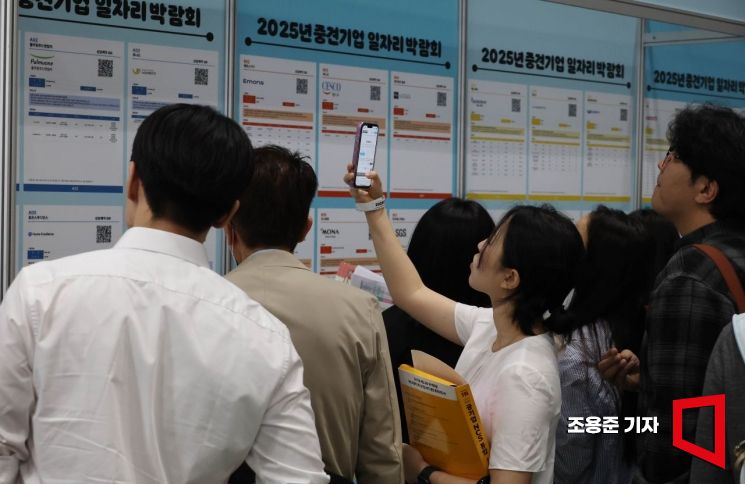 Job seekers visiting the 2025 Mid-sized Companies Job Fair held at COEX in Gangnam-gu, Seoul on the 23rd are looking at the recruitment notice board. 2025.4.23 Photo by Cho Yongjun
According to the "May 2025 Employment Trends" released by Statistics Korea on June 11, the employment rate for those aged 15 to 64 last month was 70.5%, up 0.5 percentage points from the same month last year. This is the highest figure since related statistics began being compiled in January 1989. Except for the youth aged 15 to 29 (46.2%), who are experiencing difficulties finding jobs, and those in their 50s (77.6%), who were affected by the slowdown in employment in construction, agriculture, forestry and fisheries, and accommodation and food services?with decreases of 0.7 percentage points and 0.5 percentage points, respectively?the employment rate rose across all age groups.
In particular, while the male employment rate (77.2%) remained steady, the female employment rate rose by 1.0 percentage point to 63.5%, the highest since statistics began being compiled. Notably, the employment rate among women in their 30s (73.8%) and 40s (69.0%), age groups that are highly economically active, increased by 2.7 percentage points and 1.9 percentage points, respectively. Gong Misuk, Director General of Social Statistics at Statistics Korea, explained, "The employment rate is affected by seasonal factors, tending to be lower in winter and higher as summer approaches."
The number of employed persons aged 15 and over was 29.16 million, an increase of 245,000. This is the largest increase in 13 months since April last year (261,000). The number of employed persons had been rising by around 100,000 from January (135,000) to April (194,000) this year, but last month, for the first time, the increase surpassed 200,000. The low increase in May last year (80,000) served as a base effect. In addition, the continued growth in health and social welfare services, as well as a narrowing of the decline in employment in manufacturing and construction, contributed to the increase.
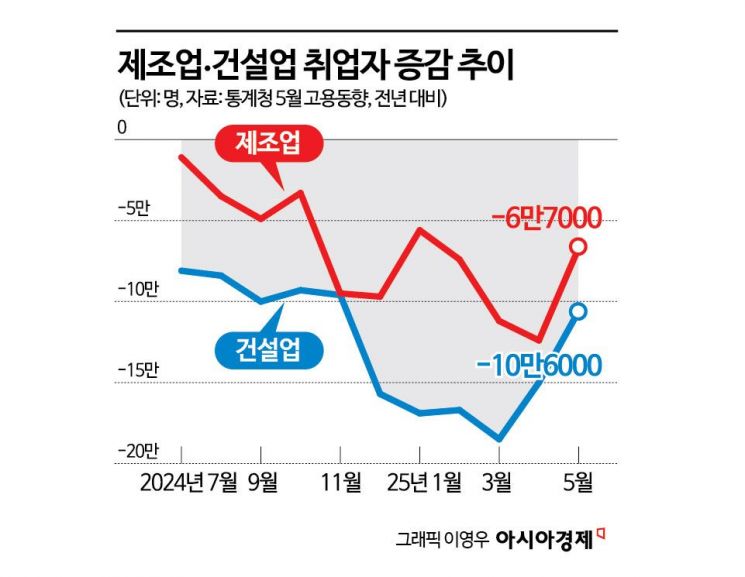
By industry, the number of employed persons increased mainly in health and social welfare services (233,000), professional, scientific and technical services (117,000), and finance and insurance (72,000). However, employment in construction (-106,000) and manufacturing (-67,000) declined. Although the declines were smaller than the previous month, the base effect played a significant role. Employment also decreased in agriculture, forestry and fisheries (-135,000), and accommodation and food services (-67,000).
Notably, the construction industry saw employment decline for the 13th consecutive month, marking the longest period of decline since the implementation of the 11th industrial classification in January 2013. Manufacturing also continued its decline for the 11th straight month. In agriculture, forestry and fisheries, abnormal weather delayed rice planting, resulting in a decrease of over 100,000 employed persons for the second consecutive month. Employment in accommodation and food services turned to a decrease for the first time in 15 months, with the largest drop since November 2021 (-86,000).
Jang Juseong, Director of Workforce Policy at the Ministry of Economy and Finance, stated, "Considering leading indicators such as construction orders and apartment occupancy volume, the decline in construction employment is expected to continue into the third quarter." However, he added, "Construction orders have been gradually increasing over the past two years, but the time lag between construction orders and construction output is becoming slightly longer than the previous 1.5 to 2 years, so we need to monitor whether employment will improve as a trend."
By age group, the number of employed persons aged 60 and over (370,000) and in their 30s (132,000) increased due to population growth. In particular, the number of employed persons aged 60 and over reached 7,049,000, the highest since related statistics began being compiled in July 1982. In contrast, employment decreased among those in their 20s (-124,000), 50s (-68,000), and 40s (-39,000). Among the youth aged 15 to 29, the number of employed persons decreased by 150,000.
The number of unemployed persons aged 15 and over was 853,000, a decrease of 32,000. The unemployment rate fell by 0.2 percentage points to 2.8%. The decrease in the unemployment rate among those in their 30s (-0.3 percentage points) and those aged 60 and over (-0.2 percentage points) contributed to this result. The youth unemployment rate fell by 0.1 percentage point to 6.6%. The economically active population, which is the sum of employed and unemployed persons, reached 30,012,000, the highest since related statistics began being compiled in June 1999, due to the effect of population growth.
Among the economically inactive population (15,722,000), the number of people "taking a break" was 2,390,000, an increase of 56,000. The number of youth "taking a break" fell by 3,000 to 396,000, dropping below 400,000. On the other hand, due to population growth, the number of people aged 60 and over "taking a break" increased by 61,000 to 1,067,000.
The government plans to respond to the continued sluggish employment in manufacturing and construction, as well as persistent difficulties among the youth, amid weak domestic demand and expanding external risks. The government will promptly prepare a supplementary budget to support economic recovery and boost consumption, and will focus on fostering next-generation high-tech industries to expand the capacity for creating quality private sector jobs. In addition, the government will promote relevant job programs to support employment stability for vulnerable groups such as youth, and assist unemployed and inactive youth.
© The Asia Business Daily(www.asiae.co.kr). All rights reserved.













