Strategic Approach Needed...
Urgent Policy Support Required
The adoption of artificial intelligence (AI) technology in South Korea's mobility industry is accelerating, but the sector is reportedly facing difficulties due to a shortage of AI professionals and insufficient data.
On June 11, EY Korea announced that it had conducted a survey last month of 189 employees from domestic mobility companies during the '5th EY Korea Mobility Conference,' revealing these findings.
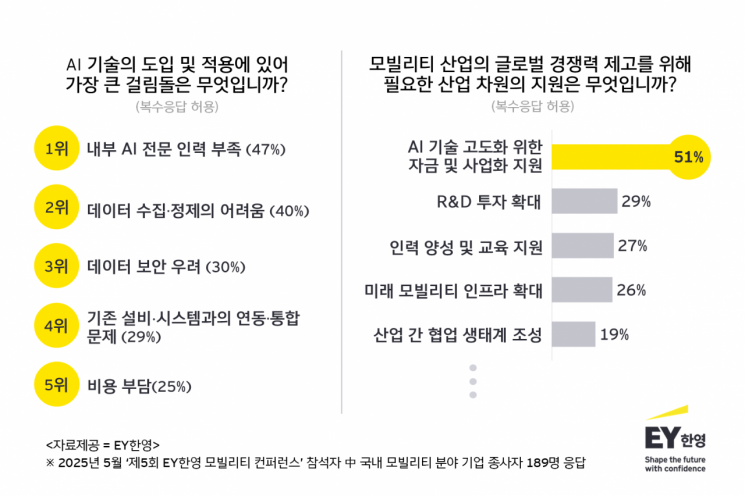
According to the survey, while there is a strong intention to utilize AI, companies are struggling to secure human resources capable of effectively operating the technology and to strengthen their data capabilities. Forty-seven percent of respondents cited a 'lack of internal AI professionals' as a key barrier to the adoption and application of AI technology. Other major obstacles identified included difficulties in data collection and refinement (40%), concerns about data security (30%), issues with integration and interoperability with existing facilities and systems (29%), and cost burdens (25%).
When asked which area is expected to experience the most significant change as AI technology spreads in the future, 43% of respondents pointed to autonomous driving. This was followed by mobility service platforms such as Mobility-as-a-Service (MaaS) and shared mobility (41%), smart logistics (38%), and user experience (UX) including infotainment systems (29%). There is growing anticipation that AI applications will expand beyond hardware-centric technologies to encompass service enhancement and the overall consumer experience.
AI is now spreading beyond the technology development stage to cover the entire product lifecycle and all customer touchpoints. Among survey respondents, 44% said they had adopted or were planning to adopt AI in 'development and design.' Other areas mentioned included production and process automation (29%), quality control (QC) (22%), products and services (18%), and customer service (CS) as well as sales and marketing (17%).
As for corporate AI adoption strategies, 'technology partnerships through alliances' (30%) was the most preferred approach. This was followed by 'in-house development through securing internal talent' (26%), 'outsourcing' (17%), and 'mergers and acquisitions of AI companies' (12%).
It is interpreted that, in a rapidly changing technological environment, companies are pursuing strategies that combine external collaboration for quick technology acquisition with a mid- to long-term focus on internalizing AI capabilities.
Many respondents also called for urgent policy support for the mobility industry. Over half of respondents (51%) said that 'funding and commercialization support for the advancement of AI technology' at the industry level is needed to strengthen global competitiveness. Other forms of support requested included increased investment in research and development (R&D) (29%), workforce training and education support (27%), and expansion of future mobility infrastructure (26%).
Youngdae Kwon, head of industry research and mobility sector leader at EY Korea, emphasized, "As AI transformation (AX) accelerates across the industry, successful transition will require the organic interplay of professional workforce development, expanded technology partnerships, and systematic government policy support."
© The Asia Business Daily(www.asiae.co.kr). All rights reserved.