Ministry of Health and Welfare Releases 2024 Survey Results
Homeless Population Continues to Decline, but Aging and Metropolitan Concentration Persist
Job Loss Remains the Leading Cause of Homelessness
Although the number of homeless people has been steadily decreasing, the concentration of street homeless individuals in the Seoul metropolitan area and the aging trend among facility-based homeless people continue. In addition, about half of all homeless people live in the metropolitan area, and job loss was found to be the most common reason for homelessness.
The Ministry of Health and Welfare announced the results of the 2024 survey on the actual conditions of the homeless and related groups on June 10. This survey, conducted in accordance with the Act on Welfare and Self-Reliance Support for the Homeless, marks its third iteration following previous surveys in 2016 and 2021. The survey targeted street homeless individuals, facility-based homeless people residing in self-support, rehabilitation, and care facilities, as well as residents of jjokbang (tiny room) housing.
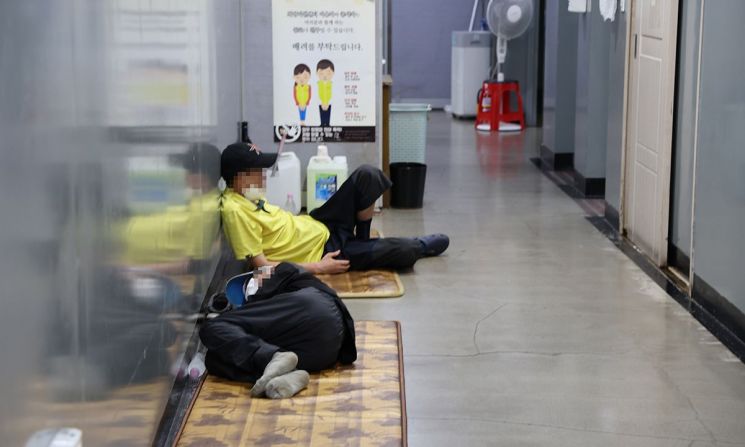 Homeless people and others are resting lying down in the hallway at Seoul Station Hope Support Center. Photo by Yonhap News
According to the survey released on this day, the number of homeless people in South Korea last year decreased by 1,679 compared to 2021 (14,404 people). Among all homeless people, those residing in facilities accounted for the largest proportion at 6,659, followed by jjokbang residents (4,717) and street homeless individuals (1,349). All categories showed a decrease compared to the previous survey.
When analyzing the age distribution of facility-based homeless people, the proportion of residents aged 65 and older in all homeless living facilities was 36.8%, an increase of 4.1 percentage points compared to 2021, indicating a worsening aging trend. In particular, among homeless care facilities, 46.6% of residents were aged 65 or older, nearly half. Among jjokbang residents, 40.8% were 65 or older.
Of the homeless and related groups, 77.6% (9,865 people) were male, while 22.4% (2,851 people) were female. In terms of regional distribution, 52.1% (6,636 people) were located in the Seoul metropolitan area, and especially among street homeless individuals, 75.7% were in the metropolitan area.
For street homeless people, the most frequently cited reason for becoming homeless was job loss (35.8%). This was followed by divorce or family breakdown (12.6%) and business failure (11.2%). Notably, the response rate for 'divorce or family breakdown' increased by 3.7 percentage points compared to the survey three years ago (8.9%).
The most common reason for not using welfare facilities such as self-support centers was "because of group living and rules" (36.8%). Other major reasons included "feeling stifled indoors" (16.6%), "not knowing much about the facilities" (14.2%), and "conflicts with other residents" (11.5%).
Among street homeless people, 4% reported experiencing assault or abuse, 3.2% had property extorted, and 2.9% experienced identity theft or fraud. In addition, 26.6% of homeless people had debts, and 71.3% were classified as credit delinquents (with overdue financial obligations).
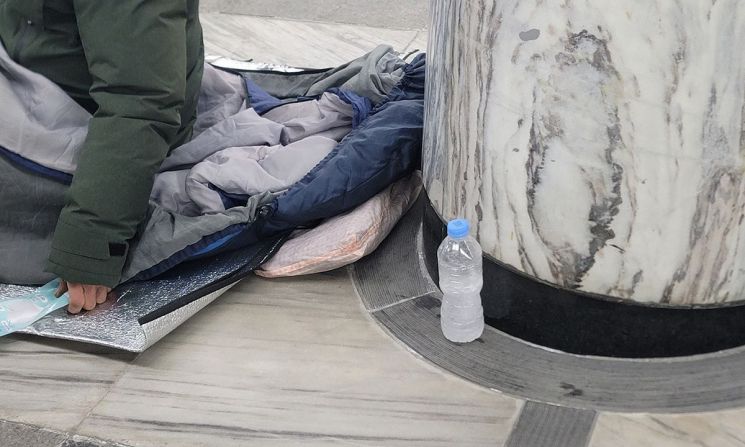 Water in a plastic bottle next to a homeless person located in an underground walkway in Jongno-gu, Seoul, is frozen solid. Photo by Yonhap News
A total of 75.3% of all homeless people were unemployed. Of these, 56.9% stated they were unable to work. The main sources of income were public assistance (47.8%) and public work programs (37.6%). Over the past year, the average monthly income was 794,000 won for street homeless people and 505,000 won for facility-based homeless people. Regarding expenditures over the past three months, 39.1% was spent on food, 18.8% on alcohol and tobacco, and 13.4% on daily necessities.
The utilization rate of social welfare services increased compared to three years ago in most categories. Among homeless people, 84.8% used free meal services, 74.2% used convenience facilities, 41.8% received legal support services, 7% received housing support, and 1.6% received disability support services. In particular, the use of free meal services rose by 17.6 percentage points compared to 67.2% in 2021.
The service considered most helpful by homeless people was free meal provision (23.8%), followed by basic living allowances (16.6%) and the use or admission to social welfare facilities (14.8%). The most needed support was income assistance (41.7%), followed by housing support (20.8%) and medical support (14.4%).
The Ministry of Health and Welfare stated that it plans to comprehensively analyze the scale of homelessness, economic activity status, welfare service needs, and health and psychological conditions identified in this survey to establish the Third Comprehensive Plan for Welfare and Self-Reliance Support for the Homeless and Related Groups (2026-2030).
© The Asia Business Daily(www.asiae.co.kr). All rights reserved.












