A technology that can chemically modify (acetylate) specific RNA using gene scissors has been developed for the first time in the world. This technology is expected to become a key platform for opening a new chapter in RNA-based therapeutics in the future.
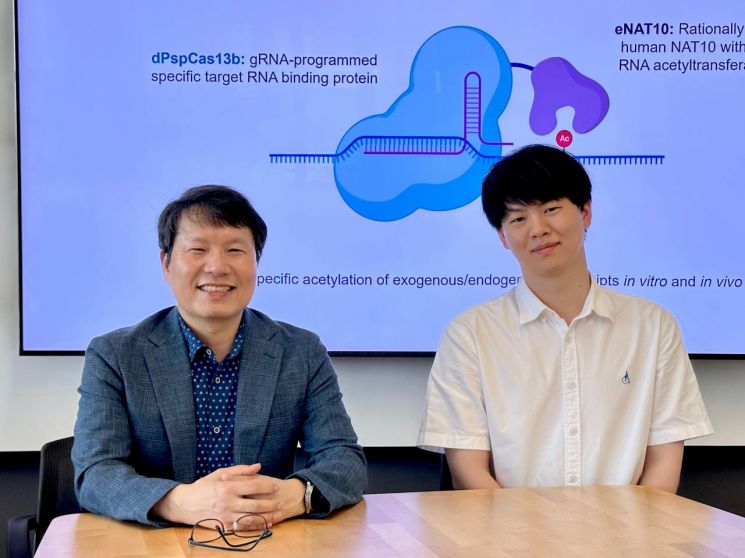 (From left) Professor Wondo Hur, Department of Biological Sciences, and doctoral candidate Jihwan Yoo. Provided by KAIST
On June 10, KAIST announced that a research team led by Professor Wondo Hur from the Department of Biological Sciences has developed a "targeted RNA modification technology" that enables acetylation of specific RNA within the human body using the RNA gene scissors system (CRISPR-Cas13).
RNA is a molecule that plays a crucial role in transmitting genetic information and synthesizing proteins. RNA gene scissors can selectively eliminate viral RNA, such as that of the coronavirus, from among the numerous RNA molecules present in cells, thereby suppressing infections or regulating the expression of disease-causing genes. Due to its low side effects, it is also attracting attention as a next-generation gene therapy.
Acetylation refers to a gene regulation process in which a specific chemical group is added to RNA, thereby altering its properties and functions, while maintaining the original RNA nucleotide sequence.
The "targeted RNA modification technology" developed by the research team precisely selects only specific RNA targets and combines the gene scissor Cas13 with a highly active variant of NAT10 (eNAT10), which acetylates RNA. The core of this technology is its ability to accurately identify and acetylate only the desired RNA.
During the research, the team demonstrated that they could acetylate specific RNA using a targeted RNA acetylation system and guide RNA that directs the system to the desired RNA within cells. They also confirmed that protein production increases from acetylated messenger RNA (mRNA).
Furthermore, by utilizing the "targeted RNA modification technology," the team was the first to reveal that RNA acetylation causes RNA to move from the nucleus to the cytoplasm. This finding also suggests the possibility that acetylation can regulate the "spatial relocation" of RNA within cells.
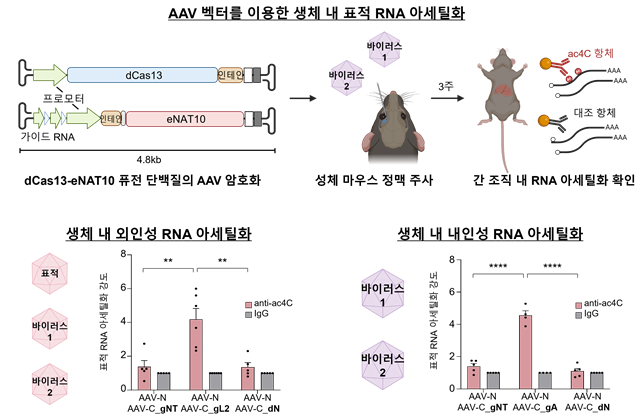 Schematic diagram of the in vivo delivery process of the targeted RNA acetylation system. Provided by KAIST. Schematic diagram of the in vivo delivery process of the targeted RNA acetylation system. Provided by KAIST.
The research team also proved that the developed technology enables precise control of RNA acetylation within the body of laboratory mice by delivering it to the liver using an adeno-associated virus (AAV), a carrier virus widely used in gene therapy.
This is the first case demonstrating that RNA acetylation technology can be applied in vivo, and it is regarded as a significant achievement that highlights the potential applications of RNA-based gene therapy technologies.
Professor Wondo Hur stated, "Previous research on RNA chemical modification faced challenges in controlling specificity, timing, and spatial targeting. However, the technology developed by our team allows for selective acetylation of desired RNA, opening the way for precise and detailed studies of the function of RNA acetylation."
He added, "The research team expects that the targeted RNA modification technology will be widely used in the future as a tool for controlling RNA-based therapeutics and regulating RNA function in vivo."
Meanwhile, this research, with doctoral candidate Jihwan Yoo from the Department of Biological Sciences at KAIST as the first author, was introduced in the international journal Nature Chemical Biology (June 2 issue).
This study was supported by the Samsung Science and Technology Foundation and the National Research Foundation of Korea's Bio-Medical Technology Development Program.
© The Asia Business Daily(www.asiae.co.kr). All rights reserved.













