From Sewage Treatment Plant to Art Garden
Following the 'Seongnam Dumulgil' Walking Trail,
Music Hall and Cafe to Be Established,
World-Class Art Museum Planned
Seongnam City in Gyeonggi Province (Mayor: Shin Sangjin) announced on June 10 that it has decided to name the cultural complex being developed on the site of the former sewage treatment plant at 195 Gumi-dong, Bundang-gu as 'Seongnam Mulbit Garden'.
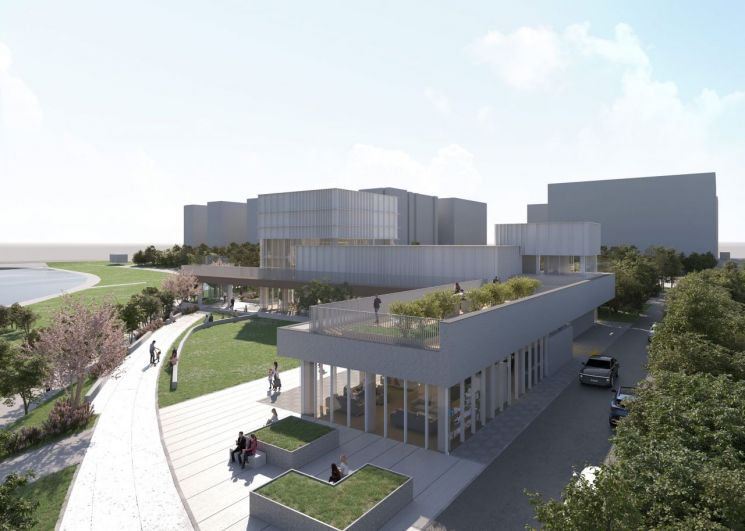 Aerial view of the music hall in the cultural complex space 'Seongnam Mulbit Garden' at 195 Gumi-dong, Seongnam City. Provided by Seongnam City
Seongnam City selected the name through a process that included the first and second rounds of review by a judging committee for 1,407 proposed names submitted during a naming contest held from April 28 to May 11, followed by a preference survey conducted from May 21 to 25.
'Seongnam Mulbit Garden' was proposed by Song Mo (female, 44, Sunae-dong).
According to the proposer, the name 'Seongnam Mulbit Garden' represents "the transformation of the former Gumi-dong sewage treatment plant into a garden of art and life, where clear water flows, the area brightens like light, and all Seongnam citizens can walk, rest, and share inspiration together."
It also symbolizes the healing of the traces left by a facility that had been neglected and regarded as undesirable for 28 years, as well as its regeneration as a beacon for the future.
The cultural complex to be named 'Seongnam Mulbit Garden' will include the 'Seongnam Dumulgil' walking trail (opening June 13) on the 29,041-square-meter site of the former Gumi-dong sewage treatment plant, a music hall scheduled to open in July, a cafe, and a world-class art museum as part of a long-term cultural and artistic project.
Seongnam City plans to present chamber orchestra and ensemble performances for citizens at the new music hall in the second half of this year.
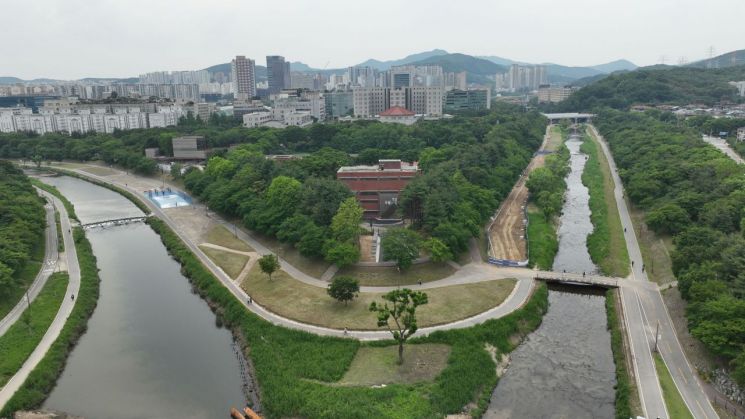 A panoramic view of Seongnam Dumulgil at the confluence of Tancheon and Dongmakcheon. Provided by Seongnam City
In conjunction with the opening of the music hall, a cafe will also be operated where visitors can enjoy a cup of tea.
The former Gumi-dong sewage treatment plant was constructed by Korea Land and Housing Corporation (LH), with construction starting in 1994 and completed in 1997. However, operation was halted during trial runs due to opposition from nearby residents, and the facility was left unused for 28 years.
In response, the city has been pursuing a plan to transform the site of the former Gumi-dong sewage treatment plant into a recreational and cultural space for citizens as part of the 8th popularly elected administration's policy initiatives.
With the addition of a world-class art museum alongside the walking trail, music hall, and cafe, Seongnam Mulbit Garden is expected to become the cultural and artistic hub of southern Seongnam, harmonizing with the landscape of Tancheon.
© The Asia Business Daily(www.asiae.co.kr). All rights reserved.


















