National Museum of Korea Celebrates 20th Anniversary in Yongsan
Special Exhibition "New Nation New Art: Early Joseon Art Exhibition" Opens
Tracing the Transformation of White Porcelain After Goryeo Celadon
Spotlighting the Enduring Influence of Buddhist Art Under the Confucian System
First Public Unveiling of 23 Works Including "Sansudo"
In the 15th century, as the Renaissance era began in Italy, a sophisticated new culture was blossoming on the other side of the world in the newly established Joseon Dynasty. The inlaid celadon of late Goryeo transitioned into Joseon, evolving through buncheong ware and ultimately transforming into white porcelain. At the same time, Hunminjeongeum, the foundation of the Korean script Hangul, was created. Centered around the scholar-officials who formed the ideological backbone of Joseon, calligraphy and painting flourished, while Buddhist art, attracting interest from people of all social classes, established new artistic trends. The special exhibition "New Nation New Art: Early Joseon Art Exhibition," commemorating the 20th anniversary of the opening of the National Museum of Korea in Yongsan, focuses on ceramics, calligraphy and painting, and Buddhist art, which constitute the largest proportion of early Joseon artworks. The exhibition features a total of 691 pieces, including 16 National Treasures and 63 Treasures. Among these, 23 items are being unveiled to the public in Korea for the first time through this exhibition.
 On the 9th, officials are viewing ceramics at the special exhibition "New Nation New Art: Early Joseon Art Exhibition" held at the National Museum of Korea in Yongsan-gu, Seoul, commemorating the 20th anniversary of the opening of Yongsan. Photo by Yonhap News
Early Joseon art refers to the approximately 200 years following the founding of the Joseon Dynasty. Well-known works such as ink landscape paintings, temple altar paintings, and "Dream Journey to the Peach Blossom Land" belong to this period. However, compared to other periods, very few artworks from early Joseon have survived, and most of the major extant pieces are located overseas. This exhibition closely examines early Joseon art through 691 works borrowed from 72 institutions both in Korea and abroad. Of these, more than 40 pieces were loaned from 24 institutions across five countries: the United States, Japan, the United Kingdom, Germany, and France.
The 200 years of early Joseon were a time of the most diverse and dynamic ceramic culture in Korean history. Buncheong ware, soft-paste white porcelain, hard-paste white porcelain, and celadon coexisted, giving rise to a ceramic culture that reflected a wide range of aesthetic sensibilities. Inlaid celadon, which had declined in the late 14th century, developed into buncheong ware with white inlaid patterns and further into white porcelain characterized by its pure white surface. Over 300 ceramic pieces are displayed on a wall measuring 14 meters in length and 3 meters in height, visually illustrating the transformation from Goryeo inlaid celadon to Joseon buncheong ware and white porcelain.
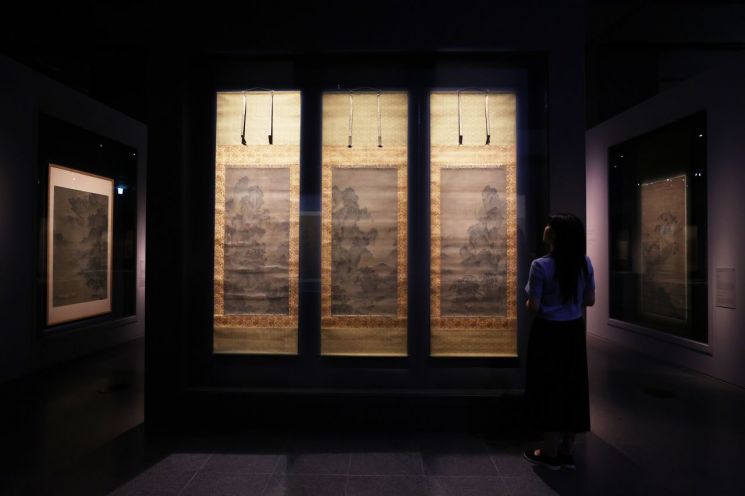 On the 9th, officials are viewing "Sansudo" at the special exhibition "New Country New Art: Early Joseon Art Exhibition" held at the National Museum of Korea in Yongsan-gu, Seoul, commemorating the 20th anniversary of the opening of Yongsan. Photo by Yonhap News
In the realm of calligraphy and painting, the three-panel "Sansudo" from Japan’s Mori Art Museum is displayed alongside the "Sansudo" owned by the National Museum of Korea. This is the first time both landscape paintings, which depict spring, summer, and autumn scenery, are being shown in Korea. Originally thought to be works from China’s Song Dynasty, the possibility that they were created in Joseon was first raised in Japan, and today, academic consensus recognizes them as early Joseon works. Kim Hyewon, head of the art department, explained, "Twenty years ago, these were considered Chinese works, but the possibility that they might be Korean was raised in Japan and abroad, and now they are internationally acknowledged as early Joseon pieces."
In addition, "Sansicheongnamdo" from the Los Angeles County Museum of Art (LACMA), "Yeonsamojongdo" from the Yamato Bunkakan in Japan, and "Sipjangsaengdo" from the Guimet Museum in France are also on display. Portraits of meritorious subjects emphasizing loyalty and calligraphy by the renowned Han Seokbong greet visitors as well.
Buddhist art continued to maintain a strong presence even after Joseon adopted Confucianism as the guiding ideology of society. Kim Younghee, a curator, explained, "Even after Joseon was established with Confucianism as the state ideology, Buddhism still retained significant influence."
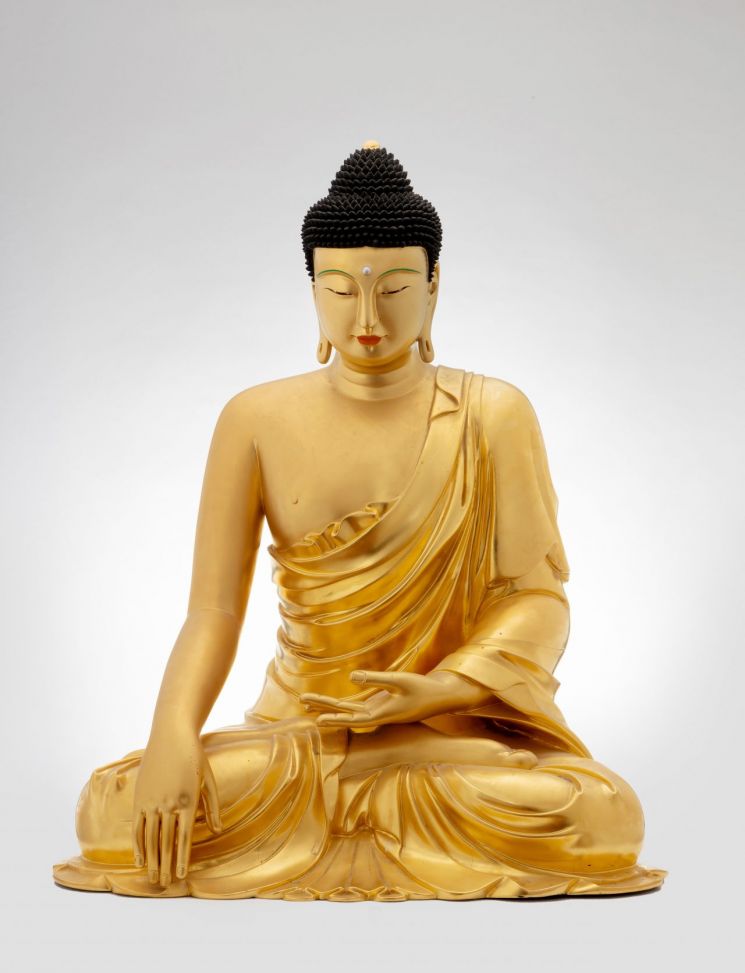
Among the many gold-adorned Buddha statues, particular attention is drawn to the "Wooden Seated Buddha Statue." Believed to have been created in the 15th century, this statue is being displayed outside the main hall of Jogyesa Temple in Seoul for the first time. Other works on display include the "Birth of Buddha" painting, which depicts the life of Shakyamuni Buddha on silk, and the "Samjangbosaldo," which features the three bodhisattvas?Cheonjang, Jiji, and Jijang?occupying a corner of the exhibition hall.
The exhibition concludes with Hunminjeongeum. The Hunminjeongeum Haeryebon, a National Treasure that serves as a commentary explaining the principles and orthography behind the creation of Hangul, is on display. As a commentary, it contains explanations in classical Chinese about the well-known Hunminjeongeum.
On the 20th, the curator who planned the exhibition will hold a session to explain the exhibition’s composition and significance. On July 17, a lecture will be given by an expert from Japan who studies Korean painting. The exhibition runs until August 31, and admission will be free from the 10th to the 15th.
© The Asia Business Daily(www.asiae.co.kr). All rights reserved.



















