Busan and Gyeongnam Achieve 21 Years of Synergy Through Successful Cooperative Administration
Park Sungho, Head of the Authority: "Beyond an Economic Policy Agency, Shaping the Future of Regional Integrated Administration"
As discussions on administrative integration between Busan and Gyeongnam are actively underway, the Busanjinhae Free Economic Zone Authority (headed by Park Sungho) is drawing attention as a leading example of administrative integration, based on its experience in joint operation by both regions.
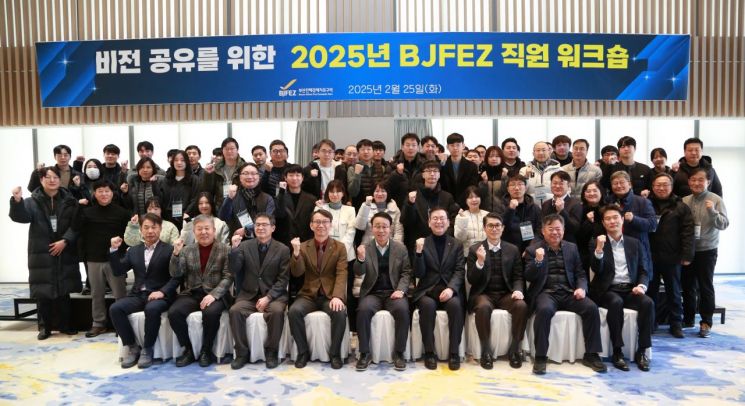 Busanjin-Haeundae Free Economic Zone Authority Highlighted as a Model Case for Administrative Integration of Busan and Gyeongnam - BJFEZ Staff Workshop for Vision Sharing. Provided by Busanjin-Haeundae Free Economic Zone Authority
The Busan-Gyeongnam Administrative Integration Public Discussion Committee plans to hold citizen forums in Gyeongnam and Busan from June 13 until mid-July, gathering a wide range of opinions from residents of both regions.
Since its establishment on March 30, 2004, the Authority has operated as a special joint organization, with Busan and Gyeongnam each sharing 50% of the personnel and budget, and jointly planning and implementing policies. Among free economic zone authorities, it is rare for two metropolitan governments to participate equally in such a cooperative administrative system, and its successful operation is being recognized as a noteworthy model in the ongoing discussions on administrative integration.
Over the past 21 years since its founding, the Authority has integrated the capabilities of Busan and Gyeongnam in strategic projects such as attracting foreign investment, building advanced industrial clusters, and establishing a global logistics hub, thereby achieving national-level results.
This integration of capabilities is particularly evident in foreign investment attraction. Over the 21 years since its opening (as of the end of May 2025), the Authority has recorded a cumulative FDI notification amount of $5.07 billion, establishing itself as a global investment hub. Major investor regions include Europe ($1.53 billion), Asia ($1.17 billion), the Americas ($1.04 billion), Japan ($370 million), and others ($960 million), demonstrating a diversified investment structure and attracting attention from investors worldwide.
Notably, since Park Sungho took office as head of the Authority in January this year, the organization has made significant efforts to attract foreign investment despite uncertain domestic and international economic conditions. As a result, as of the end of May, it achieved $353 million in foreign direct investment, marking a remarkable performance. This is the highest figure ever recorded for the same five-month period, representing an increase of approximately 66% compared to the same period in 2024 ($211.98 million).
To further accelerate foreign investment attraction, the Authority is developing a tri-port logistics network encompassing Busan New Port, Gadeok New Airport, and Jinhae New Port, while actively conducting investment promotion activities targeting regions such as the Middle East, Southeast Asia, and Europe.
The Authority serves as a model case that could provide a blueprint for the ongoing discussions on regional integration. It is highly regarded not only as an example of cooperative administration, but also as an organization that has proven that practical integration is possible even before institutional integration is achieved.
At a time when citizen-centered administrative integration is being discussed, the Authority stands as an empirical model demonstrating how practical integration?such as personnel management, organizational operation, and policy coordination?can be effectively realized. It is highly valued as an organization that has enabled the sharing of growth strategies and visions, rather than being hindered by local self-interest or the dispersion of administrative authority.
Park Sungho, head of the Authority, stated, "Public officials from Busan and Gyeongnam, united as an allied force, are fiercely engaged in a 'silent economic war' both domestically and internationally. The BJFEZ is a practical integration model where Busan and Gyeongnam cooperate with a single goal and advance together onto the global stage, and it can serve as a practical blueprint for administrative integration discussions. Moving forward, we plan to lead the joint development of Busan and Gyeongnam through the creation of the Southeast Economic Belt, attracting global companies, and expanding a smart logistics ecosystem. Through these efforts, we aim to become not just an economic policy implementation agency, but also a leading institution shaping the future of regional integrated administration."
© The Asia Business Daily(www.asiae.co.kr). All rights reserved.

















