"The Real Issue for the U.S. Economy Is Immigration"
As protests continue in Los Angeles (LA) against President Donald Trump's hardline crackdown on undocumented immigrants, an analysis has emerged suggesting that a decline in immigration is more detrimental to the economy than tariffs.
According to Fortune, a U.S. economic media outlet, on the 8th (local time), Deutsche Bank stated that immigration is the main issue facing the U.S. economy.
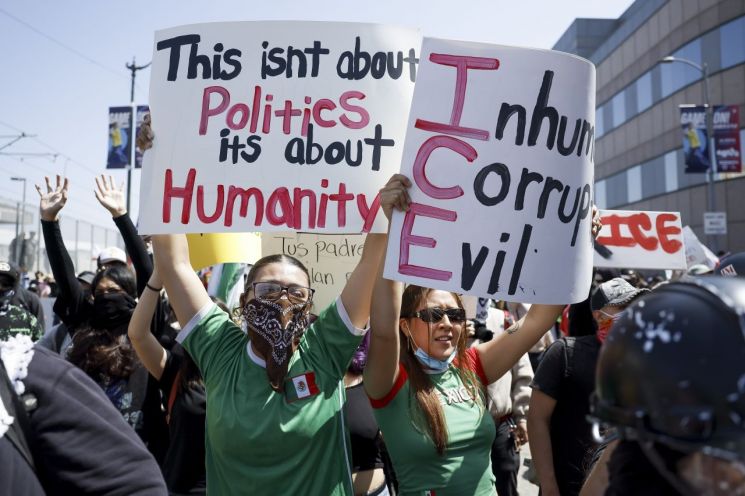 On the 8th (local time), citizens protesting against President Donald Trump's immigration crackdown demonstrated in Los Angeles (LA), California, USA. Photo by EPA Yonhap News
According to a jobs report released by the U.S. Department of Labor on the 6th, the labor force shrank last month. Bloomberg explained that this was largely due to the biggest decline in the number of foreign-born workers since 2020.
It is currently estimated that there are about 32.7 million immigrants in the U.S. labor market, meaning that one in five workers is foreign-born. Economists estimate that about 5.8 million immigrants, including undocumented individuals, joined the U.S. labor force during former President Joe Biden's term. Fortune reported that the increase in immigration during the Biden administration contributed to economic growth.
This stands in stark contrast to the Trump administration. According to Deutsche Bank’s analysis of U.S. Customs and Border Protection data, after President Trump took office, the average monthly number of illegal immigration apprehensions at the southwestern border plummeted to 12,000. This compares to an average of 200,000 per month from January 2022 to June 2024.
George Saravelos, Head of FX Research at Deutsche Bank, said, "Everyone is focused on the impact of tariffs, but the real issue for the U.S. economy is the decline in immigration." He explained, "The number of immigrants has dropped by more than 90% compared to recent years, which corresponds to a slowdown in labor force growth by more than 2 million people." He added, "This represents a much more sustained and negative supply shock to the economy than tariffs."
President Trump has cited the slowdown in job growth as a reason why the Federal Reserve (Fed) should cut interest rates. However, as the Fed remains concerned about inflationary pressures from tariffs, stricter immigration enforcement provides an additional reason to delay rate cuts.
The U.S. unemployment rate has remained around 4.2% since last summer. On Wall Street, it is believed that as immigration inflows decrease and deportations increase, the labor supply shrinks, which in turn reduces the number of new jobs needed to maintain the current unemployment rate. Morgan Stanley projected that due to forced deportations and a slowdown in immigration, the monthly job growth required to keep the unemployment rate steady will fall from 210,000 last year and 170,000 currently, to 90,000 by the end of this year.
Deutsche Bank warned that the sharp decline in immigration will have broader impacts on financial markets, including the dollar, which has already been hit by President Trump's aggressive tariff policies. Saravelos cautioned, "Last year, the U.S. enjoyed a Goldilocks combination of high job growth and low wages, thanks to the large number of immigrants." He warned, "If the recent immigration trends continue, the opposite scenario will unfold this year."
© The Asia Business Daily(www.asiae.co.kr). All rights reserved.
![Clutching a Stolen Dior Bag, Saying "I Hate Being Poor but Real"... The Grotesque Con of a "Human Knockoff" [Slate]](https://cwcontent.asiae.co.kr/asiaresize/183/2026021902243444107_1771435474.jpg)
















