Grassroots R&D Investment for a Leading Tech Nation
Must Be Established with a Sustainable Vision
The Choi Jonghyun Academic Institute has released a policy report proposing a sustainable science and technology strategy for South Korea. The report points out issues such as science and technology policies that fluctuate with each change of administration, unilateral government-led research and development (R&D) strategies, and the problem of talent outflow. It calls for a major transformation to foster creativity in the private sector and academia.
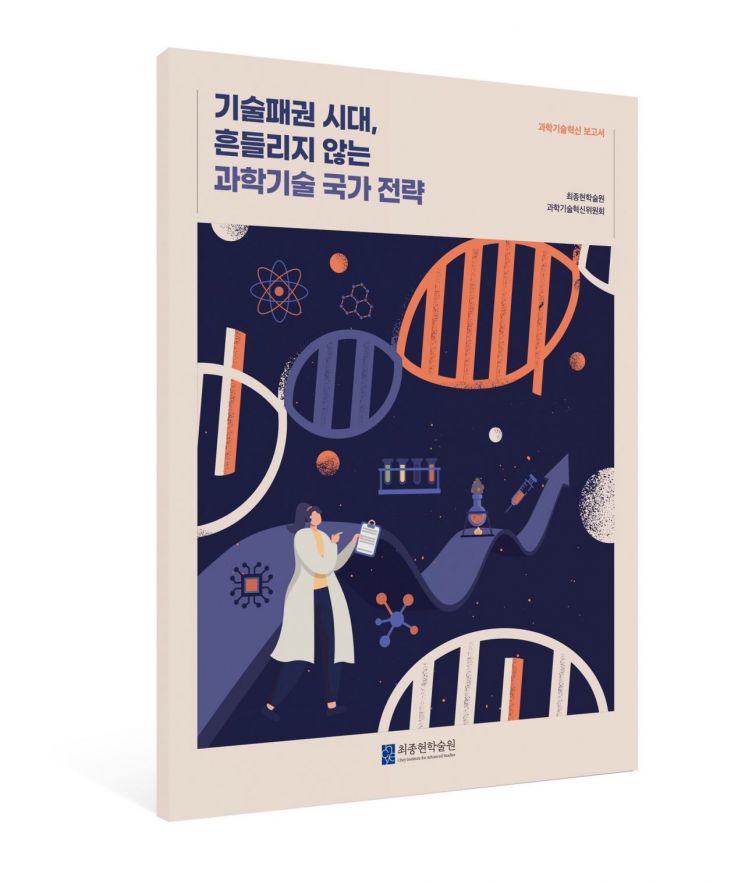 Cover image of the Choi Jonghyun Academic Institute's science and technology policy report titled "In the Era of Technological Hegemony, an Unwavering National Strategy for Science and Technology." Provided by the Choi Jonghyun Academic Institute.
On June 8, the Choi Jonghyun Academic Institute announced the publication of its report, "In the Era of Technological Hegemony, an Unwavering National Strategy for Science and Technology." This policy recommendation report was authored by the Science and Technology Innovation Committee of the Choi Jonghyun Academic Institute, based on discussions from a science and technology policy forum held by the institute in April.
The authors include Han Woong Yeom, Professor of Physics at POSTECH and former Vice Chair of the National Science and Technology Advisory Council; Sang Yup Lee, Distinguished Professor of Chemical and Biomolecular Engineering at KAIST and Vice Chair of the National Bio Committee; Jung Dong Lee, Professor at the Graduate School of Engineering Practice at Seoul National University and former Special Adviser to the President for Economy and Science; Onam Kwon, President of the Korean Federation of Women’s Science and Technology Associations; Jin Ho Jung, President of the Korean Academy of Science and Technology; and Taek Hwan Hyun, Distinguished Professor of Chemical and Biological Engineering at Seoul National University.
The report, consisting of four chapters, proposes a major shift in South Korea's science and technology policy, focusing on three main pillars: a sustainable national R&D strategy, addressing talent gaps and the research ecosystem, and innovation in technological sovereignty and policy governance.
In the report, Professor Han Woong Yeom states, "South Korea's science and technology policy remains stuck in the outdated 'selection and concentration' paradigm of a catch-up model." He emphasizes, "We need to recognize that the excessive selection and concentration?where the government designates a list of national strategic technologies and heavily allocates R&D budgets to those fields?acts as a barrier to innovation and becoming a 'first mover.'"
Professor Yeom adds, "When young researchers choose topics outside the government-designated fields, it becomes difficult for them to secure research funding, which discourages adventurous and creative attempts. There is a need to move away from unilateral, government-driven strategies and shift toward policies that foster diversity and creativity in the private sector."
The report also points out that South Korea's science and technology policy faces serious challenges to sustainability and efficiency due to repeated policy discontinuities and shifts in direction with each change of administration.
It highlights the recurring issue where large-scale national research projects initiated by previous governments are reduced or abolished, and new projects are prioritized under the slogans of the incoming administration. As a result, many researchers face difficulties as they must revise their research topics and rewrite proposals to align with the new government’s direction.
Additionally, the report expresses concern that the government's excessive emphasis on short-term outcomes conflicts with the fundamental and long-term nature of science and technology. It identifies key tasks such as establishing science and technology strategies that transcend administrations, balancing long-term plans with short-term strategies, and creating an independent research ecosystem that enables the private sector and academia to pursue creative endeavors.
Furthermore, the report stresses the need for a major shift in talent acquisition strategies. It argues that, beyond simply attracting brains, South Korea should pursue a 'Brain Home Korea' approach, making the country a base for both domestic and international talent to live and conduct research. To achieve this, comprehensive talent policies are needed, including visa system reform, improved research environments, and support for family settlement. The report also notes that strengthening the 'K-Science' image by leveraging soft power, such as K-content, could help attract young global talent.
Professor Sang Yup Lee points out, "It is as important to attract and retain top talent as it is to nurture them." He notes, "Many young people are reluctant to pursue science and engineering careers because, despite long years of study and intense research demands, they perceive that social and economic rewards are insufficient."
He continues, "It is essential to ensure fair rewards for researchers' achievements and provide stable career paths, while also fostering a social atmosphere that respects science and technology professionals. South Korea should consider adopting a system like China’s, where scientists and engineers are at the center of national strategy and receive substantial recognition."
© The Asia Business Daily(www.asiae.co.kr). All rights reserved.












