A "banana eel" with yellow skin and black spots, caught in Lake Jinzai
Estimated to be over 10 years old and 1.5 times larger than average
A rare eel resembling a banana, with an occurrence rate of one in 100,000, has been caught in a Japanese lake, drawing public attention.
According to BSS Sanin Broadcasting and other Japanese media on June 5, a so-called "banana eel" with a yellow body and black spots, resembling a banana, was caught in Lake Jinzai in Izumo City, Shimane Prefecture, on May 28. The person who caught the eel by fishing is Esumi Akira, a 75-year-old resident of Izumo City. He said, "I was lucky," and added, "The eel was strong, so it was tough to reel it in." Living near the lake, he works as a car dealer and spends time fishing for eels in Lake Jinzai from spring to autumn, supplying them to local supermarkets.
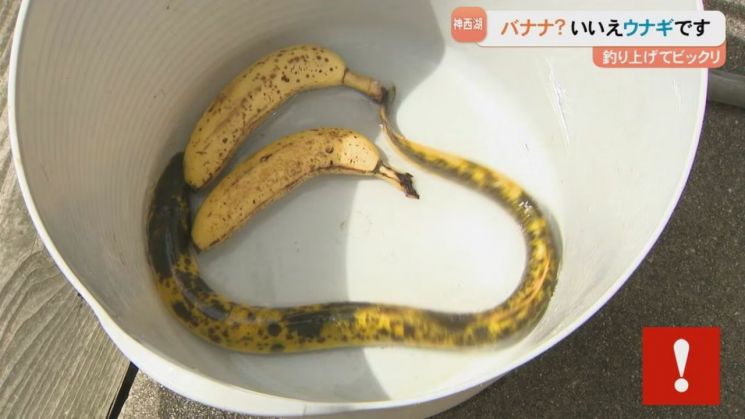 Banana eel caught in Lake Jinzai in Izumo City, Shimane Prefecture. Screenshot from BSS Sanin Broadcasting.
The banana eel Esumi caught this time measures about 80 cm in length and weighs 350 grams, making it approximately 1.5 times larger than the average eel. Based on its size, the eel is estimated to be over 10 years old. Banana eels are extremely rare, found at a rate of about one in 100,000, and in Japan, they are believed to bring good luck to those who catch them.
He said that the moment the banana eel was hooked, he felt as if he had caught a once-in-a-lifetime rare fish. He carefully reeled in the line, and when he finally brought the fish up safely, it turned out to be the rare banana eel.
Esumi also revealed that two years ago, he caught a sky-blue eel. His fishing technique involves launching his boat at dusk, when eels become active, and spreading out eight fishing rods in a fan shape before waiting. He laughed, saying, "I've caught unique eels twice now, so who knows, maybe I'll catch another in the future."
When asked by reporters if he planned to cook the eel, he hesitated for a moment before answering, "Since this eel is so rare, if there is someone who wants to keep it, I would like to give it as a gift."
Gobius, the Shimane Prefectural Shinji Lake Nature Museum, explained that this banana eel appears to be a case of "color mutation," known as chromatic variation, caused by some factor. However, since eels are generally nocturnal and hide in the mud, it is believed that such bright coloration likely does not have a significant impact on their survival.
© The Asia Business Daily(www.asiae.co.kr). All rights reserved.