If the U.S. Government Terminates All Contracts with SpaceX,
Serious Disruptions Expected
Concerns are emerging that U.S. President Donald Trump's direct criticism of Elon Musk, and Musk's immediate response, could impact America's space program and national security projects.
On June 5 (local time), President Trump posted on his social media platform, Truth Social, stating, "The easiest way to save billions of dollars from our budget is to cut off Elon's government subsidies and contracts. I have always been surprised that Biden (the former president) never did this," threatening to terminate federal government contracts with Musk.
Musk immediately fired back. On his own social media platform, X, he declared, "In response to the President's statement about canceling contracts, SpaceX will immediately begin withdrawing the Dragon spacecraft."
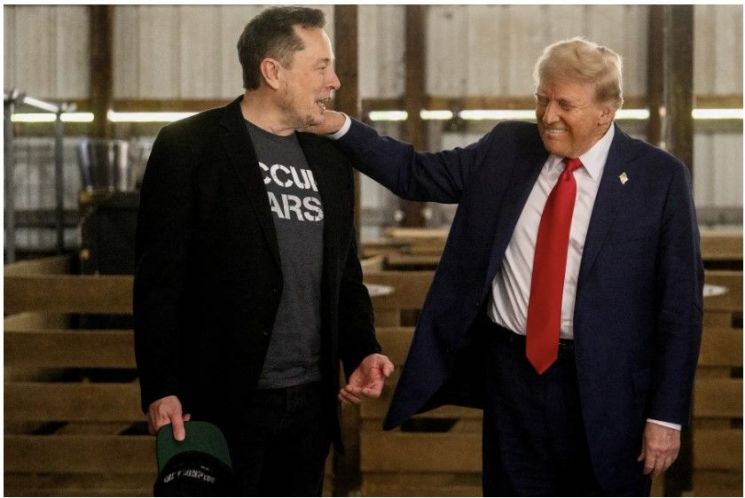 On October 5 last year, at a campaign event held in Butler, Pennsylvania, then-Republican presidential candidate Donald Trump (right) is seen patting the shoulder of Elon Musk, CEO of SpaceX and Tesla. Photo by AP and Yonhap News
There are predictions that if this kind of "mutual threat" is actually carried out, it would inevitably cause significant disruptions to the U.S. space program and military intelligence gathering.
The Crew Dragon spacecraft is currently the only spacecraft in the United States capable of transporting people to the International Space Station (ISS). The contract with NASA is worth approximately $4.9 billion (6.6 trillion won). If this spacecraft is suspended, the United States would be forced to rely once again on Russia's Soyuz spacecraft.
After retiring the Space Shuttle in 2011, the United States depended on Russian spacecraft for nearly a decade. It was only in 2020, with SpaceX's Dragon spacecraft, that independent launches became possible again.
The "Crew Dragon," which Musk has announced will be withdrawn, is used to transport people to the ISS, while the "Cargo Dragon" is used to deliver supplies. The Dragon also handles private space tourism missions. The next mission, "Axiom-4," will send astronauts from India, Poland, and Hungary to the ISS and is scheduled to launch on the 10th of this month.
Boeing's alternative spacecraft, the "Starliner," has been delayed due to structural defects, leaving no alternative to the Dragon for the time being. The Starliner experienced malfunctions during a mission in June last year, resulting in astronauts staying on the ISS for nine months.
According to Bloomberg, since 2000, the cumulative value of SpaceX's contracts with the U.S. Department of Defense and NASA, based only on publicly available data, has reached $22 billion (about 30 trillion won). NASA has also signed a $4 billion (5.4 trillion won) contract with SpaceX for its plan to send American astronauts to the Moon. Separately, SpaceX has been tasked with dismantling orbiting space laboratories by 2030, a project worth $843 million (about 1.14 trillion won).
Musk recently stated on X, "SpaceX's revenue this year will reach $15.5 billion (about 21 trillion won)," and "Of that, NASA contracts account for $1.1 billion (about 1.5 trillion won)."
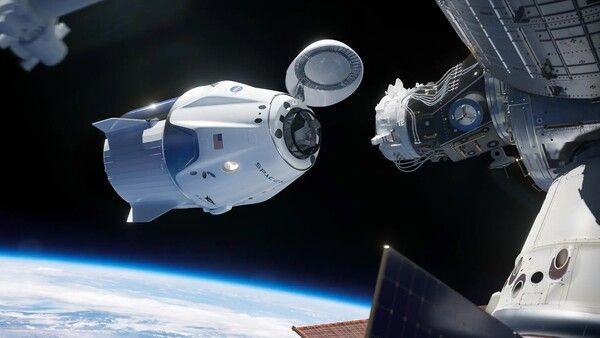 SpaceX's Crew Dragon spacecraft is attempting to dock with the International Space Station (ISS). SpaceX
SpaceX is also closely cooperating with the U.S. Department of Defense. The Starlink satellite network is under contract with the Department of Defense and is also used to provide internet connectivity in rural areas of the United States. SpaceX plays a significant role in intelligence satellites and missile defense systems as well.
The Washington Post recently revealed the scale of U.S. Space Force launch contracts, reporting that SpaceX leads with $6 billion (about 8.1 trillion won), followed by United Launch Alliance (ULA) with $5.4 billion (about 7.3 trillion won), and Blue Origin with $2.4 billion (about 3.3 trillion won).
Despite Trump's threats, the U.S. government appears to find it difficult to replace Musk immediately. Peter Hayes, a researcher at the Space Policy Institute at George Washington University, said, "Musk has launched more satellites than all other people in the world combined," and added, "It is not easy to simply say, 'We don't like you anymore, so we won't work with you.'"
Bloomberg pointed out that the president cannot unilaterally cancel contracts and that procedural decisions by contract managers are required. Since Trump has already made his remarks, there is also the possibility of legal disputes.
Bethany Stevens, a NASA spokesperson, stated, "NASA will continue to implement the President's vision for the future of space," and added, "We will continue to work with our industry partners to ensure that the President's goals in space are achieved."
© The Asia Business Daily(www.asiae.co.kr). All rights reserved.
!["The Woman Who Threw Herself into the Water Clutching a Stolen Dior Bag"...A Grotesque Success Story That Shakes the Korean Psyche [Slate]](https://cwcontent.asiae.co.kr/asiaresize/183/2026021902243444107_1771435474.jpg)

















