A Total of 770,000 Flights and 123.12 Million Passengers Carried
Leading the Popularization of "Short and Frequent" Air Travel
Jeju Air is celebrating the 19th anniversary of its launch. Since its inaugural flight, Jeju Air has transported over 100 million passengers and has expressed its ambition to lead the normalization of travel as part of everyday life.
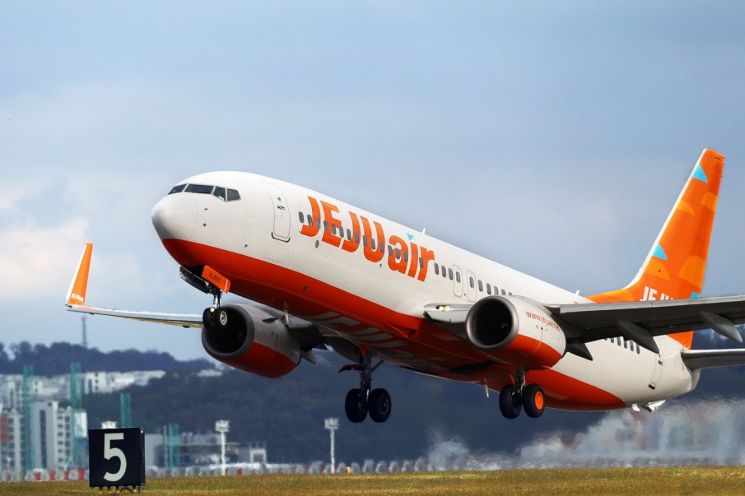
According to Jeju Air on June 5, the airline carried a total of approximately 123.12 million passengers from its first year of operation in 2006, when it started with 254,000 passengers, through April of this year. The airline has operated approximately 770,000 flights, with an average load factor in the high 80% range.
Jeju Air successfully entered the market with an average load factor of 83.5% in its first month on its inaugural route between Gimpo and Jeju. In the same year, it launched routes between Gimpo and Busan, as well as Busan and Jeju, and in March 2009, it began operating international routes between Incheon and Osaka, and Incheon and Kitakyushu.
As a result, the airline surpassed 1 million passengers in 2009, just three years after its launch, and reached the milestone of 10 million passengers in 2017. Last year, Jeju Air transported a record 13,352,500 passengers. The average annual passenger growth rate stands at 23.3%. The cumulative number of passengers exceeded 100 million in July 2023, marking the first time a domestic low-cost carrier (LCC) has achieved this milestone within 17 years of its launch.
Jeju Air emphasized that stable fleet expansion and rapid entry into new routes were key to its growth. The airline doubled its fleet from 22 aircraft at the end of 2015 to 42 aircraft currently in operation over the past decade. Jeju Air is focusing on modernizing its fleet, including the recent purchase and introduction of its fourth B737-8 aircraft last month.
By focusing on a portfolio of short- and medium-haul routes to destinations such as Japan, Greater China, and Southeast Asia, Jeju Air has also led the popularization of short, frequent air travel. In particular, for Japan, the airline has expanded consumer choice by operating exclusive routes not only to major cities such as Incheon-Tokyo (Narita), Osaka, and Fukuoka, but also to smaller cities such as Shizuoka, Hiroshima, Matsuyama, and Oita. Including the newly launched Incheon-Hakodate route on this day, Jeju Air now operates the largest number of Korea-Japan routes.
The number of passengers Jeju Air transported to Japan increased more than 33-fold, from approximately 115,300 in 2009, when it first began regular Korea-Japan routes, to about 3,842,100 last year.
A Jeju Air representative stated, "In the second half of the year, we plan to continue introducing new aircraft and expanding our routes," adding, "We will continue to discover a variety of new routes and create the normalization of travel based on convenient schedules."
© The Asia Business Daily(www.asiae.co.kr). All rights reserved.

![Clutching a Stolen Dior Bag, Saying "I Hate Being Poor but Real"... The Grotesque Con of a "Human Knockoff" [Slate]](https://cwcontent.asiae.co.kr/asiaresize/183/2026021902243444107_1771435474.jpg)














