Korean Publishers Association Releases Publishing Statistics
Publishing Becomes Relatively Easier
Number of Book Titles Steadily Increases Over Three Years
Shorter Lifespan of New Releases Leads to Smaller Initial Print Runs
Total Print Volume Has Declined Since 2005
Over the past three years, the number of book titles published has steadily increased, while the total print volume has declined, indicating a shift in the publishing landscape toward "small quantity, many titles." Analysts attribute this change to the shorter consumer lifespan of books and the relative ease of publishing.
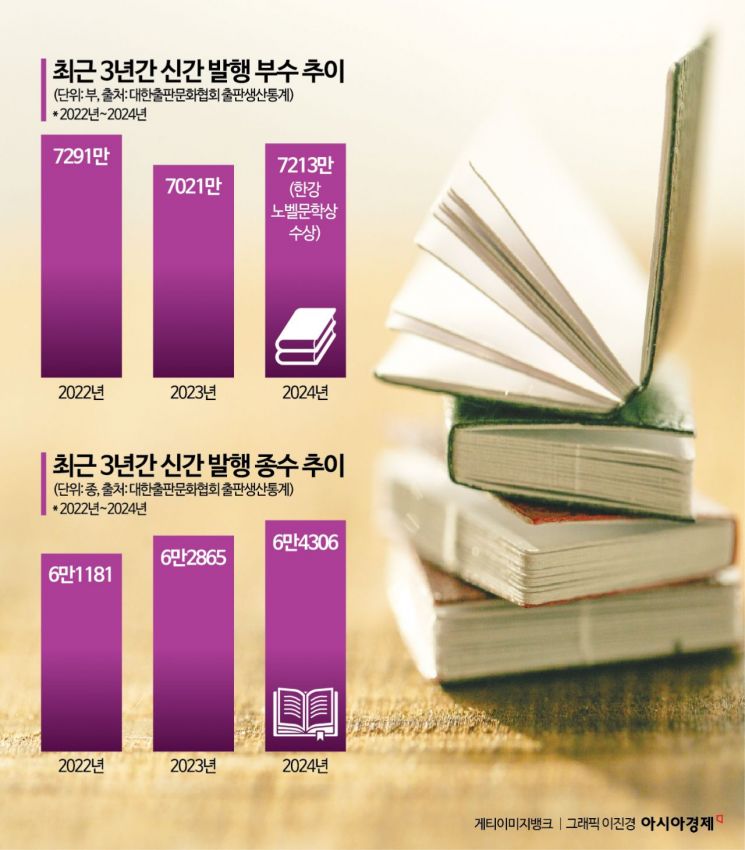
According to publishing statistics released by the Korean Publishers Association on June 5, a total of 64,306 book titles were published last year, an increase of 1,441 titles compared to 2023 (62,865 titles) and 3,125 titles compared to 2022 (61,181 titles). Compared to 2014 (47,589 titles), this represents an increase of about 35%.
Although the number of registered publishing companies continues to rise, it is unclear whether this is actually contributing to the increase in published titles. In fact, the number of publishers actively conducting business is on the decline.
Last year, there were 81,161 publishers registered in the Publishers Association's printing company search system, an increase of 2,126 from 2023 (79,035 publishers) and 9,842 from 2022 (71,319 publishers). Compared to 2014 (47,226 publishers), the number has nearly doubled. However, the number of publishers that actually released books and submitted copies to the association has decreased each year: 8,975 in 2022, 7,878 in 2023, and 5,911 in 2024.
An industry insider pointed out, "The statistics include a significant number of inactive publishers, such as one-person publishing companies that are registered but not operating."
In contrast, the total print volume has continued to decline. Since 2005, the downward trend has persisted, with only a temporary rebound in 2024 due to author Han Kang's Nobel Prize in Literature. In the past decade, there were years when the annual print volume dropped by nearly 8 million copies. The print volume decreased from approximately 79 million copies in 2022 to 70 million in 2023, and reached about 72 million in 2024.
The increase in the number of published titles is partly due to the shorter lifespan of new releases. In the past, a newly published book would maintain steady demand for several months, but recently, this cycle has become much shorter. A publishing industry representative said, "Previously, demand for a new book would last about six months, but now it often ends in less than three months, sometimes within just a few weeks. As a result, we have no choice but to reduce the initial print run and publish more titles."
The relative ease of publishing has also contributed to a trend where publishing a book is seen as a kind of "business card." There are increasing cases where the act of publishing itself is valued more than the content.
A publishing industry representative said, "There are quite a few publishers that proceed with publication whenever they receive a request, regardless of the content. In most cases, the author personally purchases and distributes about one-third to half of the initial print run."
Jang Eunsu, a publishing culture critic, said, "It has become easier to publish books, and the barriers to entry for placing books in bookstores have been lowered. Through social networking services (SNS), it is now possible to secure a certain number of readers, and with platforms like Tumblbug, the publishing and sales process can be socialized, reducing the opportunity cost of publishing." He added, "The increase in the number of published titles is also greatly influenced by independent publishing. This can now be seen as a phenomenon of 'democratization of publishing,' where anyone can publish a book."
© The Asia Business Daily(www.asiae.co.kr). All rights reserved.
![Clutching a Stolen Dior Bag, Saying "I Hate Being Poor but Real"... The Grotesque Con of a "Human Knockoff" [Slate]](https://cwcontent.asiae.co.kr/asiaresize/183/2026021902243444107_1771435474.jpg)
















