"Interest rate cut in the second half supported if inflation stabilizes"
"Stablecoins in the non-banking sector require careful consideration"
"Lower long-term rates may reduce consumption"
"Expanded fiscal spending during COVID-19 was a key driver of high inflation"
"If the effective tariff rate stabilizes close to the low-tariff scenario (10%), inflation moves toward the target of 2%, and the labor market remains robust, I would support an interest rate cut in the second half of this year based on 'good news.'
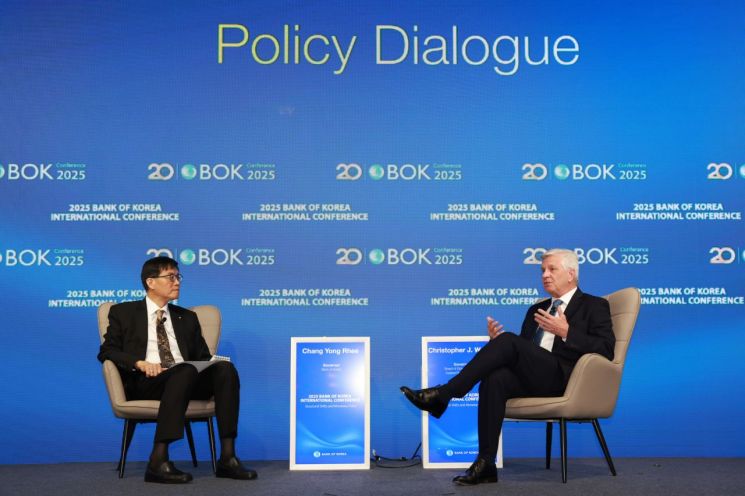 Lee Changyong, Governor of the Bank of Korea, and Christopher Waller, Member of the Board of Governors of the U.S. Federal Reserve, are having a discussion on the topic "U.S. Economic Outlook and Its Impact on Monetary Policy" at the "2025 BOK International Conference" held on the 2nd at the Bank of Korea in Jung-gu, Seoul. Bank of Korea
Christopher Waller, Member of the Board of Governors of the U.S. Federal Reserve, made this statement during his keynote speech on "U.S. Economic Outlook and Its Impact on Monetary Policy" at the "2025 BOK International Conference" held on June 2 at the Bank of Korea in Jung-gu, Seoul. He stated, "The inflation rise caused by U.S. tariffs will be temporary."
Waller had previously presented both high-tariff (25%) and low-tariff (10%) scenarios in mid-April. Based on those scenarios, he projected that if high effective tariffs were applied, inflation measured by the Personal Consumption Expenditures (PCE) index could rise to 5% this year. In the low-tariff scenario, inflation was expected to rise to 3% and then gradually decline. Waller explained, "Volatility in tariff announcements, U.S. court rulings, and last week's (European Union (EU)) doubling of metal tariffs are all contributing to uncertainty." Nevertheless, he added, "At present, due to temporary reductions in Chinese tariffs and other factors, we estimate the effective tariff rate to be around 15%, between the two scenarios."
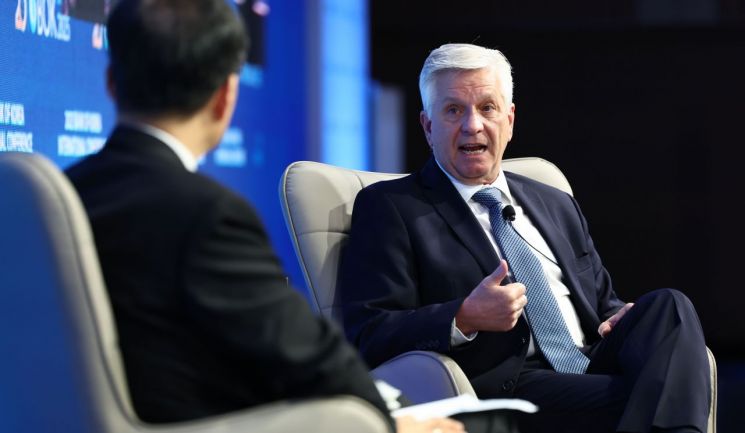 Lee Changyong, Governor of the Bank of Korea, and Christopher Waller, Member of the U.S. Federal Reserve Board, are having a discussion on the topic "U.S. Economic Outlook and Its Impact on Monetary Policy" at the "2025 BOK International Conference" held on the 2nd at the Bank of Korea in Jung-gu, Seoul. Photo by Yonhap News
He said, "Tariffs will lead to a rise in the unemployment rate, and if all other conditions remain the same, this upward trend will persist." He also predicted, "High tariffs will reduce spending, and companies will respond by partially cutting production and employment." He expects the impact of tariffs to be most pronounced in the second half of this year. However, he emphasized that the inflationary effect of tariffs will be temporary, as not all tariffs will be passed on to consumers. He stated, "In the 10% scenario, I think the burden will be distributed equally among consumers, importers, and exporters, with each bearing about one-third. In this case, inflation would rise by 0.3% in the short term." He further analyzed that if tariffs rise above 10%, companies will also reach their limits and a larger portion of the increase will be passed on to consumers.
Waller said, "I do not believe that tariff-induced inflation will be persistent, and I expect inflation expectations to remain stable. Therefore, when setting the policy rate, I do not think the short-term inflationary effect of tariffs needs to be given significant weight." Fortunately, he explained that the strong labor market and progress in inflation up to April of this year provide time to monitor trade negotiations and economic conditions.
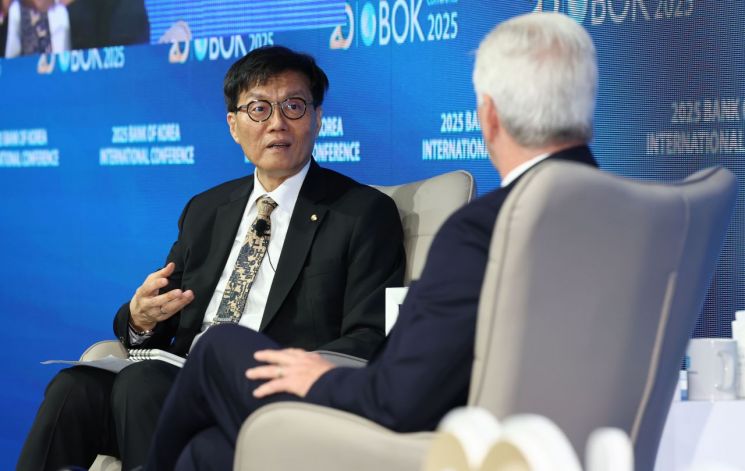 Lee Changyong, Governor of the Bank of Korea, and Christopher Waller, Member of the Board of Governors of the U.S. Federal Reserve, are having a discussion on the topic "U.S. Economic Outlook and Its Impact on Monetary Policy" at the "2025 BOK International Conference" held on the 2nd at the Bank of Korea in Jung-gu, Seoul. Photo by Yonhap News
In the subsequent policy discussion with Lee Changyong, Governor of the Bank of Korea, Governor Lee asked, "You mentioned that the impact of tariffs on U.S. inflation is temporary, but some other Fed governors have different views. How should we interpret this?" Waller replied, "Of course, there are differing opinions, but the general consensus is that tariffs, unlike oil price shocks or other shocks, do not have lasting effects." He added, "Those with different views are concerned because the surge in inflation since 2021 turned out to be more persistent than expected. However, at that time, there were overlapping factors such as a more persistent labor supply shock than anticipated, supply chain disruptions, and expansionary fiscal policy responses. The current situation is different from then."
When asked whether he is concerned about inflation remaining above target if the U.S. policy rate is cut, Waller responded, "Headline PCE inflation rose 2.1% over the 12 months through April. This is not much higher than the 2% target and is getting closer to the target," dismissing such concerns. Regarding the recent rise in U.S. long-term Treasury yields, he said, "It reflects questions about the sustainability of U.S. fiscal policy, as well as reactions to tariffs and communications from the U.S. administration." In response, Governor Lee commented, "So far, we have not seen any clear portfolio adjustments by foreign investors," adding, "I think there have been changes in expectations or sentiment."
On the hot topic of stablecoins, Governor Lee stressed that it is necessary to consider whether to allow won-denominated stablecoins in the non-banking sector, taking into account the possibility of circumventing capital regulations. He explained that financial stability must also be considered. Governor Lee said, "Korea is more cautious about stablecoins than the U.S.," adding, "We place great importance on capital regulations. Other Asian countries have similar views."
Waller described stablecoins as "a payment tool that non-bank institutions can provide." He noted that payment fees are relatively high in the U.S., so the private sector could be favorable if it can lower payment fees. He said, "If a level playing field is established, it would be acceptable." Regarding central bank digital currency (CBDC) projects, Waller assessed them as initiatives to create an "international payment and settlement system platform," but pointed out, "Globally, the pace of related discussions is slowing down."
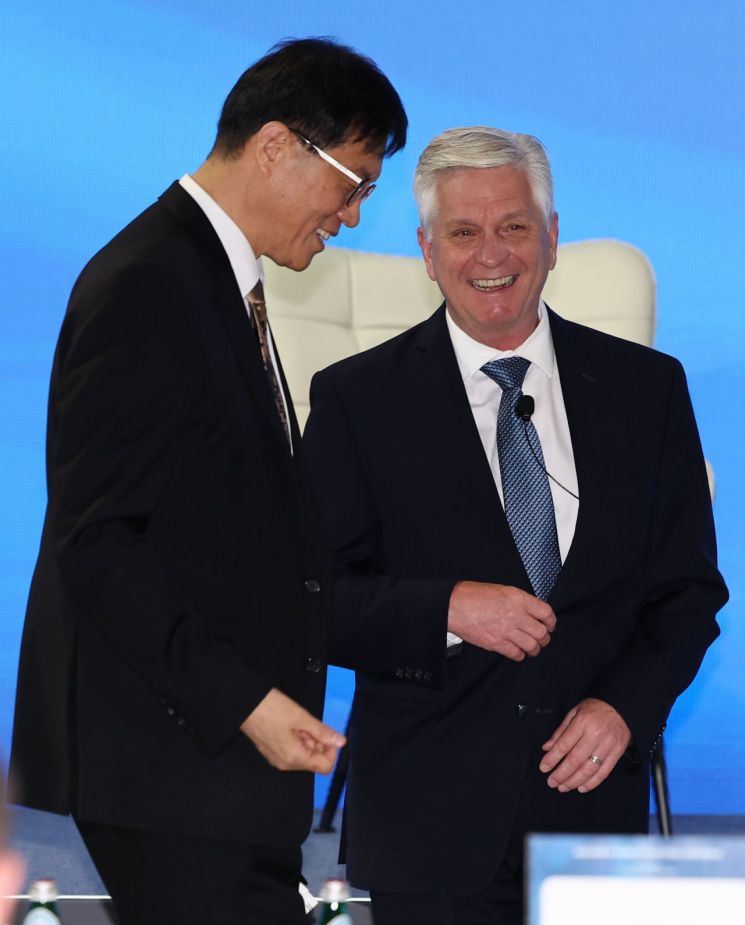 Lee Changyong, Governor of the Bank of Korea, and Christopher Waller, Member of the Board of Governors of the U.S. Federal Reserve, are smiling after concluding a policy discussion at the "2025 BOK International Conference" held on the 2nd at the Bank of Korea in Jung-gu, Seoul. Photo by Yonhap News
In the first session that followed, Charles Evans, former President of the Federal Reserve Bank of Chicago, took the podium to discuss "The Core Mandate of Monetary Policy: Implications for the Fed's 2025 Policy Framework Review." Former President Evans noted that the Fed is considering a transition to a more streamlined monetary policy framework and emphasized that strong leadership, sophisticated inflation forecasting, and clear public communication are essential for successful implementation.
He pointed out, "As the Fed's monetary policy framework became more complex during the COVID-19 response, the potential for reduced policy effectiveness and decision-making confusion increased." From 2012, the relatively simple structure of an explicit 2% inflation target and the dual mandate contributed to stabilizing inflation expectations, but after COVID-19, the addition of flexible average inflation targeting (FAIT), a focus on employment shortfalls, and explicit recognition of the effective lower bound (ELB) risk made the framework more complicated.
Evans emphasized, "While a sophisticated monetary policy framework is important, the ultimate success of policy depends heavily on the strong leadership of policymakers." He added, "It is important to clearly recognize the limitations of setting additional goals for monetary policy, such as financial stability, and to maintain credibility by considering the inherent constraints of a single-channel policy tool." To this end, he judged that in-depth research and analysis, accurate inflation forecasting, and clear and continuous communication to correct misconceptions are crucial.
In the second session, Tim Willems, Research Advisor at the Bank of England, took the stage to discuss "Monetary Policy on the Yield Curve: Why Can Central Banks Influence Long-Term Real Interest Rates?" He argued, based on both theoretical and empirical evidence, that changes in central bank policy rates can affect long-term real interest rates. Willems explained, "By constructing a model that includes life-cycle characteristics, we examined the consumption-constraining effects of declining long-term interest rates through the savings effect channel." He noted, "The analysis found that long-term real interest rates have a positive effect on consumption, while short-term real interest rates have a negative effect. This suggests that lowering long-term interest rates could actually reduce consumption."
In the third session, Francesco Bianchi, Professor at Johns Hopkins University, presented on "The Impact of Fiscal Factors on Inflation in OECD Countries." Based on the fiscal theory of the price level, he empirically analyzed the relationship between fiscal policy and prices using data from 37 OECD countries. He stated, "Analyzing the increase in government spending during the COVID-19 pandemic, normalized by the public debt ratio and maturity, showed that about 80% of government financing was achieved through the decline in the real value of debt caused by unexpected inflation." He further emphasized, "The expansion of fiscal spending during the pandemic may have been a major factor behind high inflation, and it is significant that we empirically confirmed that a substantial portion of real fiscal financing was due to unexpected inflation."
Meanwhile, the BOK International Conference has been held annually since 2005 and marks its 20th anniversary this year. This year's conference is being held over two days, June 2 and 3, under the theme "Structural Shifts and Monetary Policy." The conference will discuss and draw implications from the latest research findings and policy cases on monetary policy, including the inflation targeting regime, demographic structure, fiscal policy, climate change, and the impact of artificial intelligence (AI) technology on monetary policy.
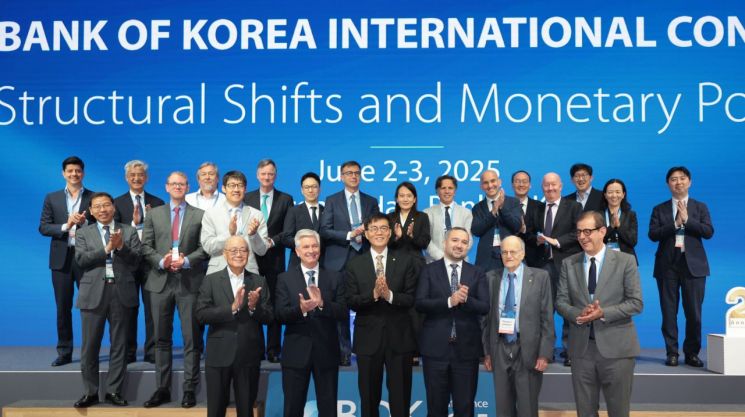 Lee Changyong, Governor of the Bank of Korea (third from the left in the front row), and Christopher Waller, Member of the Board of Governors of the U.S. Federal Reserve, among others, are taking a commemorative photo at the '2025 BOK International Conference' held on the 2nd at the Bank of Korea in Jung-gu, Seoul. Photo by Yonhap News
© The Asia Business Daily(www.asiae.co.kr). All rights reserved.














