The Gyeonggi Provincial Office of Education has begun accepting resident participation budget proposals for the next year.
The office announced that, in order to actively reflect the opinions of Gyeonggi residents in the budgeting process for the 2025 Gyeonggi Provincial Education Special Account, it will be accepting "2025 Gyeonggi Provincial Office of Education Resident Participation Budget Proposals" from June 2 to June 20.
The Gyeonggi Provincial Office of Education Resident Participation Budget System is a fiscal democracy initiative aimed at enhancing transparency and accountability in financial management by guaranteeing the participation of local residents in the budgeting process.
Since 2010, the office has consistently operated the resident participation budget system and has made continuous efforts to ensure that residents’ opinions are reflected in the Gyeonggi education budget.
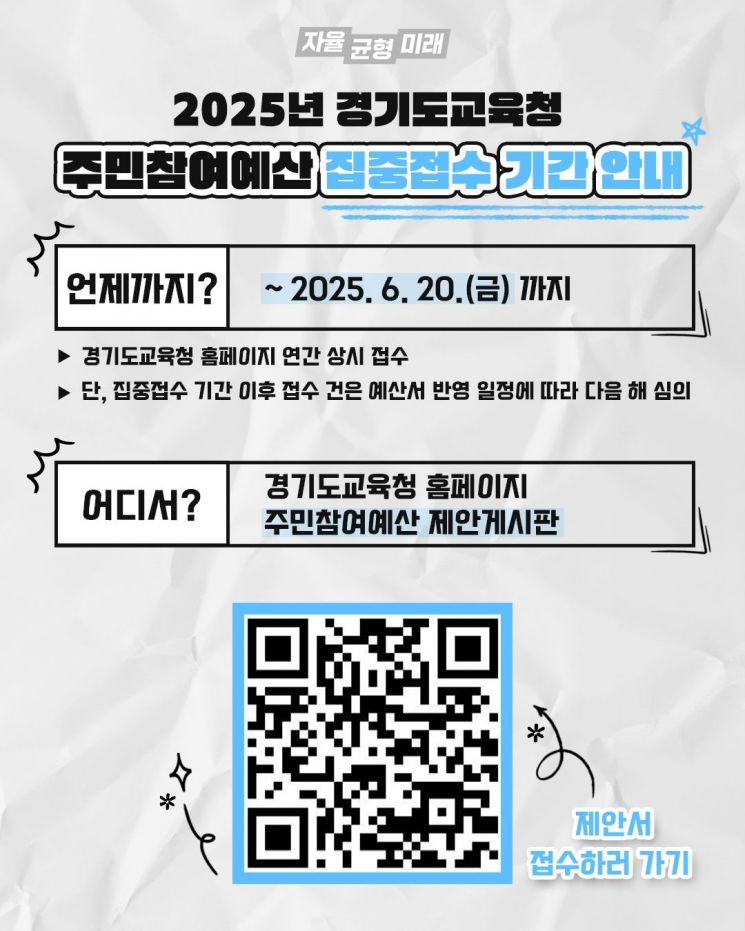 Poster for Gyeonggi Provincial Office of Education Resident Participation Budget Intensive Submission Period Announcement
The main proposal areas include: education administration, elementary and secondary education, lifelong education, early childhood education, special education, and other fields.
Residents can submit a wide range of opinions, from the basic direction of fiscal management to policy project budget matters of the office. Proposals can be submitted through the "Resident Participation Budget Proposal Board" on the office’s website.
Proposed projects will undergo a review process, including checks for legal compliance and validity by the relevant departments, as well as deliberation by the Resident Participation Budget Advisory Committee, to determine whether they will be included in next year's main budget. However, projects or support funds that are limited to specific schools, certain organizations (or companies), or individuals will be excluded from consideration.
An official from the office stated, "We will continue to actively gather diverse opinions from residents, diligently discover educational projects needed by education consumers, and ensure that these are reflected in the budgeting process."
Meanwhile, last year the office received a total of 694 proposals and, after deliberation and decision-making, adopted 46 of them.
© The Asia Business Daily(www.asiae.co.kr). All rights reserved.












