Resolving Concentration of Power Within the Executive Branch
Fulfilling the Core Role of Economic Policy
Accelerating Budget Processing Including Supplementary Budgets
The government's organizational restructuring, centered on the separation of the Ministry of Economy and Finance and reforms to the prosecution and judiciary, is drawing significant attention. President Lee Jae Myung is expected to implement a reorganization of government ministries reflecting these priorities during his term. The plan aims to resolve the concentration of power within the executive branch, strengthen democratic oversight and efficiency of certain oversized government power structures, and restore the nation’s weakened economy and society.
President Lee is highly likely to move swiftly to implement the separation of budgetary authority from the Ministry of Economy and Finance early in his presidency. The Democratic Party, now the ruling party, clearly outlined an organizational restructuring plan centered on the “separation of budget functions” from the Ministry of Economy and Finance in its policy pledge booklet published last month. Previously, President Lee stated that “the Ministry of Economy and Finance is reigning like a king,” and revealed plans to separate and transfer the ministry’s budget formulation authority to either the Presidential Office or the Prime Minister’s Office. This is explained as a measure to resolve the concentration of power within the executive branch and to allow the ministry to focus on its core economic policy role.
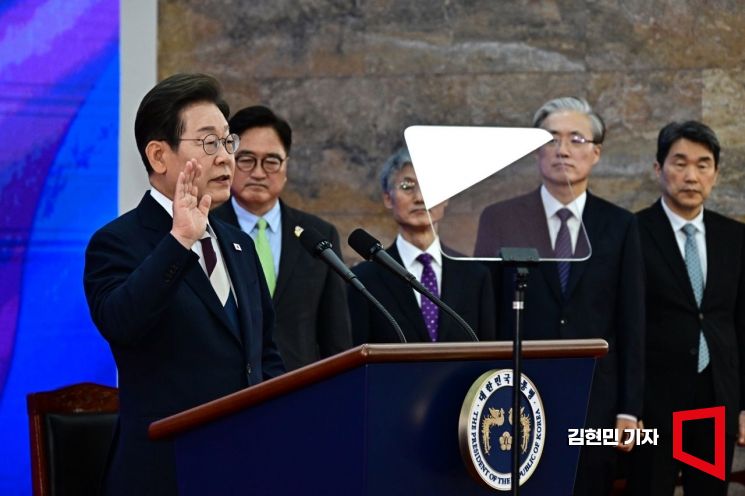 President Lee Jae Myung delivers the 21st presidential inauguration speech at the National Assembly in Yeouido, Seoul on June 4, 2025. Photo by Kim Hyun Min
If the budget formulation authority of the Ministry of Economy and Finance is actually transferred to the Presidential Office, the Lee Jae Myung administration would be able to process budgets more quickly. Observers note that this would also allow for greater flexibility in responding to the formulation of regional currency budgets and supplementary budgets, which were among President Lee’s campaign pledges. In addition to the separation of budgetary authority, the government is also discussing measures to specify the requirement for government consent when increasing budget bills, and to clarify the criteria for preparing reserve funds. There are also plans to revise the system to strengthen reporting to the National Assembly regarding the use of reserve funds, thereby enhancing budget transparency and accountability.
The administration is also considering creating a new “Ministry of Finance” by integrating financial functions currently dispersed among the Ministry of Economy and Finance, the Financial Services Commission, and the Financial Supervisory Service. During the presidential campaign, President Lee emphasized that “domestic financial policy is handled by the Financial Services Commission, while international financial policy is handled by the Ministry of Economy and Finance, resulting in overlapping responsibilities,” and stressed the need to separate and clarify supervision and policy functions.
In the area of prosecution reform, the complete separation of investigation and indictment is at the core, in order to prevent the abuse of prosecutorial indictment powers. President Lee has also proposed the unprecedented introduction of a dismissal system for prosecutors. This is intended as a practical safeguard against the abuse of prosecutorial authority. To protect the human rights of parties involved during investigations, the administration plans to enact a law on investigation procedures and introduce a pre-hearing system for search and seizure warrants.
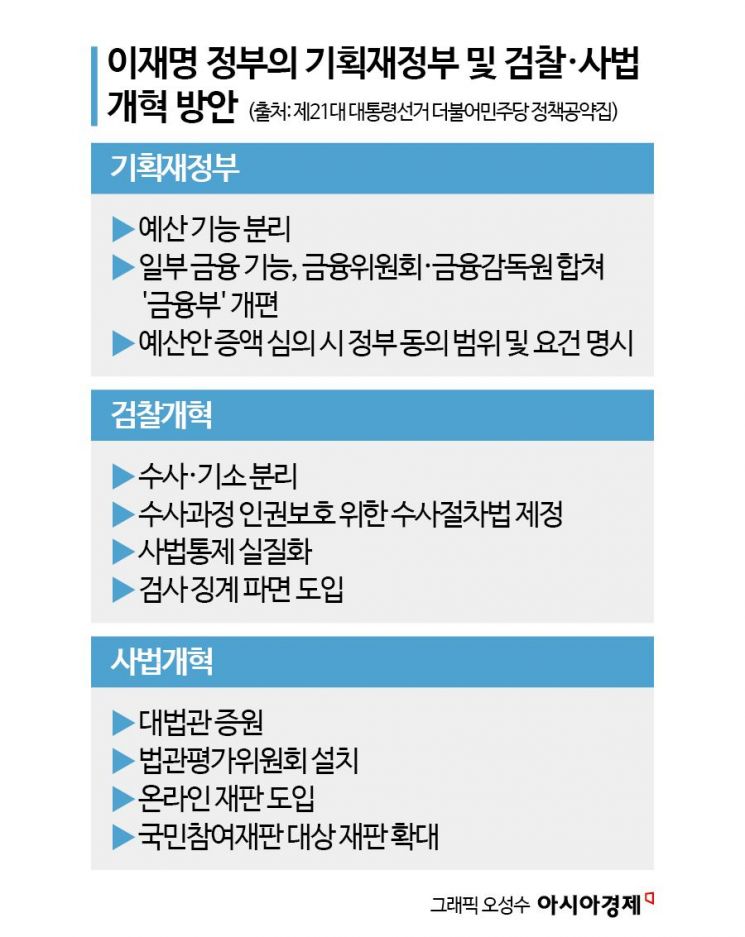
Judicial reform measures focusing on increasing the number of Supreme Court justices are also noteworthy. The expansion of Supreme Court justices is intended to resolve the backlog of appeals and expand public access to trials. However, the specific number of additional justices was not specified in the policy booklet. This appears to distance the administration from the previously controversial “proposal to increase the number of Supreme Court justices to 100” raised during the campaign. In addition, the administration plans to establish a Judicial Evaluation Committee to improve the system for evaluating judges and to manage the performance evaluations of judges. Furthermore, the requirements for excluding citizen participation trials will be strengthened to prevent judges from arbitrarily excluding such trials.
President Lee’s plans for government reorganization and prosecution and judicial reform are focused on the decentralization and control of power. In particular, measures such as the separation of the Ministry of Economy and Finance’s budget function and the introduction of a dismissal system for prosecutors are likely to provoke political debate. As a result, the pace of organizational restructuring is expected to be adjusted. A Democratic Party official stated, “President Lee is expected to proceed with organizational restructuring sequentially in order to address the longstanding issue of concentrated power.”
© The Asia Business Daily(www.asiae.co.kr). All rights reserved.













